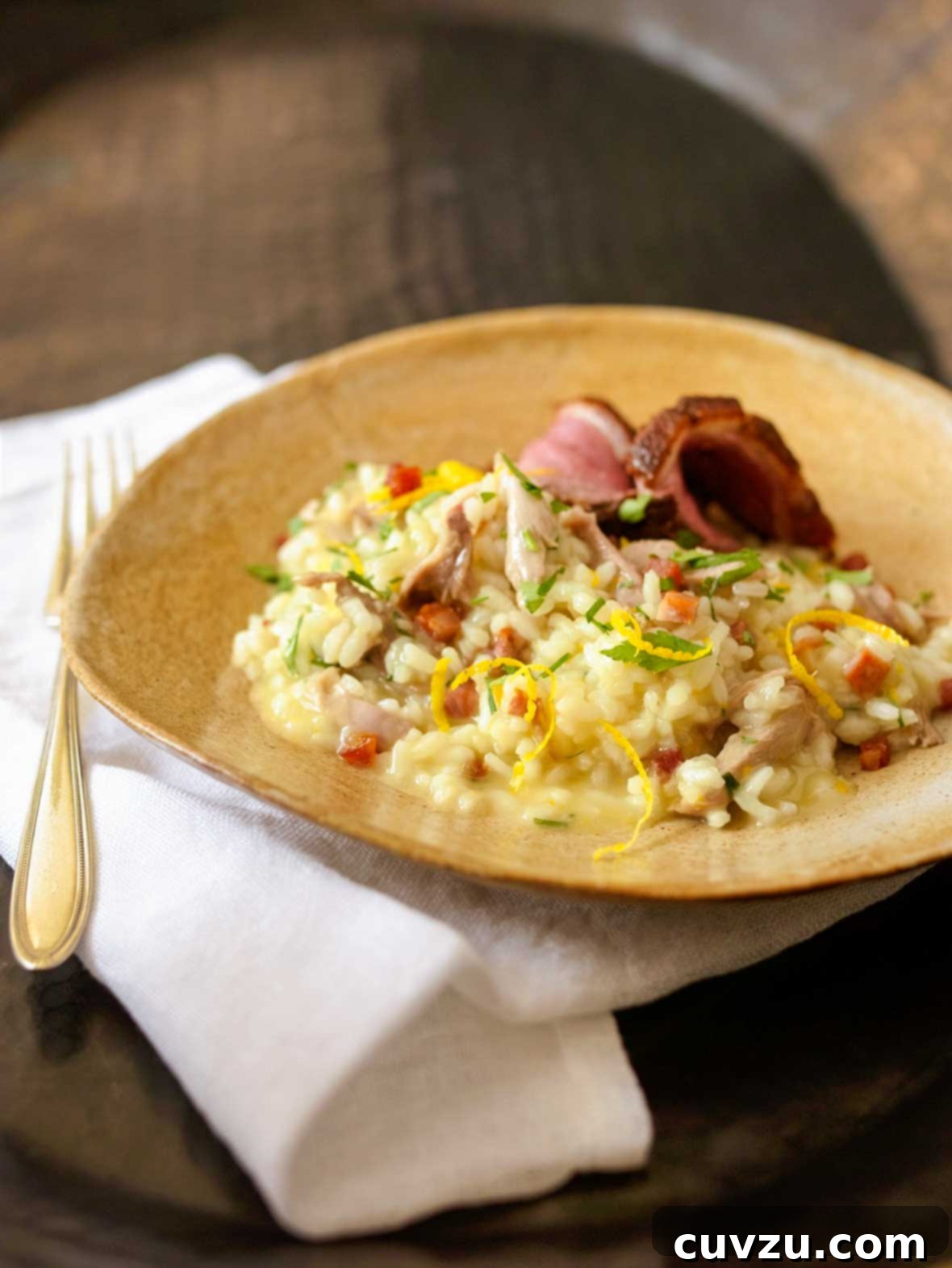
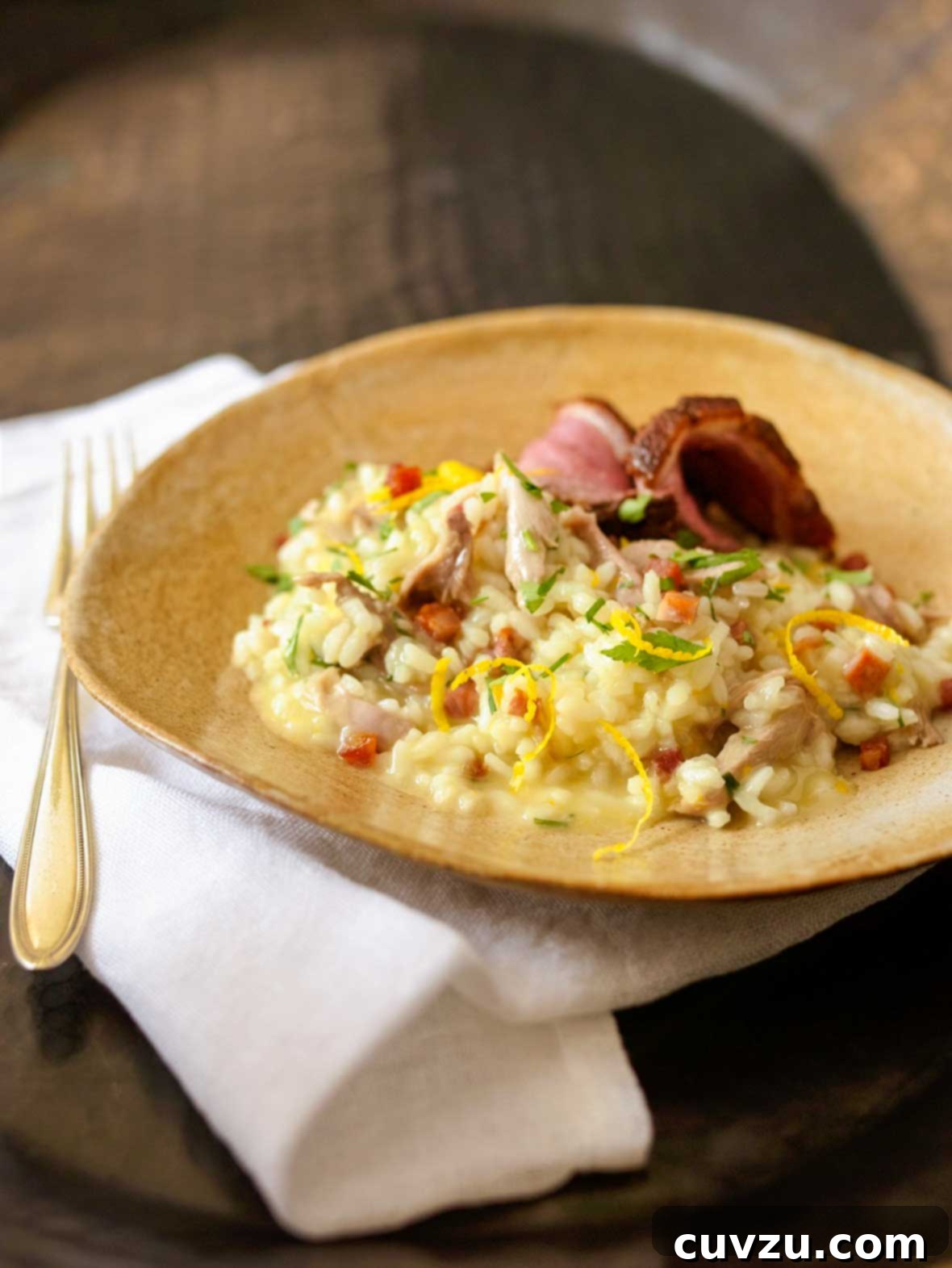
Embark on a culinary adventure with this exquisite Portuguese Duck Risotto, a dish that masterfully blends the rich traditions of Portuguese gastronomy with the creamy indulgence of classic Italian risotto. This recipe elevates the beloved Arroz de Pato by incorporating succulent duck, savory cured ham (presunto), spicy Portuguese sausage (chouriço), and a bright touch of orange zest, culminating in a truly unforgettable dining experience. It’s a modern interpretation that honors its heritage while delivering unparalleled flavor and texture.
The Genesis of Arroz de Pato: A Portuguese Culinary Treasure
Arroz de pato, literally “duck with rice,” stands as a venerable specialty deeply rooted in the Minho region of northern Portugal. This dish is more than just a meal; it’s a celebration of robust flavors and communal gatherings, often gracing family tables during holidays and special occasions. Traditionally, its preparation is an elaborate affair, a testament to the slow food movement long before the term existed. The process typically begins with boiling a whole duck to achieve tender meat and a deeply flavorful stock. Following this, the duck is often roasted to crisp the skin, and its shredded meat is then layered with rice and baked, sometimes topped with slices of cured sausage for extra zest.
While undeniably delicious when executed perfectly, the traditional technique often presents a few challenges. The extensive boiling and subsequent roasting can, paradoxically, render the duck meat dry and less flavorful if not handled with immense care. Moreover, the creation of a truly rich stock necessitates hours of simmering, followed by a lengthy chilling period to allow for efficient degreasing. This entire endeavor can span an entire day, making it a labor of love reserved for leisurely weekends or dedicated chefs. For many home cooks, the time commitment and intricate steps can be daunting, leading some to shy away from this beloved classic.
A Modern Interpretation: Elevating Arroz de Pato into a Creamy Risotto
Inspired by the innovative approach of my friend, the esteemed Chef Vitor Veloso, this “cheater’s” version of Arroz de Pato takes a decidedly modern and more approachable route, transforming it into a luxurious, creamy risotto. This method addresses the common pitfalls of the traditional recipe, offering a faster, infinitely easier, and arguably more sophisticated rendition without sacrificing any of the iconic Portuguese flavors. Instead of the laborious boil-and-roast, we opt for braising the duck legs in rich chicken stock. This technique ensures the duck meat remains incredibly tender, moist, and infused with flavor, creating a foundation that’s anything but dry or bland.
Once braised, the succulent duck meat is expertly shredded and gently folded into a classic risotto base. But this isn’t just any risotto; it’s a Portuguese-inspired masterpiece. It calls upon the de rigueur ingredients that define the authentic taste of Arroz de Pato: the salty, earthy notes of presunto (a Portuguese cured ham, similar to prosciutto), the smoky, spicy kick of chouriço (a robust Portuguese sausage), and the bright, aromatic perfume of orange zest. These elements intertwine with the creamy rice, creating a symphony of textures and tastes that dance on the palate.
To crown this culinary achievement, slices of perfectly seared duck breast are artfully arranged atop the finished risotto. This addition provides a delightful textural contrast—crisp skin, tender meat—and an extra layer of rich duck flavor that elevates the dish from comforting to truly gourmet. This innovative approach significantly reduces preparation time, making this Portuguese Duck Risotto accessible even on busy weeknights, while still delivering a dish that feels utterly special and deeply satisfying. It’s a testament to how traditional flavors can be beautifully reinterpreted for contemporary palates and lifestyles. –David Leite
The Art of Risotto: Unlocking Creamy Perfection
The mere mention of risotto can sometimes send even seasoned cooks into a panic, conjuring images of complex techniques and elusive creaminess. Yet, in truth, mastering a magnificent pot of risotto is far from an insurmountable challenge. It primarily demands two things: patience and a generous supply of hot, flavorful broth. Having prepared this duck risotto countless times, I can attest that consistency and attention to detail are your best allies in achieving culinary triumph.
However, even the most experienced cooks can stumble. A few weeks ago, in a regrettable rush, I committed the cardinal sin of cutting corners. I reached for a bargain brand of canned chicken broth and paired it with discounted duck. The outcome, predictably, was a disheartening plate devoid of the vibrant, robust flavors I had come to expect. This culinary misstep served as a potent reminder that the quality of your ingredients forms the very soul of your dish, especially something as delicate yet impactful as a risotto.
Chastened by the experience, I quickly returned to my trusted sources. For the duck, I revisited my long-standing favorite, D’Artagnan, a brand renowned for its exceptional poultry. To create a truly spectacular duck stock for the risotto, I combined excellent quality chicken stock with D’Artagnan’s exquisite Duck and Veal Demi-Glace, enhancing it further with two of their tender moulard legs and a rich magret half-breast. The results were nothing short of sensational—the risotto returned to its glorious, intensely flavorful self, just as I remembered it. While I typically refrain from brand endorsements, the transformative impact on this dish was so profound that I feel it is my duty to highlight the crucial role of quality ingredients. D’Artagnan, in this instance, proved unequivocally worth the investment. Carry on, and let your ingredients guide your success.
Selecting Your Ingredients: The Foundation of Flavor
The success of this Portuguese Duck Risotto hinges significantly on the quality of its components. Let’s delve deeper into why certain choices are paramount:
- Duck Legs for Braising: Opt for Moulard duck legs, if available, as they offer a richer flavor and more tender texture when slow-cooked. Trimming excess fat is crucial for a cleaner final dish, though reserving some rendered fat for cooking the risotto base can add incredible depth. Braising these cuts slowly ensures the meat pulls effortlessly from the bone, perfect for shredding.
- Duck Breast for Searing: A boneless Moulard duck breast, particularly a magret half-breast, is ideal for the elegant topping. Magret breasts, from ducks raised for foie gras, have a thicker fat cap that renders beautifully, yielding incredibly crisp skin and a perfectly medium-rare interior. This provides a delightful textural contrast to the creamy risotto below.
- The Broth: As learned from my own misstep, the broth is non-negotiable. Homemade chicken stock is always superior, offering a depth of flavor that no commercial broth can truly replicate. If homemade isn’t feasible, invest in the highest quality, low-sodium canned or boxed chicken broth you can find. A rich duck demi-glace, like D’Artagnan’s, can elevate even good chicken stock to extraordinary levels, imbuing the risotto with an authentic duck essence.
- Portuguese Cured Meats: Chouriço and presunto are non-negotiable for the authentic Portuguese flavor profile. Chouriço provides a smoky, spicy counterpoint, while presunto (or its Spanish cousin, Serrano ham, or Italian prosciutto as an alternative) brings a savory, salty complexity. These cured meats render their fat and infuse the risotto with incredible character. Ensure they are cut into small, even cubes for even distribution.
- The Rice: The choice of rice is critical for achieving the signature creamy texture of risotto. Portuguese Carolino rice is the traditional choice in Portugal and yields a wonderfully tender and creamy result. If unavailable, Italian Carnaroli or Arborio rice are excellent substitutes, known for their high starch content and ability to absorb liquid while maintaining a slight bite (al dente) at the core.
- Orange Zest: The inclusion of fresh orange zest and a touch of orange juice is a hallmark of Portuguese duck dishes, providing a bright, aromatic lift that cuts through the richness of the duck and cured meats. Always use organic oranges when zesting, as you’re using the peel directly.
By thoughtfully selecting each ingredient, you lay the groundwork for a Portuguese Duck Risotto that is both authentic in spirit and outstanding in flavor, a true testament to the power of quality in cooking.

Portuguese Duck Risotto | Arroz de Pato
David Leite
Mains
Portuguese
6 to 8 servings
680 kcal
30 minutes
2 hours 15 minutes
2 hours 45 minutes
Ingredients
- 1 tablespoon olive oil
- 2 (1 1/4 lbs) duck legs, trimmed of excess fat
- Kosher salt and freshly ground black pepper
- 6 to 8 cups homemade chicken stock or low-sodium canned chicken broth
- 3 ounces chouriço, linguiça, or dried-cured smoked Spanish chorizo, cut into 1/4-inch (6-mm) cubes
- One (16-ounce) boneless moulard duck breast half
- 1 small yellow onion, minced
- 2 cups Portuguese Carolino or Italian Carnaroli or Arborio rice
- 1/2 cup dry white wine
- One (1/4-inch) thick slice presunto, Serrano ham, or prosciutto, excess fat removed and cut into 1/4-inch cubes
- 2 tablespoons fresh orange juice
- 1 tablespoon (1/2 oz) unsalted butter
- Minced fresh flat-leaf parsley leaves, for garnish
- 1 to 2 tablespoons grated orange zest, preferably organic, to taste
Instructions
-
Heat the oil in a large skillet over medium-high heat. Season the duck legs well with salt and pepper. Place the duck legs in the skillet, skin side down, and sear until lightly browned, about 5 minutes per side.
-
Transfer the legs to a medium pot off the heat. Drain the fat from the skillet (and by all means, reserve this liquid gold for another use). Set the skillet aside.
-
Add enough of the stock to the pot to cover the duck, bring to a simmer, and cook, covered, over low heat until the meat is tender, 1 to 1 1/2 hours.
-
Meanwhile, sauté the chouriço in the reserved skillet over medium heat until the fat is rendered, about 5 minutes. Using a slotted spoon, transfer the chouriço to paper towels to drain.
-
Remove the duck legs from the pot and transfer to a plate. When they’re cool enough to handle, remove the skin, pull the meat from the bones, and shred into bite-size pieces. Spoon the fat from the top of the stock and add the remaining stock to the pot. Bring to a simmer over medium-low heat and keep it bubbling gently.
-
Heat the oven to warm (about 160°F [70°C]). Place a wire rack on a rimmed baking sheet.
-
Using a razor-sharp knife, score the skin of the breast in a crosshatch pattern, being mindful not to cut into the flesh. Pat it dry and season with salt and pepper. Wipe out the skillet and place it over medium-low heat. Add the breast, skin side down, and sear until crisp, allowing the fat to render slowly, 10 to 15 minutes. Don’t rush this—the last thing you want is a mouthful of chewy fat.
-
Flip and sear the other side for 3 to 4 minutes. Transfer the duck to the rack in the oven to keep warm. While in the oven, the breast should reach medium-rare, about 135°F (57°C) on an instant-read thermometer.
-
Drain all but 3 tablespoons of fat from the skillet and return it to medium heat. Add the onion and cook, stirring occasionally, until softened, about 5 minutes.
-
Add the rice, stir to coat, and cook until translucent around the edges, about 2 minutes. Splash in the wine and continue cooking until it’s absorbed. Add a ladleful of hot stock and cook, stirring continuously, until the liquid has almost burbled away. Keep up this rhythm of adding stock, stirring, and cooking for 15 minutes, then stir in the presunto and chouriço.
-
Add the shredded duck to the risotto and resume the ladling, stirring, and cooking until the rice moves wave-like when mounded, is ultra-creamy and tender, and offers just the slightest bit of resistance in the middle, 5 to 10 minutes more. A classic risotto has a loose consistency, meaning if you wobble the pot or bowl, the risotto will slump and spread. At least, that’s what results when the liquid has been added patiently and properly.
-
Remove the risotto from the heat, stir in the orange juice and butter, and season with salt and pepper to taste.
-
Slice the duck breast crosswise into thin slices. Divide the risotto among warm shallow bowls (simply run them under hot, hot water and dry them quickly or, if ovenproof, warm them in a low oven) and arrange the slices of breast on top. Sprinkle with the parsley and orange zest. Rush to the table. Originally published October 11, 2010.

Adapted From
The New Portuguese Table
Buy On Amazon
Explore More with AI
Substitutions
Scale
Summarize
Nutrition
Serving: 1 portion
Calories: 680 kcal
Carbohydrates: 56 g
Protein: 51 g
Fat: 24 g
Saturated Fat: 7 g
Monounsaturated Fat: 9 g
Trans Fat: 0.1 g
Cholesterol: 197 mg
Sodium: 1041 mg
Fiber: 2 g
Sugar: 2 g
Nutrition information is automatically calculated, so should only be used as an approximation.
Tried this recipe?
Mention @leitesculinaria or tag #leitesculinaria!
Recipe Testers’ Reviews: Real Experiences, Real Flavors
Sofia Reino
I recently prepared this Portuguese Duck Risotto for my husband’s birthday dinner, and I must confess, I approached it with a touch of skepticism. For years, I’ve made a traditional Portuguese rice with duck that he adores, and he’s generally not a big fan of risotto. So, you might wonder, why choose this particular dish for such a special occasion? As I delved into the recipe, a sense of understanding washed over me. I could fully envision that, despite being a distinct departure from the traditional Portuguese preparation, the familiar, comforting flavors would undoubtedly shine through.
The ultimate outcome? A tremendously happy husband—and two equally delighted daughters—who eagerly filled their plates not once, but twice! Just as I had hoped, the authentic Portuguese flavors were indeed present, and the dish possessed an incredible creaminess. What truly set it apart, however, was its undeniable elegance and sophisticated profile compared to the traditional version. It also felt significantly lighter, free from the heavier duck fat often associated with the classic method. The seared duck breasts, crowning the risotto, were absolutely outstanding, perfectly cooked and tender.
I did make a few minor adjustments to suit my preferences. I purchased a small whole duck, which allowed me to utilize both breasts and, crucially, to make my own duck stock from the bones. This meant I didn’t need to use chicken stock at all, further enhancing the duck flavor throughout the dish. Regarding the orange zest, I initially used the recommended 2 tablespoons, but for next time, I’ll probably scale that back to just 1 tablespoon to achieve a subtler citrus note. These small tweaks only affirmed the recipe’s versatility and how beautifully it adapted to a home kitchen. This risotto is truly a remarkable dish, sure to become a new favorite for many families.