Step into almost any kitchen today, and you’re likely to find a collection of cooking oils that rivals a gourmet food store. From robust olive oils to versatile canola, delicate sesame, and rich avocado oils, the sheer variety available can be overwhelming. While taste and culinary tradition often guide our choices, there’s a critical, often overlooked factor that dictates an oil’s suitability for a particular cooking method: its “smoke point.” Understanding this fundamental concept is not just about avoiding a burnt mess; it’s about unlocking flavors, preserving nutrients, and ensuring healthier, safer cooking.
Many home cooks store a diverse range of cooking oils, and for good reason. Each oil brings its unique flavor profile, aroma, and texture to a dish. However, pairing the right oil with the right heat level is paramount. Using an oil past its smoke point can ruin your meal, trigger your smoke alarm, and potentially produce harmful compounds. This comprehensive guide will demystify the science behind cooking oils and their smoke points, empowering you to make informed decisions in the kitchen for optimal taste and well-being.
The Craft Behind Cooking Oils: From Source to Bottle
To truly grasp the significance of an oil’s smoke point, it’s essential to first understand its origin and journey from raw ingredient to the bottle in your pantry. Cooking oils are derived from a diverse array of sources, including fruits like olives and avocados, seeds such as sunflower and sesame, nuts like peanuts and walnuts, and even grains like corn.
Each of these source materials possesses a unique chemical composition, primarily varying in their fatty acid profiles (monounsaturated, polyunsaturated, and saturated fats). This inherent composition is the first determinant of an oil’s stability and how it will react when exposed to heat. Beyond the source, however, the processing methods employed play an equally critical role in shaping the oil’s final characteristics, including its flavor, nutritional value, and, crucially, its smoke point.
Extraction Methods: A Foundation for Purity and Performance
The journey of oil extraction can significantly influence its purity and heat tolerance. There are three primary methods:
- Cold-Pressing: This is generally considered the most minimally processed approach. Ingredients are crushed and pressed without the use of heat or chemical solvents. This gentle method helps retain the oil’s natural flavors, aromas, and a greater concentration of beneficial compounds like antioxidants and vitamins. Oils such as extra virgin olive oil, flaxseed oil, and virgin coconut oil are often cold-pressed. Due to minimal processing, these oils tend to have more impurities (small particles of the source material) which can lower their smoke point, making them ideal for dressings, finishing, or low-heat cooking.
- Expeller or Mechanical Pressing: This method uses high pressure to extract oil, often generating significant heat through friction. While it doesn’t typically involve chemical solvents, the heat generated can alter some of the oil’s delicate compounds. It’s a balance between yield and preserving some natural qualities. Oils extracted this way may undergo further refining.
- Chemical Extraction (Solvent Extraction): This method, commonly used for oils like canola, soybean, and corn oil, involves using chemical solvents (like hexane) to maximize oil extraction from the raw material. This process is highly efficient, yielding more oil at a lower cost. However, the resulting crude oil must then undergo extensive refining to remove solvent residues and other impurities.
The Refining Process: Shaping an Oil’s Destiny
After extraction, many oils undergo a refining process, which is essentially a series of purification steps. Refining typically involves degumming, neutralizing, bleaching, and deodorizing. These steps remove free fatty acids, phospholipids, pigments, odors, and other organic materials that can cause an oil to spoil faster or smoke at lower temperatures. The purpose of refining is to:
- Increase an oil’s shelf stability.
- Neutralize its flavor and color, making it more versatile.
- Elevate its smoke point, making it suitable for high-heat cooking.
Highly refined oils, having had most of their “impurities” removed, are therefore more stable under high heat. Unrefined oils, conversely, retain more of their original characteristics – including those compounds that are more prone to breaking down when heated – which generally results in a lower smoke point. This vital distinction is often indicated on the oil’s label, providing crucial information for cooks to select the appropriate oil for their desired culinary application.
Defining the Smoke Point: Your Kitchen’s Crucial Temperature Guide
The term “smoke point” refers to the precise temperature at which an oil begins to visibly produce smoke. This visible wisps of smoke are not merely a visual cue; they signify a critical chemical transformation occurring within the oil. At this temperature, the various components of the oil – particularly free fatty acids, glycerol, and other organic compounds – begin to break down and oxidize, interacting with the oxygen in the air. This decomposition process produces volatile compounds, most notably acrolein, which is responsible for the irritating, pungent smell and bitter taste associated with overheated oil.
Think of the smoke point as a warning sign. Crossing this threshold indicates that the oil is no longer stable and is beginning to degrade. The higher an oil has been refined, the fewer impurities and free fatty acids remain within its composition. These impurities are often the first compounds to break down when exposed to heat, meaning that their removal during refining effectively raises the oil’s smoke point. Conversely, unrefined oils, which retain more of their natural characteristics and trace elements from their source ingredient, tend to have a lower smoke point because these delicate compounds react more readily to heat. Understanding this relationship between refinement and smoke point is key to selecting the right oil for your cooking needs.
Beyond the Wisps: The Consequences of Overheating Oil
Taking an oil past its smoke point, whether by accidentally cranking up the heat too high or getting momentarily distracted, has a cascade of undesirable effects that impact not only your food but also your health and kitchen environment. Recognizing these consequences is vital for mindful cooking.
Immediate Culinary and Sensory Impact
The most obvious indication that your oil is too hot is the visible emission of smoke. This is your cue to immediately reduce the heat or remove the pan from the stove. Ignoring this warning will almost certainly trigger your smoke alarm, filling your kitchen with a pungent, unpleasant odor. More importantly, any food cooked in oil that has surpassed its smoke point will inevitably acquire an acrid, burnt, and often bitter flavor. The beautiful sear you were aiming for will turn into a scorched exterior, and the delicate flavors of your ingredients will be overwhelmed by the taste of degraded oil. The texture of the food can also suffer, becoming dry or rubbery due to the intense, uncontrolled heat.
If you observe smoke, the best course of action is to turn off the heat, allow the pan and oil to cool completely, thoroughly wipe out the offending oil (do not pour hot oil down the drain), and start afresh with clean oil. It’s an investment in a better meal and a healthier kitchen.
Serious Health Implications
The dangers of overheating oil extend far beyond taste. On a molecular level, significant changes occur that can compromise your health:
- Nutrient Destruction: Many cooking oils, particularly those that are cold-pressed and minimally refined, are rich in beneficial nutrients like Omega-3 fatty acids, Vitamin E, and various antioxidants. These delicate compounds are highly susceptible to heat. Once an oil reaches its smoke point, these vital nutrients begin to degrade and are effectively “annihilated.” This means you lose out on the very health benefits you might be seeking by choosing a specific oil.
- Formation of Harmful Compounds: When oil is taken past its smoke point, it undergoes oxidation and thermal decomposition, leading to the formation of several potentially harmful substances:
- Acrolein: This irritant is largely responsible for the acrid smell and taste. It can also irritate your eyes and respiratory tract.
- Free Radicals: Overheating oils produces free radicals, unstable molecules that can cause oxidative stress in the body. Oxidative stress is linked to cell damage, inflammation, and chronic diseases.
- Polycyclic Aromatic Hydrocarbons (PAHs) and Heterocyclic Amines (HCAs): Especially when proteins are cooked in overheated oil, these carcinogenic compounds can form. Exposure to PAHs and HCAs has been associated with an increased risk of certain cancers.
- Trans Fats: While less common in home cooking than in industrial settings, repeatedly heating and reheating certain oils, especially past their smoke point, can lead to the formation of unhealthy trans fatty acids.
Kitchen Safety Hazard
Beyond the smoke and health concerns, there’s a tangible safety risk. If an oil remains above its smoke point for an extended period, it can reach its “flash point,” at which point the oil vapors can ignite, leading to a grease fire. Grease fires are incredibly dangerous and should never be extinguished with water, as water can cause the fire to spread rapidly. Knowing an oil’s smoke point helps prevent such catastrophic kitchen accidents.
Our intention is not to instill fear but to foster informed cooking habits. The ideal cooking temperature is when your oil achieves a beautiful, shimmering appearance, indicating it’s hot enough to cook effectively without breaking down. At this stage, it’s time to add your ingredients – not to crank up the heat further. If, by chance, you see even the slightest wisp of smoke, immediately turn off the heat, allow the pan to cool completely, carefully wipe out the oil, and begin again. Your taste buds, your health, and your smoke alarm will thank you.
Navigating the Nuances: Smoke Points of Various Cooking Oils
Delineating precise smoke points for every cooking oil can be surprisingly complicated, primarily because “olive oil isn’t always just olive oil.” As we discussed, the degree of refinement profoundly impacts an oil’s heat tolerance, meaning that a single type of oil can have a wide range of smoke points depending on its processing.
Refinement and Its Impact
Consider olive oil, a prime example of this complexity:
- Extra Virgin Olive Oil (EVOO): This is an unrefined oil, cold-pressed from olives. It retains robust fruity flavors, vibrant color, and a high concentration of antioxidants. Its smoke point typically ranges from 325-375°F (160-190°C), making it ideal for dressings, finishing dishes, sautéing at low-to-medium heat, or baking. It’s generally too delicate for high-heat frying or deep-frying.
- Virgin Olive Oil: Slightly less refined than EVOO, with a slightly higher acidity and a smoke point similar to or slightly above EVOO.
- Pure or “Light” Olive Oil: This is a refined olive oil, often a blend of virgin and refined olive oils. The refining process removes impurities, neutralizes flavor, and significantly raises its smoke point to around 425-470°F (220-245°C). This makes it suitable for higher-heat sautéing, roasting, and even some pan-frying, where a neutral flavor is desired.
- Olive Pomace Oil: Extracted from the leftover pulp and pits of olives using solvents and then refined. It has a high smoke point, similar to “light” olive oil, and is very neutral, making it a low-cost option for high-heat cooking where flavor isn’t a priority.
This illustrates why you can’t just pick up “olive oil” and assume it’s suitable for deep-frying. The label matters, indicating the level of processing and thus, its inherent smoke point.
Other Variables and Practical Guidelines
Beyond the degree of refinement, other factors can cause slight variations in reported smoke points:
- Brand-to-Brand Differences: Even within the same category (e.g., unrefined avocado oil), manufacturing processes, source material quality, and minor variations in composition can lead to different smoke point values between brands.
- Age and Storage: Oils can degrade over time and with improper storage (exposure to light and air), which can lower their effective smoke point.
- Presence of Food Particles: Reused oil will have a lower smoke point due to accumulated food particles and degradation products.
Below is a simplified guideline for the smoke points of common cooking oils. We’ve compiled this based on the most reliable research available, generally opting for the lower end of reported ranges for safety and caution, as actual smoke points can vary. This chart is an excellent starting point, but remember to always pay attention to the oil’s behavior in the pan – that beautiful shimmer is your ideal indicator.
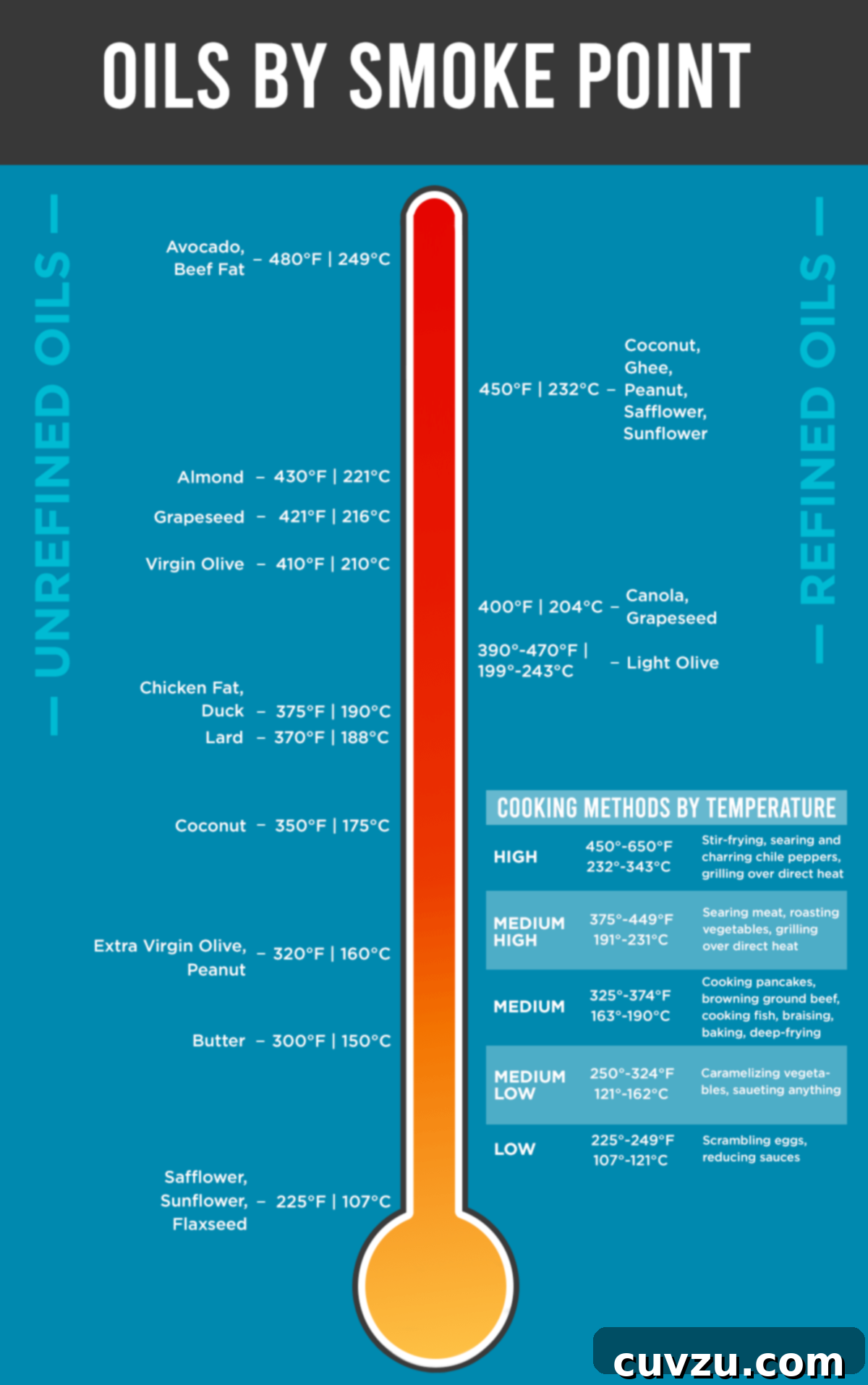
A Quick Reference for Common Cooking Oils:
- Low Smoke Point (Under 375°F / 190°C): Ideal for dressings, dips, baking at low temperatures, or gentle sautéing.
- Flaxseed Oil (Unrefined): 225°F (107°C)
- Walnut Oil (Unrefined): 320°F (160°C)
- Extra Virgin Olive Oil: 325-375°F (160-190°C)
- Unrefined Sesame Oil: 350°F (177°C)
- Butter: 302-350°F (150-177°C)
- Medium Smoke Point (375-425°F / 190-220°C): Good for general cooking, sautéing, roasting, and some baking.
- Virgin Coconut Oil: 350-375°F (177-190°C)
- Vegetable Shortening: 360°F (182°C)
- Lard: 370°F (188°C)
- Canola Oil (Unrefined): 375°F (190°C)
- Refined Coconut Oil: 400°F (204°C)
- Vegetable Oil (Blend): 400-450°F (204-232°C)
- High Smoke Point (Over 425°F / 220°C): Best for high-heat searing, deep-frying, stir-frying, and grilling.
- Peanut Oil (Refined): 450°F (232°C)
- Corn Oil (Refined): 450°F (232°C)
- Sunflower Oil (Refined): 450°F (232°C)
- Safflower Oil (Refined): 450-510°F (232-265°C)
- Grapeseed Oil: 420°F (216°C)
- Avocado Oil (Refined): 520°F (271°C)
By keeping these guidelines in mind and paying close attention to your oil’s behavior, you can ensure that your cooking is not only delicious but also safe and healthy. So, watch for that lovely shimmer, choose your oils wisely, and let’s cook with confidence!
Chat with Us: Your Culinary Questions Answered!
Do you have a burning cooking question, a culinary query, or a kitchen quagmire that you’d love us to address? Perhaps you’re still wondering which oil is best for your specific recipe, or you’ve encountered a smoke point mystery we haven’t covered. We’re here to help! Click that prominent, big-mouth button to the right to leave us a recorded message. Simply enter your name and email address, press record, and speak your mind. We promise to get back to you with a thoughtful answer. And who knows? Your insightful question might even be featured right here on our pages or, just possibly, on our popular podcast, “Talking With My Mouth Full.” We’re eager to hear from you and continue our shared journey in the delicious world of cooking!