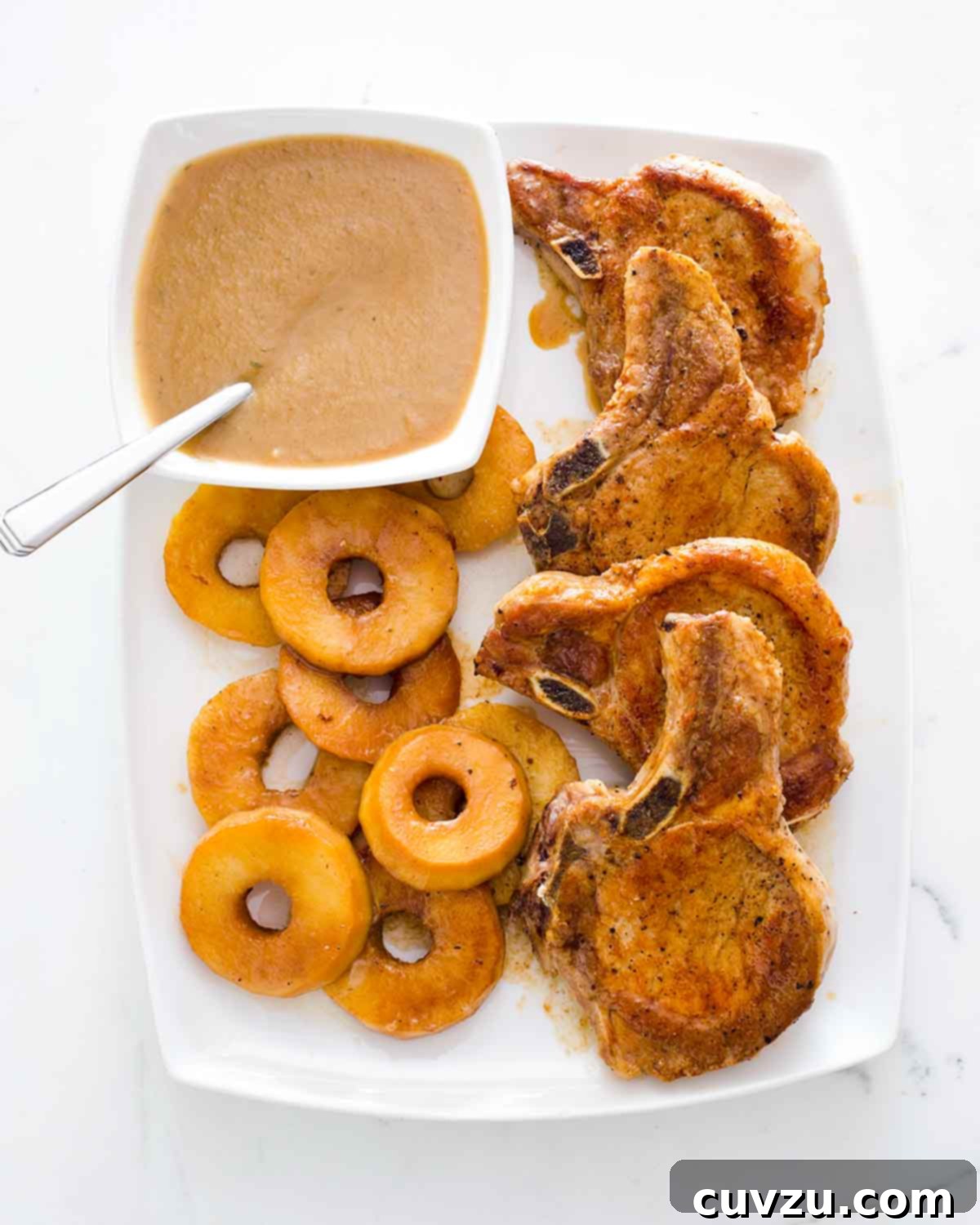
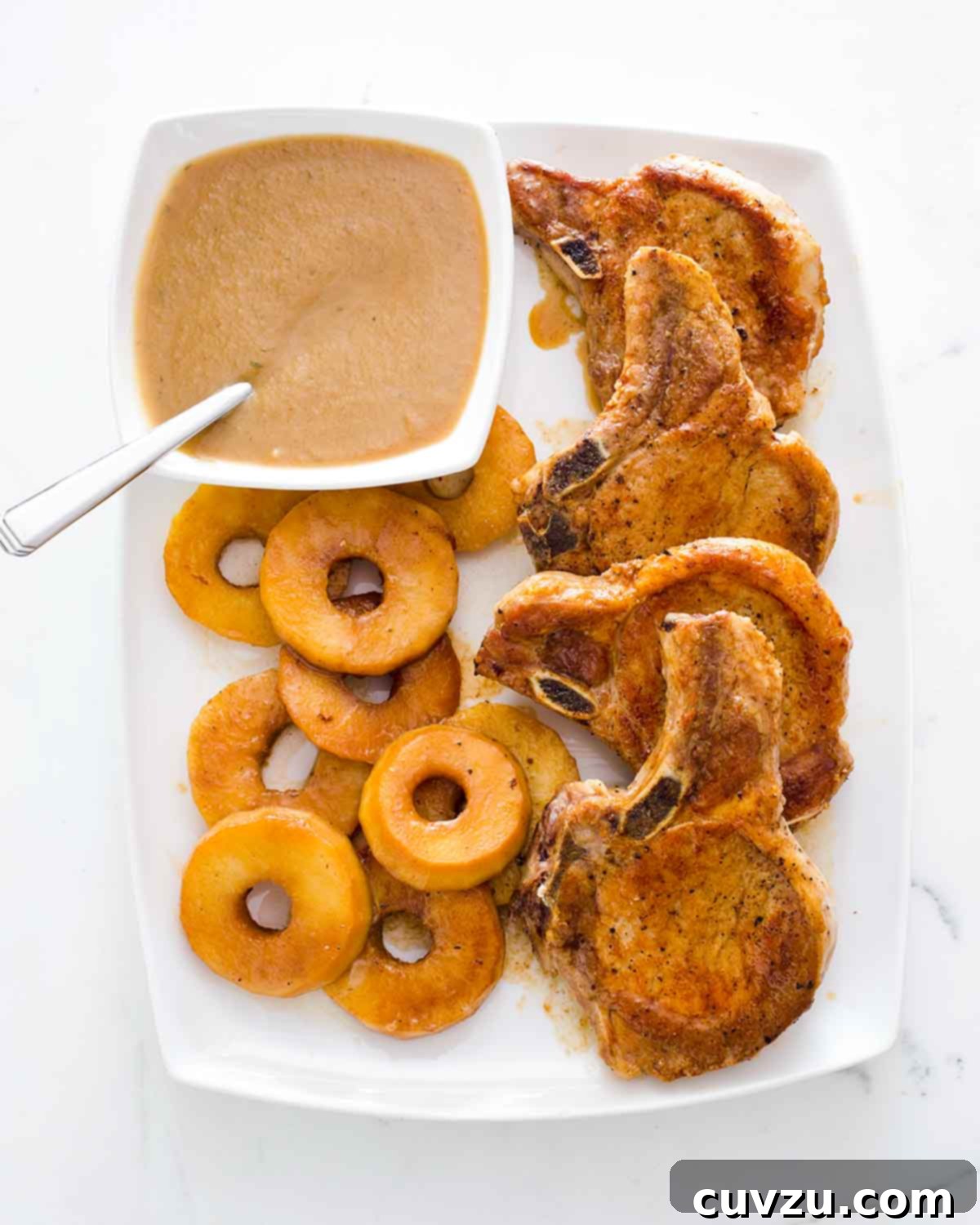
Embark on a culinary adventure to the heart of Normandy with these exquisite French-style pork chops, featuring tender apples and a luxurious Calvados-cider sauce. This dish elevates humble pork chops into an elegant entree, designed to impress while remaining surprisingly accessible even for the novice cook. It beautifully marries the rich flavors of seared pork with the sweet-tart notes of sautéed apples, all brought together by a complex sauce infused with the distinctive aroma of French apple brandy.
The Heritage of Porc à la Normande: A Timeless Classic
Porc à la Normande is more than just a recipe; it’s a testament to the enduring appeal of the classic pork-and-apples flavor pairing, deeply rooted in the gastronomic traditions of France’s Normandy region. For centuries, this beloved dish has graced French tables, celebrated for its elegant presentation and its masterful blend of savory and sweet. The essence of the dish lies in its components: expertly prepared pork, often accompanied by sautéed apples cut into various shapes—from rustic chunks to refined rings or even intricate tournées (oblong football shapes)—all unified by a rich, complex sauce. This sauce, traditionally crafted with flambéed Calvados, a renowned French apple brandy, is the soul of the dish, contributing an unparalleled depth of flavor and an intoxicating aroma that defines Normandy cuisine.
Historically, preparing a truly authentic Porc à la Normande could be an elaborate affair, demanding considerable time and an extensive array of cookware. However, as culinary tastes evolve and modern lifestyles demand efficiency, there’s a growing desire for dishes that capture the essence of tradition without the arduous effort. As quoted by America’s Test Kitchen, “While traditional versions require hours and an arsenal of pots, we wanted an elegant rendition featuring perfectly cooked pork and apples and a savory sauce rich with complex apple flavor—without requiring a lot of time or cookware.” This recipe embodies that philosophy, offering a sophisticated meal that is both achievable and utterly delicious, proving that gourmet flavors can be created with straightforward techniques and minimal fuss.
This streamlined approach to Porc à la Normande not only respects the dish’s venerable heritage but also makes it accessible to contemporary home cooks. It focuses on maximizing flavor through smart preparation, such as brining the pork for tenderness and carefully building the sauce in layers. The result is a dish that delivers all the nuanced apple richness and savory pork succulence of its ancestors, yet fits comfortably into a modern kitchen schedule. Whether you’re a seasoned chef or just beginning your culinary journey, these French-style pork chops offer a rewarding experience, transforming simple ingredients into a truly memorable meal.
More Delicious Pork + Apple Recipes
Pork Casserole with Apples and Cider
2 hrs
Sautéed Sausages with Apples
30 mins
Pork Chops with Applesauce
30 mins
Roast Pork Loin with Apples and Onions
1 hr 20 mins
Share Your Culinary Experience!
If you make this recipe, or any dish on LC, we invite you to leave a review, a star rating, and your best photo in the comments below. We love hearing from you and seeing your delicious creations!

French-Style Pork Chops with Apples and Calvados
David Leite
Saved
Mains
French
4
servings
781
kcal
1 hour
30 minutes
1 hour
30 minutes
Ingredients
For the juiciest French-style pork chops, bone-in cuts are preferred for their superior flavor and moisture retention. The choice of apples also significantly impacts the dish; firm, sweet-tart varieties like Gala or Golden Delicious hold their shape well during cooking and provide a balanced sweetness to the sauce. Calvados, the star spirit of this recipe, infuses the sauce with a distinctive apple brandy character. If Calvados is unavailable, quality Applejack or another good brandy can be used as a suitable substitute. Bacon adds a foundational layer of savory depth, complementing the pork and apples beautifully. Remember to use fresh herbs like thyme for the best aromatic contribution.
- Four (12 to 14 ounce) bone-in pork rib chops, 1 inch (25 mm) thick, trimmed
- 3 1/4 teaspoons kosher salt
- 4 medium (about 26 oz total) Gala or Golden Delicious apples (each about 3 inches [8 cm] in diameter), peeled and cored
- 2 slices thick or thin bacon, cut into 1/2-inch (12-mm) pieces
- 3 medium (about 4 oz) shallots, sliced
- Pinch ground nutmeg
- 1/2 cup Calvados, (or substitute Applejack or brandy)
- 1 3/4 cups apple cider
- 1 1/4 cups store-bought or homemade chicken broth
- 4 sprigs fresh thyme plus 1/4 teaspoon minced
- 2 tablespoons (1 oz) unsalted butter
- 1 teaspoon Freshly ground black pepper
- 2 teaspoons vegetable oil
- 1/2 to 1 teaspoon cider vinegar
Instructions
Creating this magnificent French-style pork chop dish involves a few key steps that build layers of flavor and ensure perfect tenderness. From carefully salting the pork to mastering the dramatic flambé of Calvados, each stage contributes to the final harmonious result. Follow these instructions closely for a truly impressive meal.
-
To begin, evenly sprinkle each pork chop with 3/4 teaspoon of kosher salt. This initial salting step is crucial for drawing out moisture, enhancing the pork’s natural flavor, and tenderizing the meat. Arrange the chops on a large plate, cover them loosely with plastic wrap, and refrigerate for 1 hour. This allows the salt to penetrate deeply and work its magic, preparing the chops for an exceptional sear.
-
While your pork chops are resting in the refrigerator, turn your attention to the apples for the sauce. Peel and core 2 of the apples, then cut them into 1/2-inch (12-mm) pieces. These apple pieces will break down during cooking, forming the flavorful base of your rich Calvados-cider sauce.
-
In a medium saucepan, cook the bacon over medium heat until it becomes beautifully crisp, typically 5 to 7 minutes. As the bacon renders its fat, it creates a wonderfully savory foundation for the sauce. Once crisp, remove the bacon pieces from the pan and set aside for later use or a chef’s snack! Leave the rendered bacon fat in the saucepan.
-
Add the sliced shallots, a pinch of ground nutmeg, and the remaining 1/4 teaspoon of salt to the saucepan with the bacon fat. Cook, stirring frequently, for 3 to 4 minutes, until the shallots soften and begin to turn a light golden brown. This step further develops the aromatic base of the sauce, adding a delicate sweetness and depth.
-
Carefully remove the saucepan from the heat. Add 1/4 cup of Calvados and allow it to warm through for about 5 seconds. Now for the exciting part: flambéing! Very carefully, wave a lit fireplace match or a wooden skewer with a lit end over the saucepan until the Calvados ignites. Gently shake the saucepan to ensure the flames spread evenly. Once the flames naturally subside, which usually takes 30 to 60 seconds, cover the saucepan to ensure any lingering flames are completely extinguished, waiting about 15 seconds more. This dramatic step burns off the harsh alcohol, leaving behind the rich, concentrated apple flavor.
-
Repeat the flambéing process with the remaining 1/4 cup of Calvados. The second flambé might take a little longer for the flames to subside, typically 1 1/2 to 2 minutes, as the pan and liquid are already warm. This double flambé technique intensifies the apple brandy’s essence, creating a more profound and nuanced flavor profile in the finished sauce.
-
Once the flames are fully extinguished, return the saucepan to medium-high heat. Add the apple cider, 1 cup of chicken broth, the fresh thyme sprigs, unsalted butter, and the chopped apples (from step 2). Bring the mixture to a gentle simmer. Continue to cook, stirring occasionally, until the apples become very tender and the liquid has reduced to approximately 2 1/3 cups. This reduction process can take anywhere from 25 to 45 minutes, depending on your stove and saucepan. The sauce will thicken and concentrate in flavor. Remove from heat and cover to keep warm.
-
While the sauce gently simmers, prepare your oven and the remaining apples. Adjust an oven rack to the middle position and preheat your oven to 300°F (150°C). This lower oven temperature will allow the pork chops to finish cooking gently, ensuring they remain incredibly moist.
-
Slice the remaining 2 apples into 1/2-inch-thick (12-mm) rings. These will be beautifully sautéed alongside the pork. Pat the salted pork chops dry thoroughly with paper towels. This is a critical step for achieving a perfect golden-brown crust during searing. Finally, season each chop with 1/4 teaspoon of freshly ground black pepper.
-
In a 12-inch (30-cm) skillet, warm the vegetable oil over medium heat until it just begins to visibly smoke, which should take about 2 minutes. Increase the heat to high. Carefully place the prepared pork chops in the hot skillet and brown them on both sides, for approximately 6 minutes total. This high-heat sear creates a delicious, caramelized crust, locking in the juices.
-
Transfer the beautifully browned pork chops to a large plate and temporarily set them aside. Reduce the heat in the skillet to medium. Add the apple rings to the skillet and cook them until they are lightly browned and slightly softened, 1 to 2 minutes per side. Pour in the remaining 1/4 cup of chicken broth and deglaze the pan, scraping up any delicious browned bits from the bottom with a rubber spatula. Continue cooking until the liquid has evaporated, about 30 seconds. These caramelized bits are packed with flavor and will contribute to the overall richness of the dish.
-
Remove the skillet from the heat. Flip the apple rings over and carefully place the seared pork chops directly on top of the apples in the skillet. Transfer the entire skillet to the preheated oven. Cook until the internal temperature of the pork chops registers between 135 to 140°F (57 to 60°C). This typically takes 10 to 15 minutes, but the exact time will depend on the thickness of your chops.
☞ TESTER TIP: Pork chops can vary in thickness. If your chops are thinner than 1 inch, start checking their doneness after just 4 minutes in the oven. Conversely, if they are thicker than 1 inch, they might require up to 20 minutes to reach the desired internal temperature. Always use a meat thermometer for accuracy to prevent overcooking and ensure juicy results.
-
Once cooked, carefully transfer the pork chops and their accompanying apple rings to a warm platter. Tent the platter loosely with aluminum foil and allow the chops to rest for 10 minutes. This resting period is essential; it allows the juices within the pork to redistribute, ensuring every bite is tender and succulent.
-
While the pork chops are resting, turn your attention back to the apple-brandy mixture (from step 6). Place a fine mesh strainer over a large bowl and pour the mixture through it, pressing firmly on the solids with a ladle or rubber spatula to extract every last drop of flavorful liquid. Don’t forget to scrape any concentrated goodness from the underside of the strainer into your sauce. The strained solids, composed of cooked apples, shallots, and bacon, are too delicious to discard; consider reserving them to serve as a wonderful jam or chutney alongside your meal or for another use.
-
Stir the minced fresh thyme into the strained sauce. Taste and season the sauce carefully with cider vinegar, salt, and pepper until the flavors are perfectly balanced. The vinegar adds a bright counterpoint to the richness. Transfer the finished sauce to a small bowl or gravy boat and pass it separately at the table, allowing each diner to add as much or as little as they desire.
☞ TESTER TIP: The exact amount of cider vinegar needed will vary. Sweeter apple ciders might require a full teaspoon or even a touch more to achieve the desired tart balance, while less sweet ciders might need only half a teaspoon. Adjust to your personal preference and the specific sweetness of your ingredients.
Serve these French-style pork chops immediately, paired with a complementary side dish. Mashed potatoes, particularly those with a hint of pepper or garlic, are excellent for soaking up the exquisite sauce. Roasted root vegetables or a simple green salad also make wonderful accompaniments. A light, crisp white wine from the Loire Valley or a dry cider would be a perfect pairing, enhancing the subtle apple notes in the dish.

Adapted From
100 Techniques
Buy On Amazon
Explore More with AI
Substitutions
Scale
Summarize
Nutrition
Calories: 781 kcal
Carbohydrates: 41 g
Protein: 56 g
Fat: 36 g
Saturated Fat: 13 g
Monounsaturated Fat: 13 g
Trans Fat: 0.5 g
Cholesterol: 200 mg
Sodium: 2385 mg
Fiber: 5 g
Sugar: 31 g
Nutrition information is automatically calculated, so should only be used as an approximation.
Tried this recipe?Mention @leitesculinaria or tag #leitesculinaria!
Insights from Our Recipe Testers
Our dedicated team of recipe testers meticulously evaluated these French-style pork chops with apples and Calvados, offering invaluable feedback and personal experiences. Their insights highlight the dish’s strengths, share useful tips, and even suggest creative ways to enjoy the flavorful byproducts of the cooking process. Read on to see what they loved and how you can make this dish shine in your own kitchen.
Ilda Costa-Sarnicki
Ilda described this recipe as a “de-light” to complete, resulting in “absolutely fantastic” pork chops. She noted that while the initial preparation might feel involved, subsequent attempts would be more streamlined, possibly shaving off 10 minutes or so. For Ilda, each step was a crucial building block to a “wonderful finale,” making the effort entirely worthwhile. Her favorite part, beyond the eating, was the flambé technique, enjoying the “pleasure of watching the flames lick away at the shallots and bacon,” which ultimately contributed to a “luxurious and complex sauce.”
A particularly ingenious observation from Ilda concerned the solids left after straining the sauce. Though the recipe suggests discarding them, she found the resulting apple, shallot, and bacon purée to be “jammy and chutney-like.” She wisely reserved and served it as a chutney, demonstrating a clever way to minimize waste and add another textural and flavorful component to the meal. She praised the strained sauce as “velvety, tangy, and savory,” perfectly complementing the “thick, juicy, and peppery pork chops.” The apples maintained their shape and offered a “tasty with just a hint of sweetness.” Ilda concluded that the finished dish was “elegant, delicious, and evocative of the traditional Porc à la Normande,” yielding four generous servings, which she paired with thyme mashed potatoes.

Janie P.
Janie, who often finds pork chops challenging to prepare without drying out (unless slow-cooked), was delighted that these chops were “anything but dry!” She found them “tasty and tender with very little cooking time.” She particularly appreciated the cooking method of browning them for a few minutes before finishing in the oven, noting that it resulted in “nicely browned and a pleasing presentation.” The apple rings were highlighted as an “easy, flavorful addition” with a “nice texture—not too soft.”
While impressed with the pork, Janie felt the sauce “was not as flavorful as I had hoped.” She commented that it “seemed to be more work than was worth it for the finished product,” and she “could not really taste the thyme or any hint of bacon in the finished product.” She expressed a desire for it to be “more savory and a little thicker consistency.” Despite this, Janie concluded that “overall, this was a really good meal. With the addition of some flavor to the sauce it would be great!” Her feedback suggests that some cooks might prefer to adjust the sauce to their taste, perhaps by reducing it further or intensifying the savory elements.
Nadine Bonda
Nadine declared this dish “wonderful,” praising the pork as “moist and tender” and the sauce as “wonderfully complex.” She even used special Mangalica pork chops she had acquired from a farm in Maine, noting that while the recipe called for 1-inch thick chops, her 1 1/2-inch thick chops “worked perfectly.” She observed that at an internal temperature of 140°F, the pork chops were “a beautiful light pink and very moist,” with a “subtle infused taste of the apples they were cooked on” that was “perfect.”
To further enhance the dish, Nadine periodically basted the pork chops with any liquid found at the bottom of the pan. She enthused, “Add the wonderful sauce and you have a meal that could be served to guests or enjoyed by your family.” Recognizing that time can be a factor, Nadine successfully prepared the sauce earlier in the day and reheated it in the microwave just before serving, confirming its excellent holding qualities, which makes it suitable for a weekday meal. She confidently added this recipe to her list of favorites, noting her use of Gala apples and thick-cut bacon, which contributed to her successful outcome.
Irene Seales
Irene was pleasantly surprised by the “surprisingly easy recipe for such a familiar yet sophisticated combination of flavors.” She drew a fond comparison to childhood pork chops and applesauce, noting that this rendition offered a “much fancier” presentation and sauce that wasn’t “too daunting for a weeknight.” She even prepared it twice, trying both rib chops and center-cut boneless chops, concluding that while both were very good, “you do really want the rib chop if possible, for it delivered more flavor and seemed more tender.” She found the rib chops “so delicious.”
Experimenting with apple varieties, Irene found both Honeycrisp and Golden Delicious worked well, though Golden Delicious “broke down a bit more in the sauce which was desirable to yield as much sauce as possible after reducing.” She used a modest, inexpensive French Calvados and confirmed the flambéing worked “just as described,” cautioning against using precious, rare brandies for this step. She also successfully used unfiltered apple juice in place of cider. Irene found the dish paired nicely with roasted potatoes and Brussels sprouts for a “real fall meal.” Like Ilda, Irene recognized the value of the strained solids, transforming them into an “apple-bacon jam or chutney” the next day, which “begs to be spread on rustic bread for sandwiches or dolloped alongside some curried vegetables.” She emphasized that there was “no possibility I would discard that.” Irene also noted that a half-recipe generously served two people, and commented on the deliciousness of 14-ounce chops, suggesting one might end up eating it all anyway!
Gabi H.
Gabi’s review was short, sweet, and to the point: “The taste. OMG. The taste is just amazing. The apple, the cider, the pork. OMG and OMG again.” This enthusiastic reaction perfectly encapsulates the sheer deliciousness of the dish. She noted that it “serves 4 or two very hungry young men,” indicating its satisfying portion size. Gabi used her “own stock” for the recipe, mentioning it was her “first try, made from scraps and it’s soo good,” which highlights the versatility of using homemade ingredients. The timing of the recipe was “perfect,” and she successfully executed the “Calvados flambéing.” Gabi initially planned to save the dish for tomorrow’s lunch, but her son “already ate a chop and he loved the sauce,” a true testament to its irresistible flavor.
Terry S.
Terry, always on the lookout for new pork chop recipes to avoid “sawdust experiences of pork chops long past,” found these chops to be “soft, tender, and succulent, all the things you hope to find in a chop.” She described the sauce as “velvety smooth and has a delicate flavor which is balanced by the cider vinegar,” with the sautéed apple slices providing a “good counterpoint to the sweet-sour profile of the sauce.” Terry firmly believed this recipe should be “included” in a “pantheon of pork recipes,” praising its “perfectly balanced” mix of tart and sweet.
Addressing the flambé, Terry acknowledged it “might be offputting to a novice cook,” but encouraged them to “jump in and take the risk.” She found the instructions “clear and concise,” assuring that the “two-step flambé process can be completed without fear of burning down the house.” She did note that during the second flambé, flames appeared on only one side of the pan despite shaking, but it didn’t hinder the result. For Terry, the flambé step was the “only really complicated step,” with the rest of the preparation being “simple and straightforward.” She successfully adjusted cooking time for smaller chops and achieved meat that was “so tender after the 10-minute rest, and it dissolved on contact with my tongue.” Terry served the dish with small roasted potatoes and Brussels sprouts, adding “a dash of an Italian cider vinegar to the sprouts as they came out of the oven,” which “tied the entire meal together.” She also suggested Black Pepper Mashed Potatoes as an ideal accompaniment and plans to make this recipe “on a regular basis,” even making a full batch of sauce for only two chops to use later.