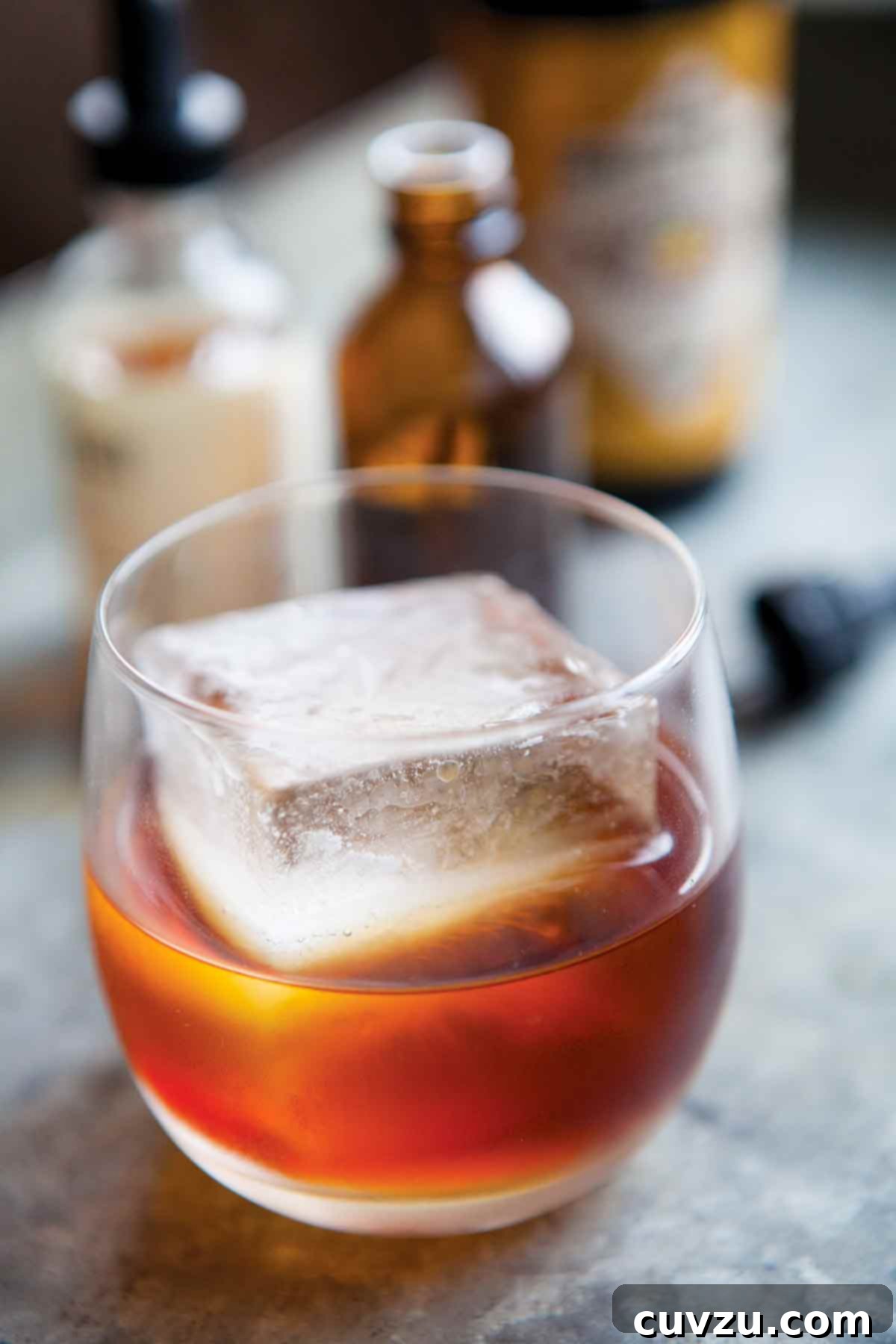
The Sazerac, a truly iconic American cocktail, whispers tales of old New Orleans from its amber depths. While traditionally known for its distinctive absinthe rinse, this recipe boldly reimagines the classic. Our **Sazerac cocktail without absinthe** offers a delightful twist, substituting the potent anise spirit with aromatic anise bitters (or a touch of anise extract). This subtle yet impactful change creates a smooth, approachable rendition of a beloved tipple, perfectly balancing the robust flavors of rye whiskey and rich cognac with a carefully selected medley of bitters and a hint of sweetness from simple syrup.
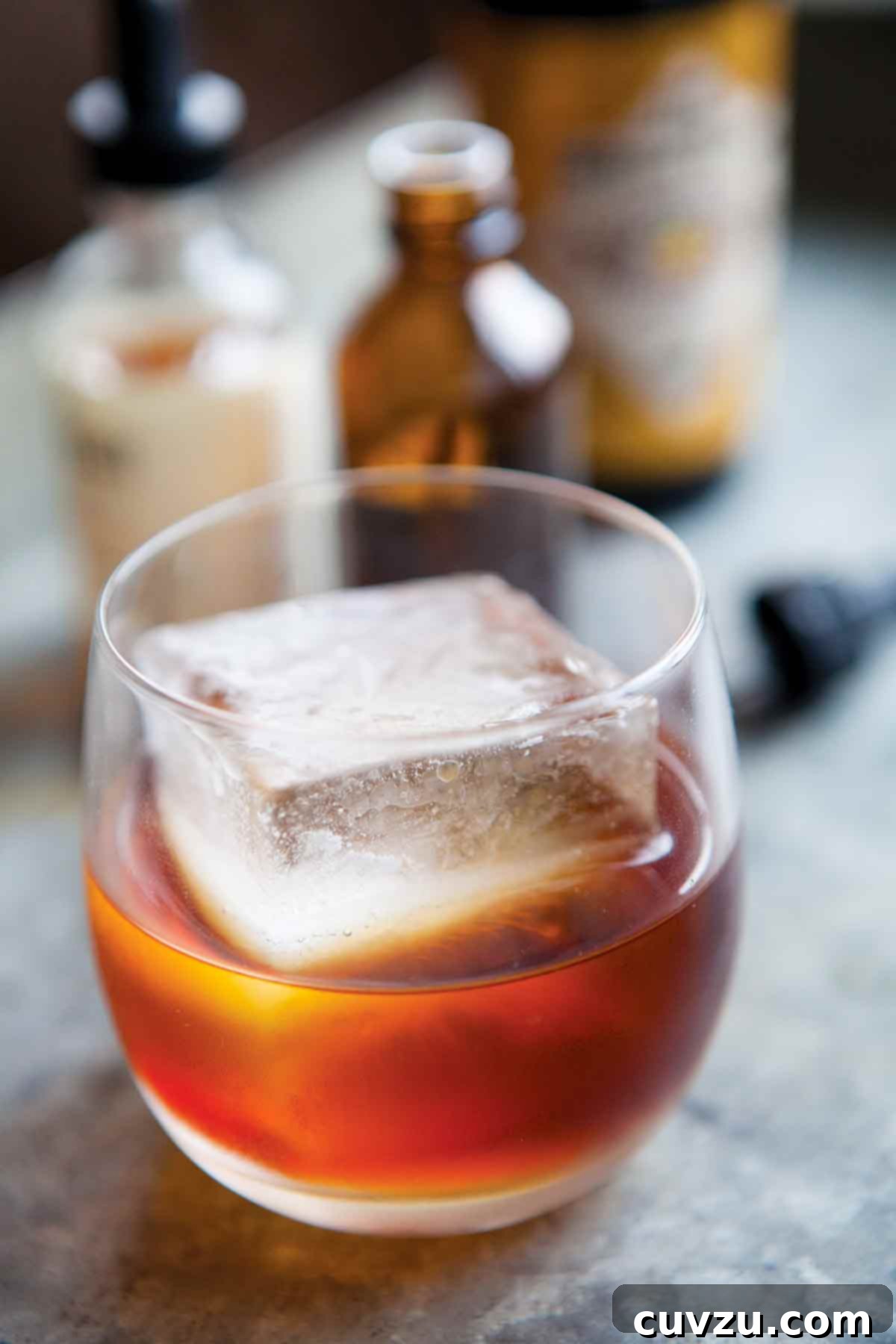
This innovative Sazerac recipe consciously steps away from the conventional, bypassing the anise-flavored spirit that often defines the drink. Instead, it ingeniously employs a trio of bitters to construct a layered flavor profile that is both complex and incredibly inviting. The result is a contemporary interpretation that maintains the essence of the original Sazerac while offering a smoother, perhaps less intense, experience – certainly one less prone to evoking visions of literary figures like Baudelaire or Hemingway! This thoughtful adaptation, crafted by Angie Zoobkoff and championed by David Leite, proves that a magnificent Sazerac is entirely possible and deliciously satisfying even without its traditional absinthe component.
An Absinthe-Free Sazerac: A Timeless Cocktail Reimagined
The Sazerac holds a hallowed place in the pantheon of classic cocktails, a drink steeped in history and cloaked in a certain mystique. Originating in the vibrant city of New Orleans, it’s often hailed as one of America’s first cocktails. Its complex character, typically marked by the distinct aroma of absinthe, rye whiskey, cognac, and Peychaud’s bitters, has captivated connoisseurs for generations. However, not everyone appreciates the strong licorice notes of absinthe, and sometimes, sourcing the spirit can be a challenge. This guide offers a brilliant solution: a refined **absinthe-free Sazerac recipe** that delivers all the elegance and depth of the original, but with a more nuanced anise presence, making it accessible and enjoyable for a wider audience.
The Genesis of a Classic: Understanding the Sazerac’s Heritage
To truly appreciate an absinthe-free Sazerac, it helps to understand the drink’s illustrious past. The Sazerac’s story began in the mid-19th century in New Orleans, specifically at the Sazerac Coffee House, where apothecary Antoine Amédée Peychaud served up a brandy toddy made with his proprietary bitters. Over time, rye whiskey replaced brandy as the base spirit, and a rinse of absinthe became a signature element, contributing to the cocktail’s iconic herbal aroma and flavor. The ritual of preparing a Sazerac, from chilling the glass to stirring the ingredients and finishing with a lemon peel twist, is as much a part of its charm as the drink itself. This cocktail isn’t just a mix of spirits; it’s a piece of American liquid history, a symbol of New Orleans’ sophisticated drinking culture, and a testament to the art of mixology.
The Absinthe Dilemma: Crafting a Sazerac Without the Green Fairy
Absinthe, with its historical reputation and potent anise flavor, is undeniably a key player in a traditional Sazerac. However, its strong profile can be polarizing. Some find its intensity overpowering, while others may simply not have it readily available in their home bar. Our absinthe-free approach addresses these considerations head-on. By replacing the absinthe rinse with several dashes of dedicated anise bitters (or a high-quality anise extract), we achieve that characteristic hint of licorice without the assertive herbal punch or the historical baggage of the “Green Fairy.” This method allows the other primary ingredients — the robust rye, the delicate cognac, and the complex Peychaud’s and aromatic bitters — to shine through more clearly, resulting in a Sazerac that is wonderfully balanced, smooth, and deeply satisfying.
This isn’t about compromising the Sazerac’s integrity; it’s about offering an alternative that maintains the spirit of the drink while adapting it for modern palates and practicalities. The anise bitters provide the necessary aromatic foundation, allowing the cocktail to evoke its New Orleans heritage without strictly adhering to every historical ingredient. It’s a testament to how classic cocktails can evolve and remain relevant, demonstrating that thoughtful substitutions can lead to equally compelling and delicious results.
Deconstructing the Absinthe-Free Sazerac: Key Ingredients Explained
The beauty of this Sazerac lies in its carefully selected components. Each ingredient plays a vital role in building the drink’s nuanced flavor profile. Understanding these elements is key to appreciating and mastering this recipe.
Rye Whiskey: The Backbone of the Sazerac
For any Sazerac, rye whiskey is paramount, and this recipe calls for a 100-proof rye. The higher proof means more flavor, ensuring that the whiskey’s bold, spicy, and sometimes fruity notes stand up to the other strong flavors in the cocktail. Rye provides the assertive foundation that defines the Sazerac’s character, offering a drier, spicier profile compared to bourbon. Brands like Knob Creek or Rittenhouse Bottled-in-Bond are excellent choices, bringing a robust backbone that supports the cognac and bitters without being overwhelmed. The rye is truly the heart of this drink, contributing depth and a distinctive American whiskey charm.
Cognac: A Touch of French Elegance
While often overshadowed by the rye, cognac is the unsung hero that adds an extraordinary layer of complexity and sophistication to the Sazerac. Just a half-ounce of this French brandy introduces subtle fruity, floral, and sometimes nutty notes, rounding out the whiskey’s sharper edges. It brings a velvety texture and a hint of sweetness that enhances the cocktail’s smoothness and depth. Choosing a VS (Very Special) or VSOP (Very Superior Old Pale) cognac will provide the perfect balance without overpowering the other ingredients. The interplay between the bold rye and the refined cognac is what gives the Sazerac its unique elegance, a dance of American strength and French finesse.
The Symphony of Bitters: Anise, Peychaud’s, Aromatic, and Lemon
This absinthe-free Sazerac distinguishes itself by utilizing not one, but a complex array of three primary bitters, plus a fourth for garnish, to create a truly multi-faceted experience:
- Anise Bitters (or Anise Extract): This is the star replacement for absinthe. It provides the essential licorice-like aroma and flavor that is characteristic of a Sazerac, but in a more controlled and less potent manner. Anise bitters integrate seamlessly, offering a subtle, aromatic foundation that hints at the traditional without overwhelming the palate.
- Peychaud’s Bitters: Indispensable to any Sazerac, Peychaud’s is arguably the cocktail’s most iconic ingredient. Its unique blend of gentian, anise, and other botanicals imparts a vibrant red hue and a distinct cherry-like, floral, and slightly bitter profile. These bitters are crucial for authentic Sazerac flavor, linking this modern version directly to its historical roots.
- Aromatic Bitters: Often overlooked, a dash of aromatic bitters (like Angostura) adds another layer of spice and complexity. It contributes notes of clove, cinnamon, and other warm spices, adding depth and a harmonious balance to the overall flavor. This inclusion enriches the Sazerac, providing a fuller, more well-rounded taste experience.
- Lemon Bitters (for Garnish): Rather than a traditional lemon twist expressed over the drink, this recipe calls for lemon bitters as a garnish. Sprinkled directly on top, they release a bright, zesty aroma that contrasts beautifully with the rich, deep flavors of the cocktail. This aromatic flourish elevates the drink, adding a fresh, fragrant finish that awakens the senses.
Double-Strength Simple Syrup: The Sweet Balancer
Simple syrup is vital for balancing the potent spirits and bitters in a Sazerac. This recipe calls for a double-strength simple syrup, which means it has a 2:1 sugar-to-water ratio. This higher concentration allows for less liquid dilution in the cocktail while still providing ample sweetness. Using Demerara or turbinado sugar further enhances the depth of flavor, introducing subtle molasses notes that complement the rye and cognac beautifully. A good simple syrup is the unseen hero, meticulously marrying all the strong components into a cohesive and harmonious drink.
Sazerac Cocktail Without Absinthe Recipe
This Sazerac cocktail thoughtfully omits traditional absinthe, yet it captivates with a delightful anise presence derived from anise bitters. Combined with a rich tapestry of other aromatic bitters, it offers a sophisticated and accessible take on a classic cocktail. Perfect for those seeking a nuanced, flavorful experience.
Author: David Leite
Course: Drinks
Cuisine: American
Servings: 1
Calories: 218 kcal
Prep Time: 15 minutes
Cook Time: 15 minutes
Total Time: 30 minutes
Rating: 5 out of 5 stars (from 1 vote)
Print Recipe
Ingredients
For the Double-Strength Simple Syrup
- 2 cups Demerara or turbinado sugar
- 1 cup cold water
For the Sazerac
- 6 dashes anise bitters or anise extract
- 1 1/2 ounces 100-proof rye
- 1/2 ounce cognac
- 1 teaspoon double-strength simple syrup
- 4 dashes Peychaud’s bitters
- 2 dashes aromatic bitters
- 2 dashes lemon bitters, for garnish
Instructions
Make the Double-Strength Simple Syrup
- In a medium saucepan, combine the sugar and cold water. Stir gently until all the sugar is thoroughly wet.
- Place the saucepan over medium heat and continue to cook, stirring occasionally, until all the sugar crystals have completely dissolved. Be careful not to let the syrup boil vigorously; simply heat until clear.
- Once dissolved, remove the syrup from the heat and allow it to cool to room temperature. Transfer the cooled syrup into a clean jar or an airtight container. Store it in the refrigerator for up to 2 months for future use.
Make the Sazerac
- Begin by chilling your old-fashioned glass. Pour 6 dashes of anise bitters or anise extract into the glass, rotating it to fully coat the inside. Discard any excess bitters.
- In a separate mixing glass, combine the 100-proof rye, cognac, 1 teaspoon of double-strength simple syrup, 4 dashes of Peychaud’s bitters, and 2 dashes of aromatic bitters.
- Fill the mixing glass generously with ice. Stir the ingredients vigorously for approximately 30 seconds until the mixture is thoroughly chilled and slightly diluted. Proper stirring is essential for texture and flavor.
- Strain the chilled cocktail from the mixing glass into your prepared, anise-coated old-fashioned glass.
- Add one large, clear ice cube to the cocktail. A single large cube melts slower, keeping your drink perfectly chilled without over-dilution.
- For the final touch, sprinkle 2 dashes of lemon bitters directly over the top of the cocktail. This provides a bright, citrusy aromatic garnish that enhances the overall sensory experience.
Adapted From

Buy On Amazon
Nutrition Information
The following nutrition information is an estimation per serving:
- Serving: 1 serving
- Calories: 218 kcal
- Carbohydrates: 37 g
- Protein: 6 g
- Fat: 1 g
- Saturated Fat: 0.1 g
- Monounsaturated Fat: 0.1 g
- Sodium: 5 mg
- Fiber: 10 g
- Sugar: 6 g
This nutrition information is automatically calculated and should be used as an approximation.
Insights from Our Recipe Testers
Our dedicated team of recipe testers put this absinthe-free Sazerac to the test, offering invaluable feedback that highlights the drink’s unique qualities and potential customizations. Their experiences provide practical tips and confirm the deliciousness of this modern interpretation.
Jessie Hagan’s Take
Jessie Hagan, a self-proclaimed enthusiast for black licorice, found this cocktail to be a perfect match for her palate. She noted that the Sazerac, prepared as written, was a resounding hit at her happy hour. Despite the absence of traditional absinthe, she concluded that a truly excellent Sazerac could indeed be crafted. Jessie’s experience highlights the successful balance achieved by the blend of bitters, specifically mentioning how the “amalgam of bitters and the velvety syrup added floral notes and balanced the drink to form a well composed cocktail.”
One challenge Jessie encountered was the hunt for anise bitters, which proved elusive in her bustling, foodie-friendly city. Opting for a substitution, she successfully used anise extract, demonstrating the flexibility of the recipe. Based on personal preference, Jessie suggested that doubling the simple syrup and lemon bitters might further enhance the drink for those who desire a slightly sweeter and more tart profile to complement the anise. She used Knob Creek Kentucky Straight Rye Whiskey (100 proof), a robust choice that contributed significantly to the cocktail’s character.
Irene Seales’ Perspective
Irene Seales praised this Sazerac as a “lovely and complex tasting cocktail” that is surprisingly easy to assemble. She acknowledged the various ways one could approach an absinthe-free Sazerac, from using a simple anisette to a more complex infusion. Like Jessie, Irene faced difficulty finding anise bitters locally, prompting her to create a homemade infusion, which yielded pleasing results. In a side-by-side comparison with a traditional absinthe Sazerac, she found this version to be “quite good,” affirming its stand-alone quality.
Irene’s tasting notes suggested that the cocktail, as originally written, was “just a shade sweet.” She preferred it with half the amount of simple syrup (1/2 teaspoon), indicating that personal preference for sweetness can be a factor. She highlighted the importance of securing the anise bitters (or a suitable alternative) as the one hard-to-find ingredient, deeming the effort worthwhile. For future preparations, Irene plans to make extra-large ice cubes, underscoring the importance of proper chilling and minimal dilution for this “keeper” of a drink.
Enhancing Your Sazerac Experience
Crafting a perfect Sazerac, even an absinthe-free one, is an art form. Here are some tips to elevate your cocktail:
- Chill Your Glassware: Always start with a thoroughly chilled old-fashioned glass. This helps keep your cocktail cold for longer and prevents premature dilution, enhancing the overall drinking experience. You can achieve this by placing the glass in the freezer for at least 15 minutes or by filling it with ice water while you prepare the other ingredients.
- Quality Ice Matters: A single large ice cube is preferred for a Sazerac. It melts slower than smaller cubes, ensuring your drink remains perfectly chilled without becoming watery. Consider investing in large ice cube molds for the best results.
- Proper Stirring: Stirring is crucial for chilling and slight dilution, which mellows the spirits and integrates the flavors. Stir your cocktail in the mixing glass for at least 30 seconds with plenty of ice until it’s very cold. This technique ensures a smooth, silky texture that is characteristic of well-made stirred cocktails.
- Lemon Bitters Garnish: The lemon bitters sprinkled on top are not just for show. They release a burst of citrus aroma that enhances the drinking experience, providing a fresh counterpoint to the rich, spicy notes of the cocktail. Don’t skip this aromatic touch!
- Experiment with Anise: If anise bitters are hard to find, a high-quality anise extract can be a good substitute. Start with a smaller amount (e.g., 2-3 drops) and adjust to your taste. You could also explore other anise-forward liqueurs, used sparingly, for a similar effect, though this moves further from the “absinthe-free” spirit of this recipe.
- Adjust Sweetness: As our testers noted, personal preference for sweetness varies. Feel free to adjust the amount of double-strength simple syrup to your liking. A little less can result in a drier, spirit-forward drink, while a touch more can soften the edges.
Conclusion: A Sazerac for Every Palate
The Sazerac cocktail without absinthe is more than just a substitute; it’s a celebration of adaptability and flavor innovation. By thoughtfully replacing absinthe with a nuanced blend of anise bitters and other aromatics, this recipe achieves a captivating depth and balance that honors the original while forging its own path. Whether you’re an absinthe skeptic, an adventurous home bartender, or simply seeking a fresh take on a classic, this cocktail promises a sophisticated and immensely enjoyable experience. It’s a testament to the idea that great cocktails can evolve, inviting new palates to discover the timeless allure of New Orleans in a glass. So go ahead, mix one up, and savor the rich history and vibrant flavors of this reimagined Sazerac.
Tried this Sazerac recipe?
Share your creation with us on Instagram! Mention @leitesculinaria or tag #leitesculinaria. We love seeing your delicious creations!