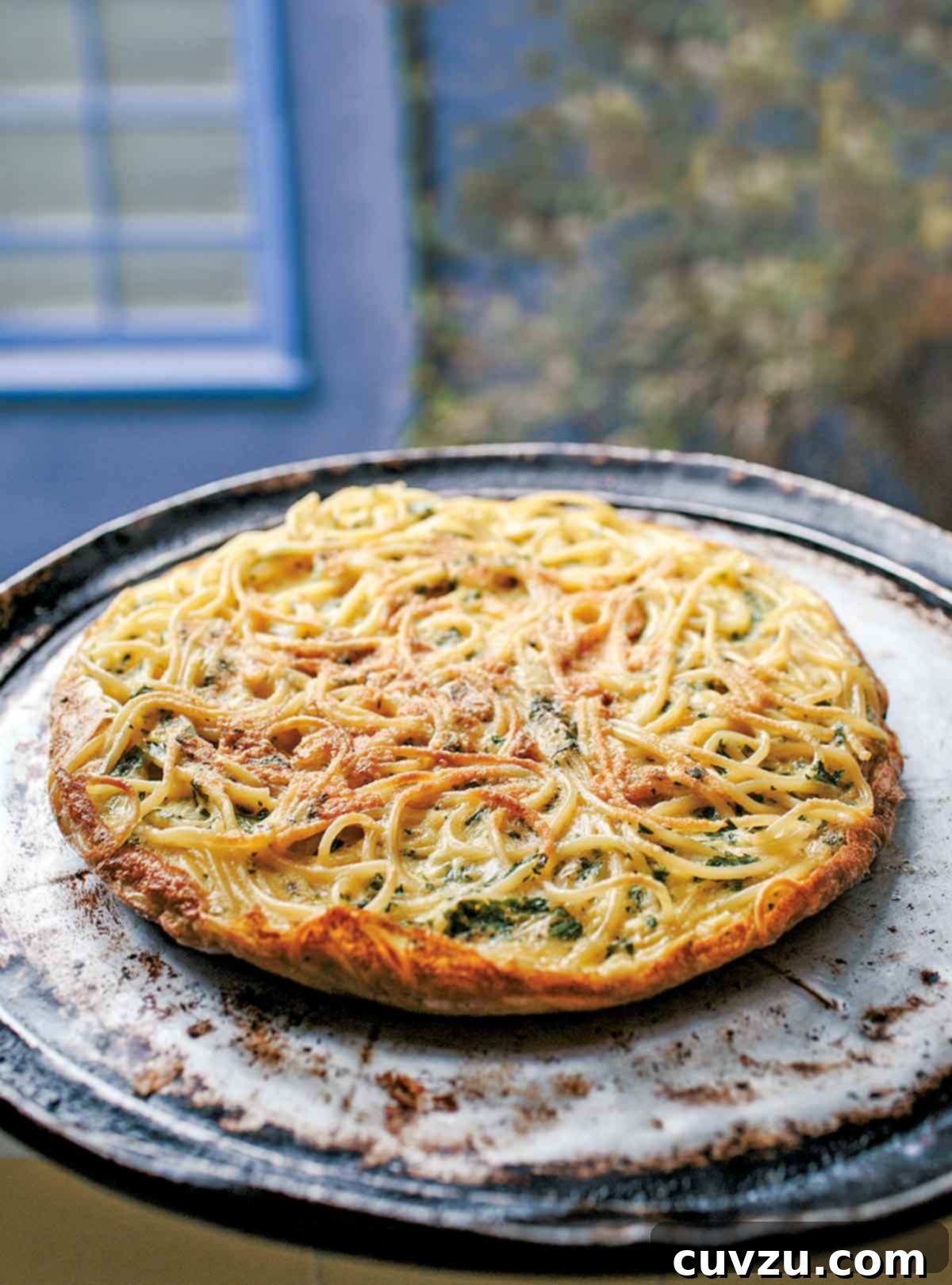
Unlock the incredible potential of your kitchen leftovers with this delightful Leftover Pasta Frittata. This recipe transforms last night’s spaghetti, whether sauced or plain, into a hearty, satisfying meal with the simple addition of eggs and a sprinkle of Parmesan cheese. It’s a testament to resourceful cooking, proving that deliciousness often lies in reinventing what you already have.
The beauty of a pasta frittata lies in its versatility and ease. It’s a dish that gracefully bridges the gap between breakfast, lunch, and dinner, offering a comforting and flavorful experience any time of day. Instead of discarding that extra bowl of pasta, you can elevate it into a star dish that’s both economical and incredibly tasty. This frittata showcases the delightful textural contrast of tender pasta strands bound together by fluffy eggs, all kissed with golden crispness from the skillet.
The Art of the Skillet Frittata: Why Stovetop Reigns Supreme
Creating this leftover pasta frittata begins with preparing your pasta filling. If you have sauced spaghetti—perhaps a vibrant puttanesca, a herbaceous pesto, a fresh primavera, or any other flavorful creation—gently warm it in a skillet with a couple of tablespoons of water. This step helps loosen the pasta and integrate the flavors without overcooking. For those with plain, unsauced spaghetti, consider a crispier approach: a light browning in oil before adding the egg mixture will add an irresistible crunch to your frittata.
A crucial tip for frittata success, and one we passionately advocate, is to ensure your pasta filling is warm before combining it with the eggs. This seemingly small detail plays a significant role in the flipping process. By pre-warming the filling, the frittata begins to cook gently from the inside, preventing the bottom from over-browning before the center has a chance to set properly. Unlike many frittata recipes that finish in the oven, we prefer the stovetop method exclusively. While it requires a bit more finesse, it ensures a superior texture—delicately set and never dry or “overfluffed”—and a much higher flavor factor. This technique, though slightly trickier, consistently delivers a perfect frittata every time, preserving its moistness and rich taste.
Conquering the Frittata Flip: A Moment of Culinary Drama
We understand that the thought of flipping a frittata can be daunting. It’s often perceived as a high-stakes culinary maneuver, fraught with potential disaster. But let us assure you, dear home cook, that this fear is entirely unwarranted. With a little confidence and practice, the frittata flip can become a moment of ease, perhaps even grace, in your kitchen. As one of our seasoned recipe testers eloquently put it, “It is a nervous minute or two when flipping the frittata, but it does become easier with practice, and it makes for a dramatic presentation if you happen to have an audience in the kitchen when you’re preparing it.”
The key to a successful flip lies in preparation and a swift, decisive motion. Ensuring the frittata is properly loosened from the skillet before the flip is paramount. Use a thin metal spatula and a table knife to gently separate the edges and the underside. When it’s time to flip, place a plate (one that is flat and ideally wider than your skillet) firmly over the skillet. Hold the plate securely with one hand and the skillet handle with the other. The motion should be an upward scoop and an over-and-down movement, rather than just a simple roll. It needs to be quick and confident to prevent the frittata from folding or sliding prematurely. Even if, despite your best efforts, the flip doesn’t go exactly as planned and your frittata ends up looking a bit like a culinary “Humpty Dumpty,” don’t despair! Simply nudge it back together as best you can, return it to the skillet to finish cooking, and serve it proudly. It may not be picture-perfect, but we guarantee it will still taste absolutely spectacular.
Can I Use My Cast Iron Skillet For This Recipe?
Absolutely! A well-seasoned cast-iron skillet is a fantastic choice for this recipe, offering excellent heat retention and a beautiful crust. Many cooks, ourselves included, prefer cast iron for its robust performance. The critical factor is ensuring your cast iron skillet is genuinely “slick from use” and meticulously seasoned. We’ve crafted countless pasta frittatas in our trusty cast-iron skillets with great success. However, we have heard from others who encountered difficulties with the frittata releasing cleanly. To mitigate this, make certain your skillet has no rough patches or sticky areas, and don’t hesitate to use a slightly more generous “smidgen” of oil or butter than usual. This extra lubrication will create a more nonstick surface, ensuring an effortless flip and a perfectly intact frittata.
Leftover Pasta Frittata
★★★★☆
David Leite
PIN IT
Print Recipe
Ingredients
- 6 large eggs
- 1/4 cup grated Parmesan or Pecorino cheese
- 2 tablespoons olive oil, plus more oil or butter for the skillet
- 1/8 teaspoon salt
- Freshly ground black pepper, to taste
- 4 ounces cold leftover spaghetti, (sauced or unsauced, ideally refrigerated as a compact nest on a dinner plate) [Editor’s Note: Spaghetti is recommended here; other pasta shapes can be trickier to manage.]
Instructions
-
Crack the eggs into a medium-sized bowl and whisk them vigorously until no streaks of egg white remain and the mixture is uniformly yellow and frothy. Stir in the grated Parmesan or Pecorino cheese, 2 tablespoons of olive oil, salt, and a generous grind of black pepper. Set aside.
-
For Sauced Spaghetti: If using leftover spaghetti with sauce, transfer it to a large nonstick skillet. Add a couple of tablespoons of water and heat over medium-high heat. Warm the pasta gently until it is heated through and pliable, but before it starts to sizzle aggressively. Drain any unevaporated water and immediately add the warm spaghetti to the whisked egg mixture, ensuring it’s well combined. Wipe the skillet clean, return it to medium-low heat, and add enough oil or butter to thoroughly coat the bottom and sides. Pour the spaghetti-egg mixture into the skillet, distributing the pasta evenly if it has clumped together.
For Plain, Unsauced Spaghetti: Heat a couple of tablespoons of oil or butter in a large nonstick skillet over medium to medium-high heat. Carefully add the cold spaghetti to the hot skillet. The easiest way to handle cold, unsauced spaghetti is to have stored it as a compact “nest” on a dinner plate; this allows you to slide the entire frisbee-like chunk directly into the skillet. Let the spaghetti crisp and brown on the bottom, gently pressing down once or twice with a spatula to ensure good contact with the pan. Once browned, reduce the heat to medium-low and pour the whisked egg mixture over the crispy spaghetti, ensuring it coats all the pasta evenly. -
Reduce the heat to low. Cook the frittata, rotating the skillet a quarter turn occasionally to encourage even cooking, particularly around the edges. After about 8 minutes, the perimeter of the frittata should appear set, while the center still retains a slight liquid wobble. At this point, run a table knife around the edges of the skillet to loosen the frittata from the sides, then carefully slide a thin metal spatula underneath to ensure the entire underside is free.
Now for the moment of truth: the flip! Invert a large, flat plate or a cutting board over the skillet. Place one hand firmly on top of the plate and the other on the skillet handle. With a swift, confident, upward-and-over motion, flip the frittata directly onto the plate. The goal is to avoid it sliding or folding, so execute the flip quickly. The frittata should now be resting on the plate, and your skillet should be clean.
Set the plate down, then quickly add a little more oil or butter to the skillet to re-slick it. With the aid of your spatula, gently encourage the frittata to slide back into the skillet, cooked side up. Don’t be concerned if it looks a bit imperfect – simply fit everything back together. Continue cooking over low heat for approximately 7 more minutes, or until cooked through. -
To verify doneness, make a small crack in the middle of the frittata with the tip of your spatula to check that the egg is fully set and no liquid remains. Once cooked, slide or flip the frittata onto a serving plate. Frittatas have two sides, so you can choose which side to present! If you prefer the appearance of the first cooked side, slide the frittata out onto the plate in the same orientation it was in the skillet. If the second side has achieved a more appealing golden hue, flip it out onto a clean plate to showcase that side. Let it cool for at least 15-30 minutes, or even longer, as frittatas often taste even better after they’ve had a chance to rest and regroup. Slice it into wedges, squares, or long strips, and serve. A frittata is delicious warm, but truly shines after it has cooled for a half hour or so, and some argue it’s best after an afternoon on the countertop!
Notes and Creative Variations
Leftover Pasta Frittata Variation: Herbed Frittata (No Pasta)
For a delightful frittata that omits the pasta, simply whisk chopped fresh herbs such as parsley, basil, chives, mint, or tarragon into the egg mixture along with the cheese, oil, salt, and pepper. This creates a lighter, fragrant version that’s perfect for a quick breakfast or brunch.
Expanding Your Frittata Horizons: Additional Fillings
The versatility of the frittata truly knows no bounds. Consider incorporating boiled green vegetables, such as tender green beans, sweet peas, or asparagus cut into 1-inch pieces. These can be added directly to the eggs once they are in the skillet. For a creamy, tangy twist, dab small bits of ricotta or goat cheese into the egg mixture once it’s already in the pan. However, in our household, the original leftover pasta frittata, with its comforting blend of eggs, cheese, and spaghetti, remains an undisputed favorite. Don’t be afraid to experiment with other sautéed vegetables like onions, bell peppers, or even cooked crumbled bacon or sausage to create your signature frittata.
Adapted From
Twelve Recipes by Cal Peternell
Buy On Amazon
Nutrition Facts
Calories: 301 kcal
Carbohydrates: 22 g
Protein: 15 g
Fat: 16 g
Saturated Fat: 4 g
Monounsaturated Fat: 8 g
Trans Fat: 0.03 g
Cholesterol: 284 mg
Sodium: 290 mg
Fiber: 1 g
Sugar: 1 g
Nutrition information is automatically calculated, so should only be used as an approximation.
Tried this recipe?
Mention @leitesculinaria or tag #leitesculinaria!
Insights from Our Recipe Testers
At Leite’s Culinaria, we believe in real-world testing. Here’s what our team of recipe testers had to say about the Leftover Pasta Frittata, offering valuable tips and creative inspirations:

Susan Bingaman
Susan found this frittata to be a surprisingly delicious meal, even when using intensely flavored leftovers like Spaghetti all’Amatriciana, which gave it a unique pinkish hue. She noted that the exact amount of spaghetti isn’t critical, making it incredibly flexible for using up varying quantities of leftovers. While her frittata might not have been the prettiest due to the flipping process, she confirmed that the stovetop method truly delivers a fluffy and flavorful result, outweighing any aesthetic imperfections. Susan served hers for 4, emphasizing that yield depends on your pasta amount. She cleverly omitted extra salt and pepper, knowing her pasta was already well-seasoned.

Helen Doberstein
Helen declared this pasta frittata her favorite egg dish after simple soft-boiled eggs, appreciating its elegant simplicity and the “dramatic flipping” aspect. She affirmed its versatility for breakfast, lunch, or dinner. Helen got creative with her ingredients, adding fresh spinach, a few finely sliced scallions, and a hint of nutmeg to her pecorino romano cheese and egg mixture. She recommends wilting the spinach first in a little olive oil and butter before adding the eggs. Helen echoed the sentiment that flipping gets easier with practice, and confirmed that the frittata tastes just as good, if not better, the next day. She even made a second variation with chopped mushrooms, crumbled bacon, Cheddar, and chives, suggesting this recipe truly belongs in everyone’s culinary repertoire.

Lori Widmeyer
Lori praised the frittata as an “easy recipe that you can see what you have on hand, follow the basic plan, and create something delicious very quickly.” She described it as a “treasure” for its personalization potential. She used leftover angel hair pasta with a three-meat pasta sauce and worried about adding too much pasta, as it covered her 10-inch cast iron skillet. However, this turned out to be a “very good thing,” especially with a slightly increased amount of cheese (closer to 1/2 cup). Lori found the flipping process easier than anticipated, opting for a small cutting board instead of a plate for her flip. The “crispy pasta edges” and the meatiness from the extra sauce were highlights for her tasters. Lori’s creativity extended to a “crazy” second attempt, incorporating a spicy, unbaked crab dip mixture, which was also a huge hit. She pondered an all-veggie version with onions, tomatoes, mushrooms, and summer squash, or even a jambalaya-inspired frittata with andouille sausage, and considered making individual pancake-sized frittatas, acknowledging the trade-off of losing some of those coveted crispy edges.

Robyn Rice-Foster
Robyn admitted to initial nervousness about the flipping step, traditionally finishing her frittatas under the broiler. However, she found the stovetop flipping method superior, as it “avoids overcooking on either the top or the bottom and gives it a very nice ‘filling’ without a crust of overdone egg on the outside.” She prepared hers with leftover spaghetti and a simple tomato basil sauce. To better suit her plates, Robyn used two 9-inch skillets, making the cooking and flipping process efficient. She noted that the entire dish came together in about 8 minutes of prep and 22 minutes total cooking time. Robyn also highlighted the importance of letting the frittata rest: “I think that letting it sit a little longer improves the frittata a great deal.” She enthusiastically recommended it as a perfect addition to a selection of small plates for a wine tasting or cocktail party, and encouraged experimenting with fresh herbs and different cheeses for varied flavor profiles.

Dawn English
Dawn, a self-proclaimed frittata lover, typically uses the oven method but was impressed by the stovetop version’s excellent results. She successfully halved the recipe, using fresh parsley and freshly grated Parmigiano Reggiano. Her well-seasoned cast-iron skillet performed admirably, allowing her to easily flip the frittata with a spatula, confirming its nonstick properties. Dawn’s experience further solidifies the reliability of the stovetop method, especially when paired with a properly cared-for cast-iron pan.