
Experience the rich, vibrant flavors of authentic Mexican cuisine right in your own kitchen with these incredible Red Chile Pork Tamales. This recipe delivers a truly traditional taste, reminiscent of tamales lovingly prepared by a skilled Mexican abuela, offering a perfectly balanced, slightly spicy kick enveloped in tender pulled pork and sweet corn masa dough. While making tamales is a labor of love, the unparalleled flavor and texture of these homemade delicacies make every moment worthwhile. Prepare to impress your family and friends with a culinary masterpiece that transports them straight to the heart of Mexico, one delicious bite at a time.

These red chile pork tamales are a celebration of Mexican culinary heritage. Each tamale features a sweet corn masa dough that delicately encases a richly spiced, irresistibly tender pulled pork filling. The process, while requiring a dedicated effort, culminates in an abundant yield of savory pork filling that you’ll be grateful for. This versatile filling is a culinary godsend, perfect not just for tamales but also for stuffing into pork tacos, serving atop fluffy rice, or simply savoring by the forkful. It’s an authentic taste that will make your knees wobble with delight.

Why Our Testers Loved These Authentic Tamales
Let’s be upfront: crafting this tamale recipe demands a significant investment of time and effort. However, our dedicated recipe testers universally agree that the exquisite results are worth every minute spent in the kitchen. The consensus is clear – these tamales are a true culinary triumph.
Carlin B. eloquently described them as “a plateful of tasty comfort food,” encapsulating the heartwarming and satisfying nature of each bite. Sandy O. was equally enthusiastic, declaring them to be “absolutely wonderful.” Such glowing endorsements speak volumes, inviting you to embark on this rewarding culinary journey to create these beloved Mexican classics.
Essential Ingredients for Perfect Red Chile Pork Tamales
Achieving truly authentic and flavorful tamales begins with selecting the right ingredients. Each component plays a vital role in developing the deep, rich taste and characteristic texture of this traditional Mexican dish. Here’s a closer look at the key ingredients and what to consider when sourcing them:
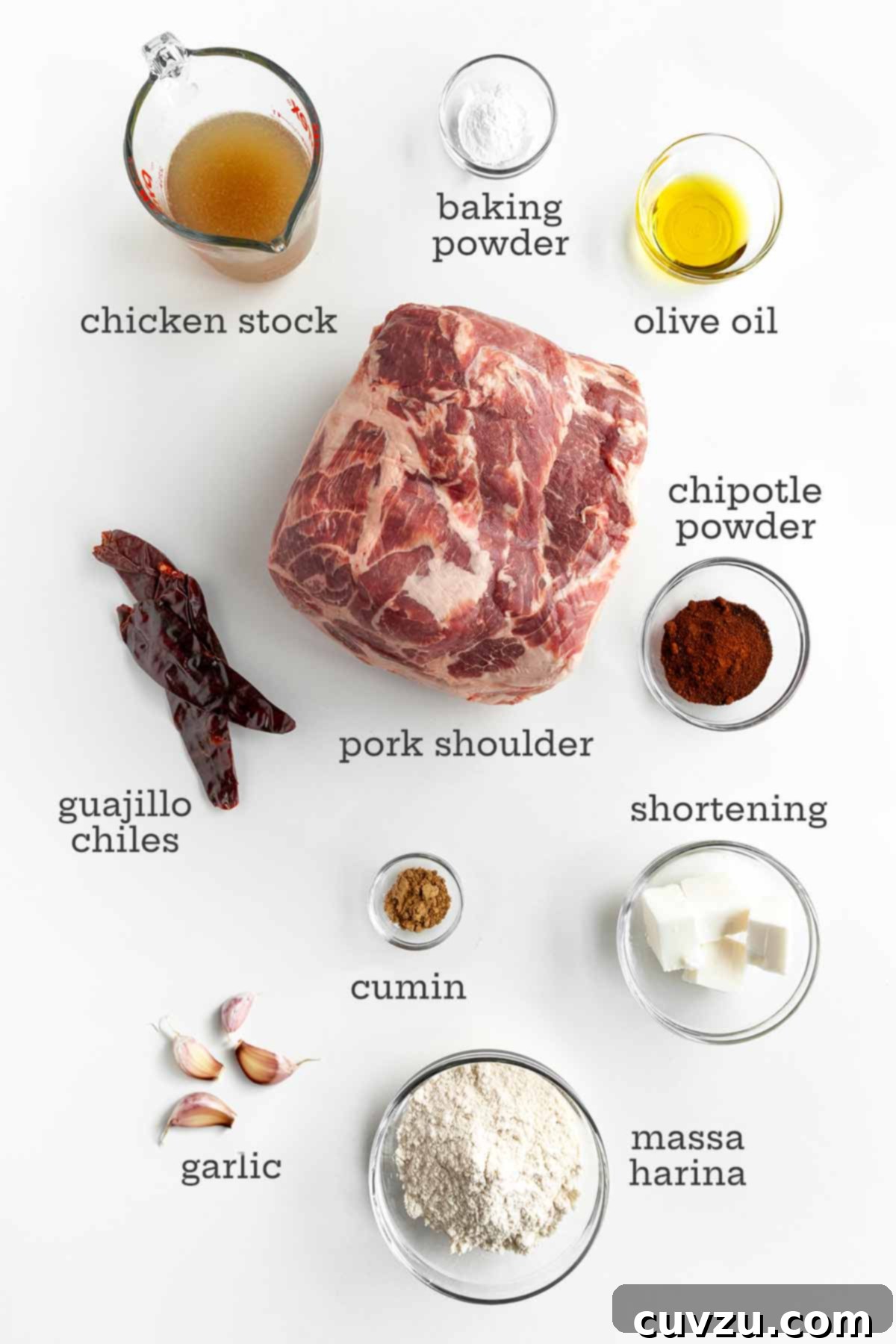
- Pork Shoulder: Often labeled as Boston Butt in many grocery stores, pork shoulder is the ideal cut for this recipe. Look for a piece that is well-marbled with fat. This marbling is crucial as it renders down during the long, slow cooking process, resulting in exceptionally tender, juicy, and flavorful pulled pork that easily shreds and melts in your mouth. Avoid leaner cuts, as they tend to dry out.
- Guajillo Chiles: These are a cornerstone of Mexican cuisine, known for their mild to medium heat and distinctive fruity, slightly smoky, and tangy flavor. Guajillo chiles are the dried form of the mirasol pepper. You can typically find them in the Hispanic or international aisles of larger supermarkets or at specialty Mexican grocery stores. If guajillo chiles are unavailable, dried ancho chiles make the best substitute, offering a similar depth of flavor, though they are slightly sweeter and less spicy.
- Masa Harina: This finely ground flour, made from nixtamalized corn (corn treated with an alkaline solution, then hulled and ground), is the authentic base for tamale dough. Nixtamalization is a traditional process that enhances the corn’s nutritional value and makes it more pliable and flavorful for dough. Masa harina is readily available in most major supermarkets, often in the baking or international food sections. It’s also the key ingredient for making homemade corn tortillas and is featured in recipes like tortilla soup. Do not confuse it with regular cornmeal or corn flour, as these will not yield the correct texture for tamales.
- Corn Husks: You will need approximately 32 large, intact corn husks for this recipe. These are used to wrap the tamales, imparting a subtle corn flavor and helping them steam perfectly. A standard 1-pound bag of dried corn husks usually contains anywhere from 80 to 100 husks, providing plenty for this recipe and any potential re-do’s. Ensure you select husks that are not broken or torn, as these will be difficult to form into tamales.
- Lard or Vegetable Shortening: Traditionally, lard is used in tamales to create a light, fluffy, and tender masa dough. It contributes a distinctive flavor and rich texture that is hard to replicate. However, for those who prefer, vegetable shortening can be used as a suitable alternative to achieve a similar light consistency.
- Chipotle Powder: This spice, made from smoked and dried jalapeño peppers, adds a smoky depth and a pleasant heat to the pork filling, complementing the guajillo chiles beautifully.
- Cumin and Garlic: These aromatic spices are fundamental to the robust flavor profile of the red chile sauce, providing earthy and pungent notes that balance the sweetness of the corn masa and the richness of the pork.
- Kosher Salt: Essential for seasoning both the pork and the masa dough, kosher salt provides a clean, pure salty taste without the additives found in table salt.
- Chicken or Vegetable Stock: Used in the masa dough to add moisture and flavor, ensuring the tamales are savory and tender.
By carefully selecting and preparing these ingredients, you lay the foundation for truly memorable red chile pork tamales that will be the highlight of any meal or celebration.
Crafting Authentic Red Chile Pork Tamales: A Step-by-Step Guide
Making tamales is an art form, a culinary tradition passed down through generations. While it involves several steps, each one contributes to the incredible depth of flavor and texture that defines these beloved Mexican delights. Follow this comprehensive guide to create a batch of homemade red chile pork tamales that taste truly authentic.
Part 1: Preparing the Rich Red Chile Pork Filling
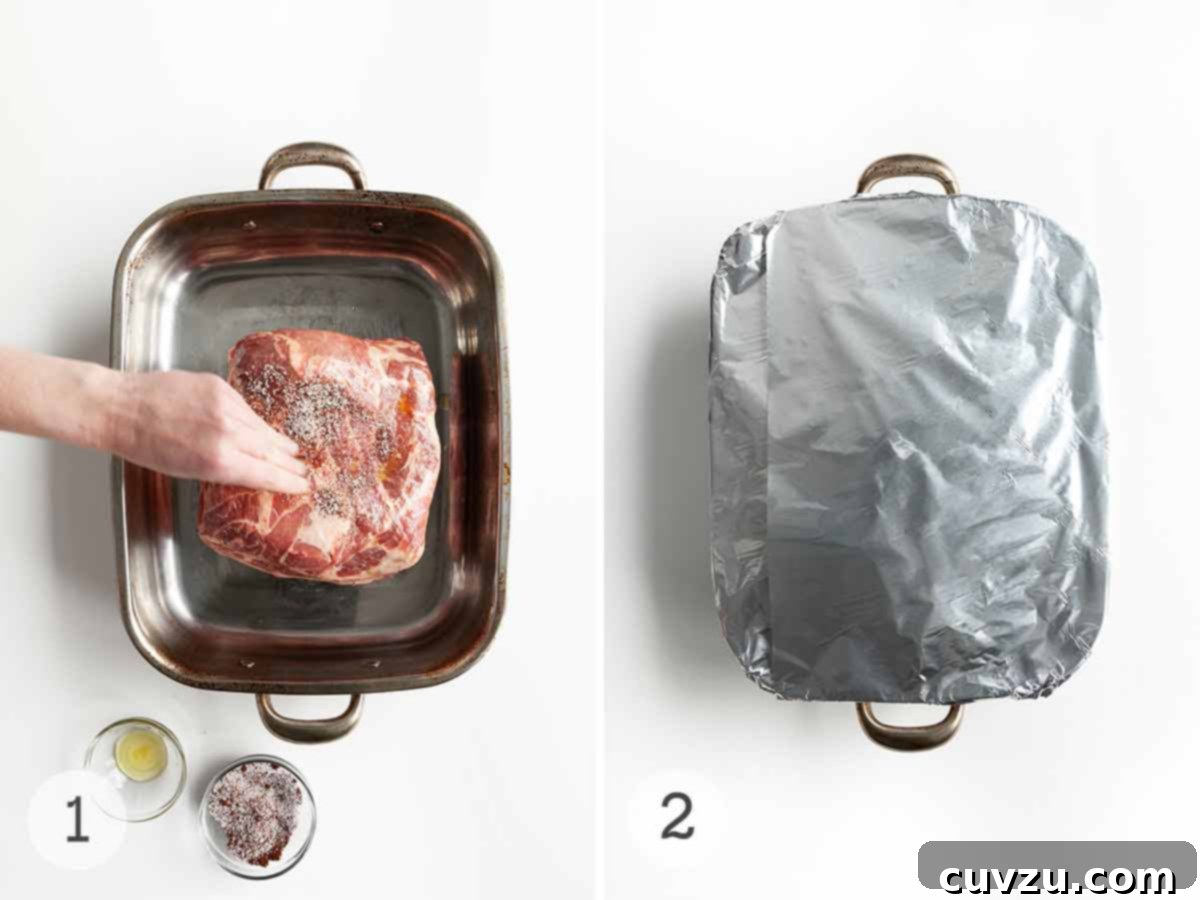
- Prepare the Pork Shoulder: Begin by patting the entire pork shoulder thoroughly dry with paper towels. This step is crucial for allowing the seasoning to adhere properly and for achieving a good sear later, if applicable. Drizzle the pork all over with a light coating of olive oil or vegetable oil. In a small bowl, combine 4 tablespoons of kosher salt with the chipotle powder. Generously rub this spice mixture evenly over all surfaces of the pork shoulder, ensuring it’s completely coated. Allow the seasoned pork to rest at room temperature for a minimum of 1 hour. This resting period allows the salt to penetrate the meat, enhancing its flavor and tenderness. However, do not exceed 1 hour, as prolonged exposure to salt can draw out too much moisture and toughen the meat.
- Slow-Roast for Tenderness: Preheat your oven to a low temperature of 275°F (135°C). Place the seasoned pork shoulder, fatty side down, into a sturdy roasting pan. Cover the pan securely with two layers of aluminum foil to create a tight seal. This ensures the pork steams in its own juices, resulting in exceptional tenderness. Roast the pork for approximately 3 1/2 to 4 hours, or until it is incredibly tender and easily falls apart when gently pressed with the back of a fork. The internal temperature should reach 195°F (91°C). Once cooked, remove the roasting pan from the oven and let the pork rest, still covered, for at least 30 minutes. This resting period allows the juices to redistribute, keeping the pork moist.
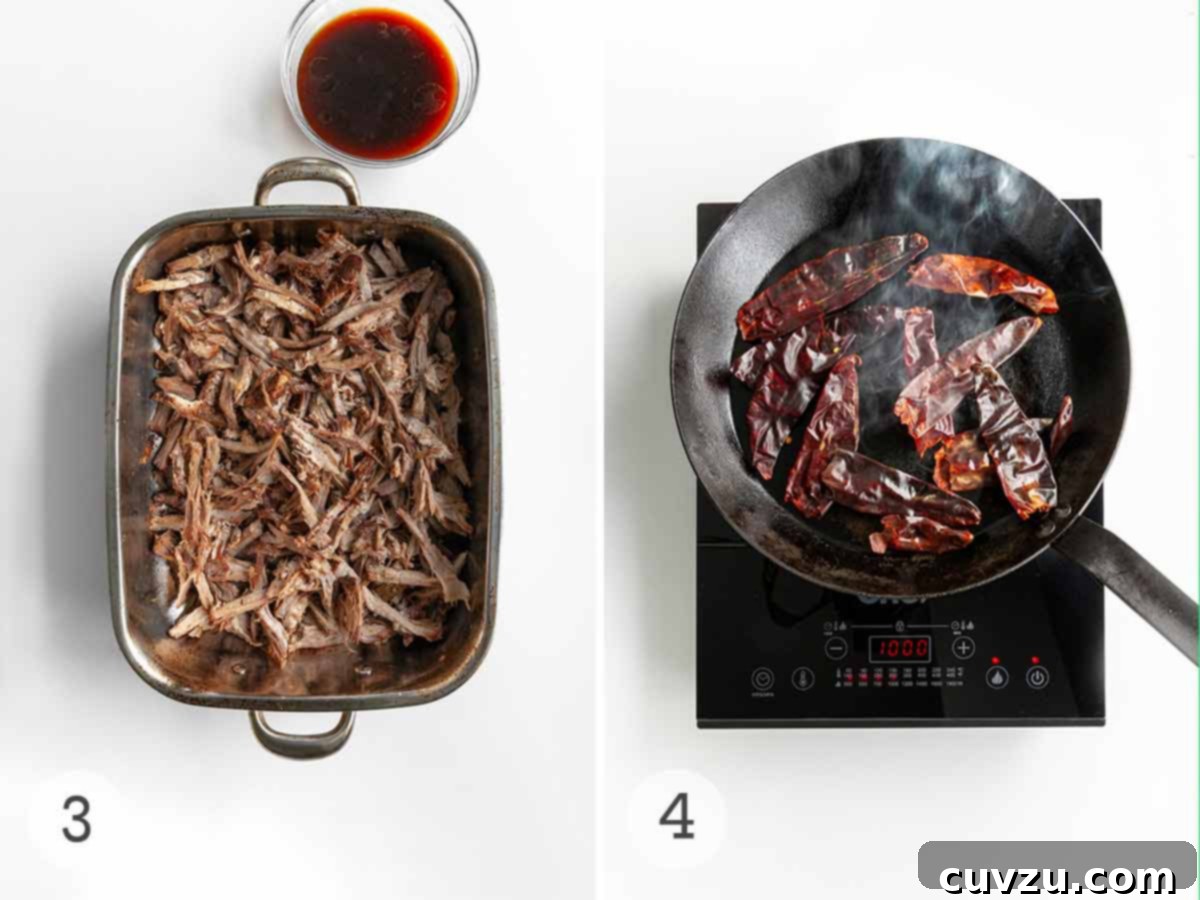
- Shred the Pork and Reserve Liquid: After the pork has rested and cooled sufficiently to handle, use two forks to meticulously pull the pork into long, tender strands. Resist the urge to chop it into chunks, as the long strands provide a more authentic texture within the tamales. Discard any tough gristle or large pieces of excess fat. Carefully strain the cooking liquid from the roasting pan, reserving it for later use. You should yield approximately 2 to 4 cups (473 to 946 ml) of this flavorful liquid.
- Toast and Rehydrate Chiles: While the pork is cooling, heat a cast iron skillet or a heavy-bottomed skillet over medium-high heat until it’s very hot. Add the seeded and stemmed guajillo chiles to the dry skillet and toast them for approximately 30 seconds per side. This quick toasting process awakens their aromatic oils and deepens their flavor. Be extremely careful not to over-toast or blacken the chiles, as this will result in a bitter sauce. Immediately remove the toasted chiles from the pan and place them in a heatproof bowl. Cover the chiles with enough hot water to submerge them completely and let them soak for about 30 minutes, allowing them to rehydrate and soften.
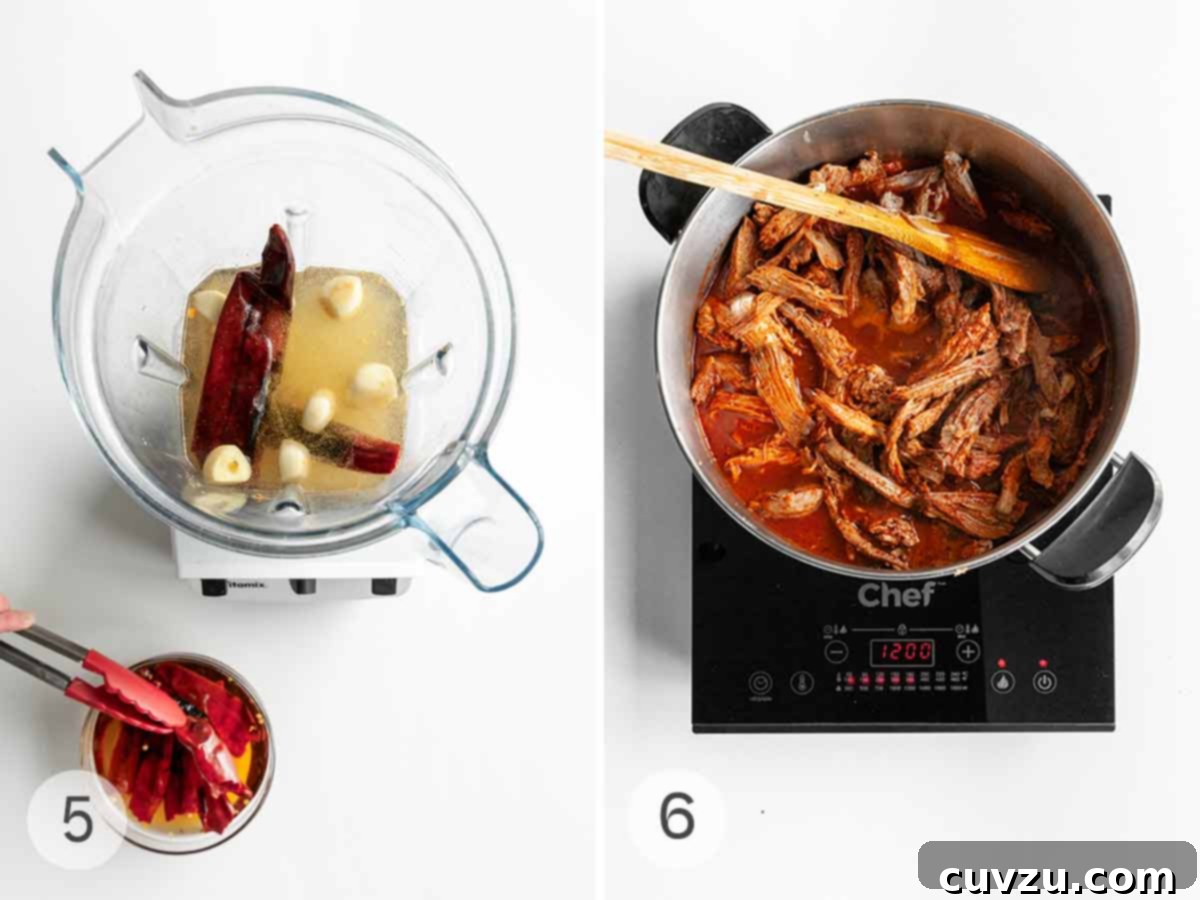
- Create the Chile Puree: After 30 minutes, use a slotted spoon to transfer the rehydrated chiles to a blender. Discard the soaking liquid, as it can sometimes be bitter. Add the garlic cloves, ground cumin, the remaining 1 teaspoon of kosher salt, and 3 cups of cold water to the blender. Puree the mixture until it forms a perfectly smooth, vibrant red paste. Heat 1 tablespoon of olive oil or vegetable oil in a large, heavy stockpot over medium-high heat until it is very hot and begins to shimmer. Carefully pour the chile puree into the hot oil, stirring immediately to prevent sticking. Be cautious, as the sauce may splatter. Cook the sauce, stirring constantly, for 2 to 3 minutes, until it visibly thickens and its color deepens.
- Combine and Simmer: Stir the reserved shredded pork and the strained cooking liquid into the pot with the chile sauce. Bring the mixture to a gentle simmer and cook, uncovered, for an additional 15 minutes. This allows the flavors to meld beautifully. Let the red chile pork filling cool slightly before proceeding to assemble the tamales. If you are preparing this ahead, the filling can be covered and refrigerated overnight, or even frozen for longer storage.
Part 2: Preparing the Masa Dough and Corn Husks
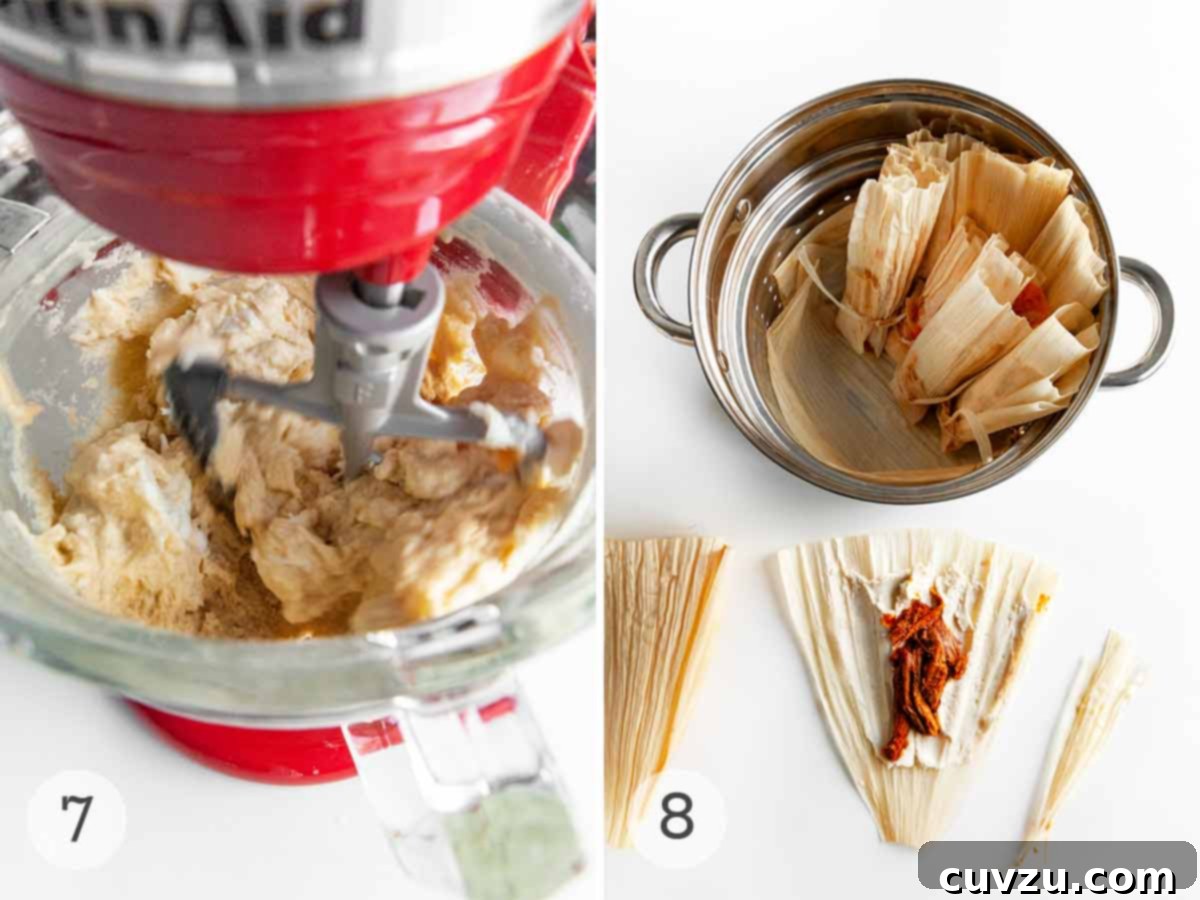
- Prepare the Tamale Dough: In a large mixing bowl or the bowl of a stand mixer fitted with the paddle attachment, combine the masa harina with 2 1/4 cups of warm water. Stir thoroughly until the mixture forms a cohesive ball of rehydrated masa. Add the lard or vegetable shortening, baking powder, 1 1/2 cups of chicken or vegetable stock, and 2 teaspoons of kosher salt. If using a stand mixer, beat on medium speed for approximately 5 minutes until the dough is light and fluffy. If mixing by hand, whisk vigorously until well combined and aerated. Set the prepared masa dough aside until you are ready to assemble the tamales. Simultaneously, prepare the corn husks. Separate approximately 32 dried corn husks and place them in a large bowl or your kitchen sink. Fill with enough warm water to completely submerge them. Let the husks soak for at least 30 minutes, or until they become soft, flexible, and pliable. Once softened, remove them from the water, separate them completely, and pat them dry with a clean kitchen towel.
- Make Corn Husk Ties: To prepare ties for your tamales, tear several of the softened corn husks into strips approximately 1/2 inch (1.3 cm) wide. You’ll need about 24 strips in total. Gently tie a knot at one narrow end of each strip. Then, carefully tear the opposite end lengthwise to effectively double the strip’s length, making them approximately 12 inches (30.5 cm) long. These ties will be used to secure the tamales during steaming.
Part 3: Assembling and Steaming Your Tamales
- Fill and Form the Tamales: Clear a clean, flat surface to create an assembly line. Take one softened corn husk and place it smooth side up, with the shortest side facing you. Spoon approximately 1/4 cup (60 grams) of the prepared masa dough onto the upper center of the husk. Using a butter knife or the back of a spoon, spread the masa into a square shape, roughly 1/4 inch (6 mm) thick, across the width of the husk. Ensure you leave a plain border of about 1/2 inch (13 mm) at the top and sides of the husk; this space is essential for easier rolling and sealing. Next, spoon approximately 2 tablespoons (30 grams) of the red chile pork filling in an even line along the center of the masa. Carefully fold the husk over widthwise, completely encasing the filling and forming a tight tube. Then, fold the bottom of the husk up towards the center of the tamale. Secure this fold with one of your prepared corn husk ties, ensuring the bottom is sealed while the top remains open. Repeat this process with the remaining corn husks, masa dough, and pork filling. This recipe yields approximately 24 tamales.
- Steam the Tamales to Perfection: Prepare a large stockpot by filling it about 1/4 full with warm water. Bring this water to a rolling boil over medium-high heat. Line a bamboo steamer basket or a steamer tray (designed for your stockpot) with a few unfilled corn husks; this prevents the tamales from touching the metal directly and adds extra corn flavor. Carefully stand the assembled tamales upright in the steamer basket, with their open tops facing upwards. It’s perfectly acceptable, and often necessary, to stack the tamales one on top of another in concentric circles. Top the tamales with a few more corn husks. Cover the steamer basket with a tight-fitting lid. Place the steamer basket over the boiling water in the stockpot. Steam the tamales for approximately 1 hour in total, or until the masa dough easily pulls away from the corn husks. Occasionally check the water level in the stockpot, replenishing with hot water as needed to prevent it from boiling dry.
☞ TESTER TIP: A clever trick for steaming tamales is to drop a clean coin into the pot of water. As the water boils vigorously, the coin will rattle, providing an audible signal that there’s enough water. If the rattling stops, it’s a clear indication that the water level is low and needs to be replenished. Alternatively, simply set a timer for every 10 to 15 minutes to manually check and add water.
- Rest Before Serving: Once the tamales are cooked, turn off the heat but leave them in the steamer basket. Allow them to rest for at least 30 minutes, or until they begin to firm up. This resting period helps the masa set properly and makes them easier to handle. Then, it’s time to dig in! You’ll be amazed at how quickly these delicious tamales disappear, despite the effort put into making them.
Red Chile Pork Tamales: Frequently Asked Questions
Tamales are a beloved Mexican dish consisting of a savory or sweet filling encased in a tender masa dough, which is then wrapped in a corn husk (or occasionally a banana leaf) and steamed until firm and flavorful. They are a popular culinary staple year-round, but their significance truly shines during festive occasions, particularly around the Christmas holidays, making them a fantastic addition to holiday potluck menus. While this recipe focuses on pork, tamale fillings are incredibly versatile and can include beef, chicken, cheese, vegetables (like in these delightful sweet potato tamales), or even sweet fruit preparations.
These flavorful Mexican pork tamales are delicious on their own, but they truly shine when paired with complementary toppings and side dishes. Consider topping them with a rich mole sauce, a dollop of cool sour cream or Mexican crema, your favorite salsa (salsa verde or a roasted tomato salsa are excellent choices), a fresh squeeze of lime juice for brightness, or a sprinkle of crumbled cotija cheese. For heartier side dishes, traditional accompaniments include creamy refried beans, fluffy Mexican rice, or zesty Mexican street corn (Esquites or Elote). And for a sweet finish, don’t forget delightful Mexican pastries like biscochitos for dessert.
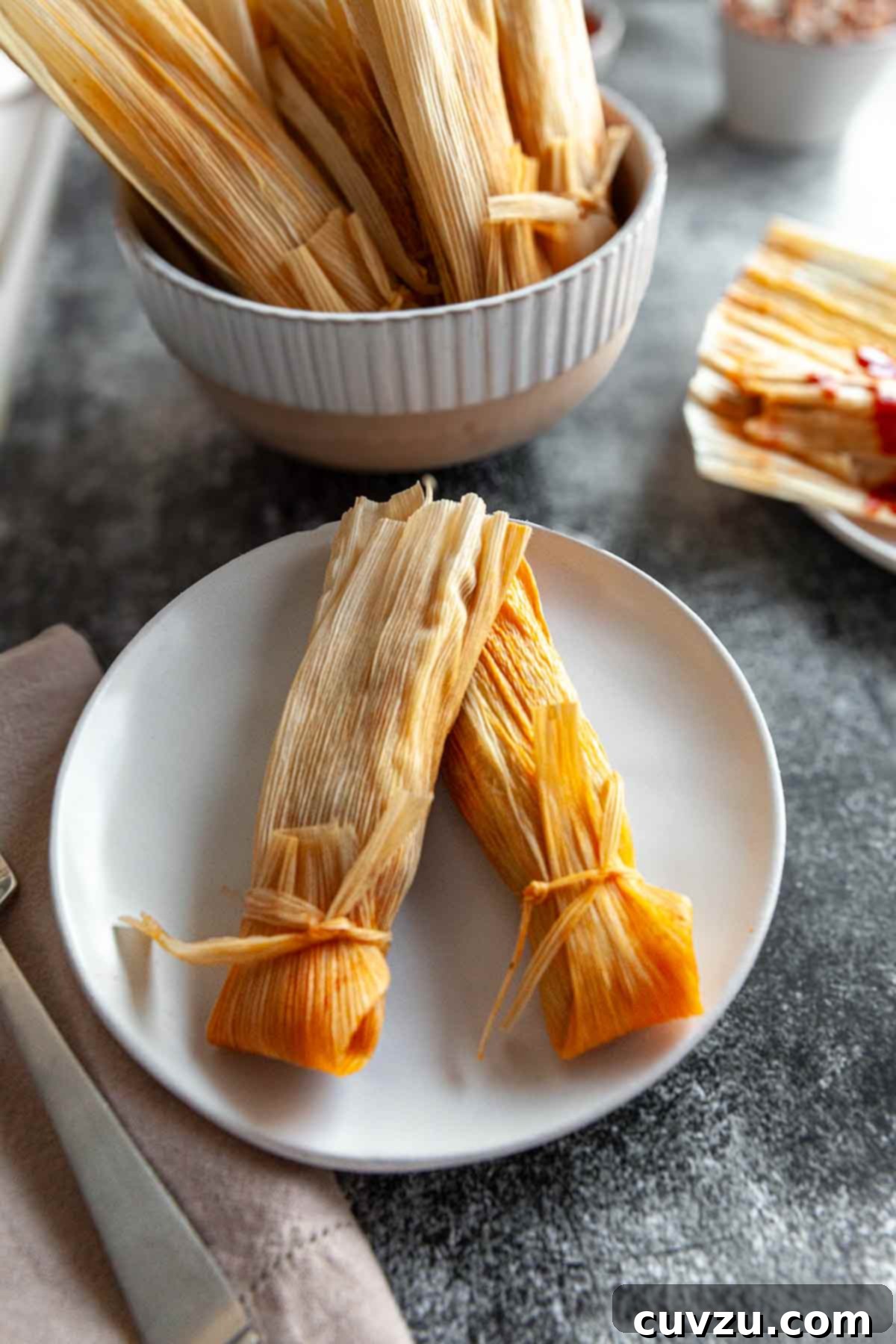
Eating a tamale is a straightforward and enjoyable experience. The corn husk is simply a wrapper and is not meant to be eaten. To enjoy your tamale, carefully unwrap and remove the corn husk from around the masa filling. You can either discard the husk immediately or use it as a convenient, eco-friendly plate. The tender masa filling, with its delicious pork center, can then be eaten with your fingers, or with a fork and knife, depending on your preference and the tamale’s consistency.
Storing, Freezing, and Reheating Your Homemade Tamales
One of the many joys of making tamales is their excellent keeping quality, allowing you to savor their authentic flavors long after they’re made. Proper storage ensures they remain delicious and ready for a quick meal.
Cooked red chile tamales can be refrigerated for up to 3 days. To store them, allow the tamales to cool completely to room temperature. Then, place them in an airtight container or a resealable plastic bag. For longer preservation, tamales freeze exceptionally well for up to 6 months. When freezing, wrap individual tamales tightly in plastic wrap before placing them in a freezer-safe bag or container to prevent freezer burn.
When you’re ready to enjoy frozen tamales, it’s best to let them thaw overnight in the refrigerator before reheating. To reheat both refrigerated and thawed tamales, the steaming method is highly recommended to maintain their moisture and tender texture. Line your steamer basket with a few extra corn husks to protect the tamales and add a touch of flavor. Arrange the tamales in the basket, then set it over a pan of simmering water. Allow the tamales to steam gently until they are thoroughly heated through, which typically takes about 20-30 minutes for thawed tamales, and slightly less for refrigerated ones. This gentle reheating process will bring them back to their original deliciousness.
Pro Tips & Troubleshooting for Tamale Success
Making tamales can seem daunting, but with a few expert tips and common troubleshooting advice, you’ll master this traditional dish in no time. These insights will help you achieve perfect results every time.
- Pork Cooking Time Variance: Be aware that the cooking time for the pork shoulder can vary significantly. Factors like the thickness of your pork butt and its starting temperature will influence how long it takes to become fall-apart tender. The key is patience! The low and slow roasting method is designed to break down tough connective tissues, ensuring you end up with incredibly tender, shreddable meat. Always cook until the internal temperature reaches 195°F (91°C) and the meat easily shreds.
- Utilizing Leftover Pulled Pork Filling: It’s common to have extra red chile pulled pork filling, and that’s a good thing! This flavorful pork is incredibly versatile. It can be transformed into delicious tacos, savory pulled pork sandwiches, enchiladas, or simply served as a topping for a quick and satisfying rice bowl. To store, allow the pork to cool completely, then transfer it to an airtight container or a resealable freezer bag. It can be frozen for up to 3 months, ready to be defrosted and enjoyed whenever a craving strikes.
- Filling Tamales – Smooth Side Up: When spreading the masa dough and pork filling, always ensure you are working on the smooth, inner side of the corn husk. The smooth side allows the cooked tamale to release easily and cleanly from the husk, while the rougher outer side tends to stick. This small detail makes a big difference in the final presentation and eating experience.
- Storing Unused Corn Husks: Don’t discard any unused corn husks! They can be stored in their original plastic bag or a similar airtight container in a cool, dry place for up to 6 months. This ensures you always have them on hand for your next tamale-making adventure or other culinary uses.
- Masa Consistency is Key: The masa dough should be light and fluffy, not dense or sticky. If your masa feels too dry, add a tiny bit more stock, one tablespoon at a time, until it reaches a spreadable consistency. If it’s too wet, you can add a little more masa harina. The perfect masa will have the texture of a soft cookie dough.
- Preventing Dry Tamales During Steaming: To prevent your tamales from drying out during the steaming process, ensure the lid of your steamer is tight-fitting. You can even place a clean kitchen towel between the lid and the steamer basket to trap steam more effectively. Always monitor the water level in the stockpot and replenish it with hot water as needed.
By keeping these tips in mind, you’ll navigate the tamale-making process with confidence, resulting in a batch of delicious, perfectly textured red chile pork tamales.
Explore More Authentic Mexican Recipes
If you’ve fallen in love with the rich flavors of these Red Chile Pork Tamales, you’ll be thrilled to discover more incredible Mexican culinary traditions. Dive deeper into the vibrant and diverse world of Mexican cooking with these other fantastic recipes that will transport your taste buds south of the border:
These recipes offer a delightful exploration of Mexico’s regional specialties, from complex and aromatic mole sauces to the distinctive flavors of cochinita pibil. Expand your culinary repertoire and continue your journey into the heart of Mexican gastronomy.
Share Your Culinary Journey: Write a Review!
We love hearing about your cooking adventures! If you make this Red Chile Pork Tamales recipe, or any other delicious dish from Leite’s Culinaria, we encourage you to share your experience. Please consider leaving a review, a star rating, and even your best photo in the comments section below. Your feedback and creativity inspire us and our community of home cooks. – David
This is THE BEST tamale recipe. I’ve been using it for a couple of years now and always get compliments that they’re “the best tamales they’ve ever had!” Thank you so much for sharing this recipe!
shelly
Red Chile Pork Tamales

These red chile pork tamales are truly the real, authentic Mexican deal. They taste as though they were lovingly crafted by the loveliest abuela imaginable, perfectly spiced and filled with tender pulled pork. Here’s your comprehensive guide to making them at home, step by step, for a deeply satisfying culinary experience.
Recipe by David Leite
Print Recipe
Mains
Mexican
24 tamales
266 kcal
1 hour 30 minutes
7 hours
8 hours 30 minutes
Equipment
- Bamboo steamer or steamer tray for a large stockpot
- Large roasting pan with lid or aluminum foil
- Cast iron skillet or heavy-bottomed skillet
- Blender
- Large stockpot
- Large mixing bowl or stand mixer
- Measuring cups and spoons
- Paper towels
- Clean kitchen towels
- Slotted spoon
- Butter knife or spoon for spreading masa
Ingredients
For the Red Chile Pork Tamales Filling
- 5 pounds pork shoulder (Boston Butt), well-marbled
- 1 tablespoon mild olive oil or vegetable oil, plus more for coating the pork
- 4 tablespoons plus 1 teaspoon kosher salt, divided
- 2 tablespoons chipotle powder
- 14 dried guajillo chiles, seeded and stemmed
- 6 garlic cloves, peeled
- 1 teaspoon ground cumin
- 3 cups cold water
For the Tamale Dough (Masa)
- 3 1/2 cups masa harina
- 2 1/4 cups warm water
- 10 ounces lard or vegetable shortening, at room temperature
- 1 1/2 teaspoons baking powder
- 1 1/2 cups chicken stock or vegetable stock
- 2 teaspoons kosher salt
- 32 dried corn husks, soaked and patted dry
Instructions
Make the Red Chile Pork Tamales Filling
- Pat the pork shoulder completely dry with paper towels. Rub the pork shoulder all over with just enough olive oil or vegetable oil to coat it lightly.
- In a small bowl, combine 4 tablespoons of kosher salt with the chipotle powder. Rub this mixture generously onto all surfaces of the pork, ensuring complete coverage. Let the pork rest at room temperature for 1 hour. Do not exceed 1 hour, as longer resting can draw too much moisture from the pork and make it tough.
- Preheat your oven to 275°F (135°C).
- Place the pork in a roasting pan, fatty side down. Cover the pan securely with a double layer of aluminum foil. Roast for 3 1/2 to 4 hours, or until the pork is fork-tender and falls apart easily, reaching an internal temperature of 195°F (91°C). Remove the pork from the oven and let it rest, still covered, for 30 minutes.
- After the pork has cooled for 30 minutes, use two forks to pull the pork into long strands. Avoid chopping the pork into chunks. Discard any gristle or large pieces of fat. Strain the cooking liquid from the pan and reserve it. You should have approximately 2 to 4 cups (473 to 946 ml) of liquid.
- While the pork is roasting or cooling, heat a cast iron skillet or heavy-bottomed skillet over medium-high heat. Once hot, add the dried guajillo chiles and toast them for about 30 seconds per side, until slightly fragrant and pliable. Be careful not to burn them, as burned chiles will make the sauce bitter.
- Remove the toasted chiles from the pan and place them in a bowl. Add enough hot water to completely submerge the chiles and let them soak for 30 minutes to rehydrate.
- After 30 minutes, use a slotted spoon to transfer the soaked chiles to a blender, discarding the soaking liquid. Add the peeled garlic cloves, ground cumin, the remaining 1 teaspoon of kosher salt, and 3 cups of cold water to the blender. Puree until the mixture forms a completely smooth paste.
- Heat the 1 tablespoon of olive oil in a heavy, large stockpot over medium-high heat until very hot and shimmering. Carefully pour the red chile puree into the pot, stirring immediately and constantly. Be cautious of splattering. Cook the sauce for 2 to 3 minutes, until it thickens and darkens in color.
- Stir the reserved pork drippings and the pulled pork into the pot with the chile sauce. Bring the mixture to a gentle simmer and cook, uncovered, for 15 minutes, allowing the flavors to meld.
- Let the red chile pork filling cool slightly before proceeding to prepare the tamales. The filling can be covered and refrigerated overnight if preparing in advance.
☞ TESTER TIP: This recipe yields a generous amount of red chile pulled pork. You can either plan to make a double batch of masa dough for more tamales or save the leftover pork to serve in soft tortillas, over rice, or in other creative dishes.
Make the Tamale Dough
- In a large bowl or the bowl of a stand mixer, combine the masa harina with 2 1/4 cups of warm water. Stir thoroughly until the mixture forms a solid ball of rehydrated masa. Add the lard (or vegetable shortening), baking powder, chicken or vegetable stock, and 2 teaspoons of kosher salt. Whisk thoroughly by hand or blend on medium speed in a stand mixer for approximately 5 minutes until the dough is light and fluffy. Set the dough aside until ready to assemble.
Assemble the Tamales
- Separate the dried corn husks and place them in a large bowl or your kitchen sink. Add enough warm water to fully submerge them. Let the husks soak for at least 30 minutes until they become soft and pliable.
- Remove the softened husks from the water, separate them completely, and pat them dry with a clean towel.
- Prepare ties for your tamales by tearing several of the husks into strips approximately 1/2 inch (1.3 cm) wide until you have 24 strips. Gently tie a knot at a narrow end of each strip and tear the opposite end lengthwise to create a strip about 12 inches (30.5 cm) long.
- Place a large corn husk on a clean, flat surface with the shortest side facing you and the smooth side facing up. Spoon approximately 1/4 cup (60 grams) of masa dough onto the upper center of the husk. Using a butter knife or the back of a spoon, spread it into a square shape, about 1/4 inch (6 mm) thick, across the width of the husk. Leave about 1/2 inch (13 mm) border on the top and sides of the husk for easier rolling.
- Spoon approximately 2 tablespoons (30 grams) of the pork mixture in an even line along the center of the masa. Gently fold the husk over widthwise to completely encase the filling and form a tight tube. Fold the bottom of the husk up towards the center of the tamale and secure it with one of the prepared corn husk strips. Leave the top of the husk open. Repeat this process with the remaining corn husks and masa dough.
- Fill a large stockpot about 1/4 full with warm water and bring it to a boil over medium-high heat. Line a steamer basket with several unfilled corn husks. Stand the prepared tamales upright in the steamer basket, with the open tops facing towards the top. You can stack the tamales if necessary. Top with additional corn husks.
- Cover the steamer basket with a tight-fitting lid and place it on top of the stockpot with boiling water. Steam the tamales until the masa pulls away easily from the husks, which will take about 1 hour total. Check the water level occasionally and add more hot water as needed.
☞ TESTER TIP: When steaming, drop a clean coin in the pot with the water. As the water boils, the coin will rattle, indicating that there is still enough water. If the rattling stops, it’s time to add more water. Alternatively, set a timer for every 10-15 minutes to check the water level manually.
- Turn off the heat and let the tamales rest in the steamer basket for at least 30 minutes, allowing them to firm up. Then, they are ready to serve and enjoy! (It’s amazing how quickly tamales disappear compared to the time it takes to make them!)
Notes
- Leftover Pork: Any extra pulled pork filling is highly versatile. Use it in tacos, sandwiches, enchiladas, or as a flavorful topping for a rice bowl.
- Filling Tips: For easy release from the corn husk, always spread the masa dough and filling on the smooth, inner side of the husk.
- Storage: Store leftover cooked tamales in an airtight container or resealable bag in the refrigerator for up to 3 days. Reheat gently in a steamer to retain moisture.
- Freezing: Cooked tamales can be frozen for up to 6 months. Wrap individually in plastic wrap, then store in a freezer-safe bag or container. Thaw in the refrigerator before steaming to reheat.

Adapted From
The Gourmet Mexican Kitchen
Buy On Amazon
Nutrition Information
Calories: 266 kcal
Carbohydrates: 15 g
Protein: 13 g
Fat: 17 g
Saturated Fat: 5 g
Monounsaturated Fat: 7 g
Trans Fat: 2 g
Cholesterol: 39 mg
Sodium: 1269 mg
Fiber: 2 g
Sugar: 1 g
Nutrition information is automatically calculated and should only be used as an approximation. Individual results may vary based on ingredient brands and preparation methods.
Recipe Testers’ Reviews
Sandy Owen
OH MY GOODNESS!! These red chile pork tamales were absolutely delicious! Despite my feeble attempt at wrapping, folding, and tying, these red chile pork tamales looked terrific!! And they tasted absolutely fantastic. The taste of the sweet corn masa perfectly balanced the richly seasoned red chile pork filling. The mixture of chile powder and salt for the pork rub was the ideal amount, delivering a robust flavor without being overpowering. Once the pork was thoroughly covered with the chile-salt rub and had come to room temperature, I popped everything in the oven and roasted it for about 4 1/2 hours until it was incredibly tender. I removed it from the oven and let it rest until cool enough to handle, which was a little over an hour.
Shredding the Pork
Shredding the pork took me about 30 minutes. It was a large piece of meat and still quite warm, so it required some effort. While the pork was cooling, I diligently seeded the guajillo peppers and toasted them in a skillet. Although 14 chiles seemed like a considerable amount, I followed the recipe exactly, trusting the process for authentic flavor. After covering the peppers with hot water and letting them sit for 30 minutes to rehydrate, I transferred them to my food processor along with the garlic, cumin, and salt. The addition of water helped loosen the mixture, transforming it into a smooth, sauce-like consistency. I then poured the vibrant red sauce into the pot and stirred constantly as it cooked. It didn’t dramatically change color or thicken up significantly, but the aroma was incredible.
While the meat was cooling, I weighed down the corn husks in water in the sink for about an hour to ensure they were thoroughly softened and pliable. During this time, I also prepared the masa dough. I opted for vegetable shortening instead of lard, and the dough came together very nicely, achieving a light and fluffy texture, even though it was a substantial amount. The masa itself tasted subtly sweet from the corn, a perfect counterpoint to the savory pork.
An Assembly Line is Best for Making Tamales
To tackle the assembly efficiently, I cleared my counter space and meticulously lined up the shredded pork filling, the softened corn husks, and the prepared masa dough in a row, with my steamer pot conveniently placed to the right. Here comes the “fun” part – the assembly! Since this was my first time making tamales, I carefully followed the directions for spreading the masa and filling the husks. My husks were nicely softened, but I did encounter some challenges when spreading the dough; a few husks unfortunately tore. Adding the meat filling was relatively easy, but the wrapping part proved to be a bit of a fiasco for me! I did my best to take my time and carefully fill and wrap each one. I initially attempted to secure them with the strips of husk as instructed, but after a few tries, I stopped trying to tie them altogether. Some of my tamales were fuller than others, and they were certainly in no way uniform in appearance, but I persevered and kept on filling them!
Cooking the Tamales
After stuffing three dozen tamales, my steamer pot was full to the brim, and I still had a good amount of masa dough and pork meat filling left over – a clear sign of the recipe’s generous yield! I steamed the tamales for 55 minutes, carefully checking until the dough pulled away easily from the husks, indicating they were perfectly cooked. I then removed the steamer basket from the heat and allowed the tamales to rest while I finished cleaning up the kitchen. This is undeniably a very time-consuming and fairly labor-intensive dish. By the end, I had more dirty pots, pans, and bowls than I could ever remember having for a single dish!
Next time, I probably will have to consider cutting the recipe in half. Or, perhaps, I’ll strategically invite friends and family over to help with both the cooking process and, more importantly, the joyful devouring of these magnificent tamales!