Classic French Madeleines: The Ultimate Recipe for Perfect Shell-Shaped Cakes
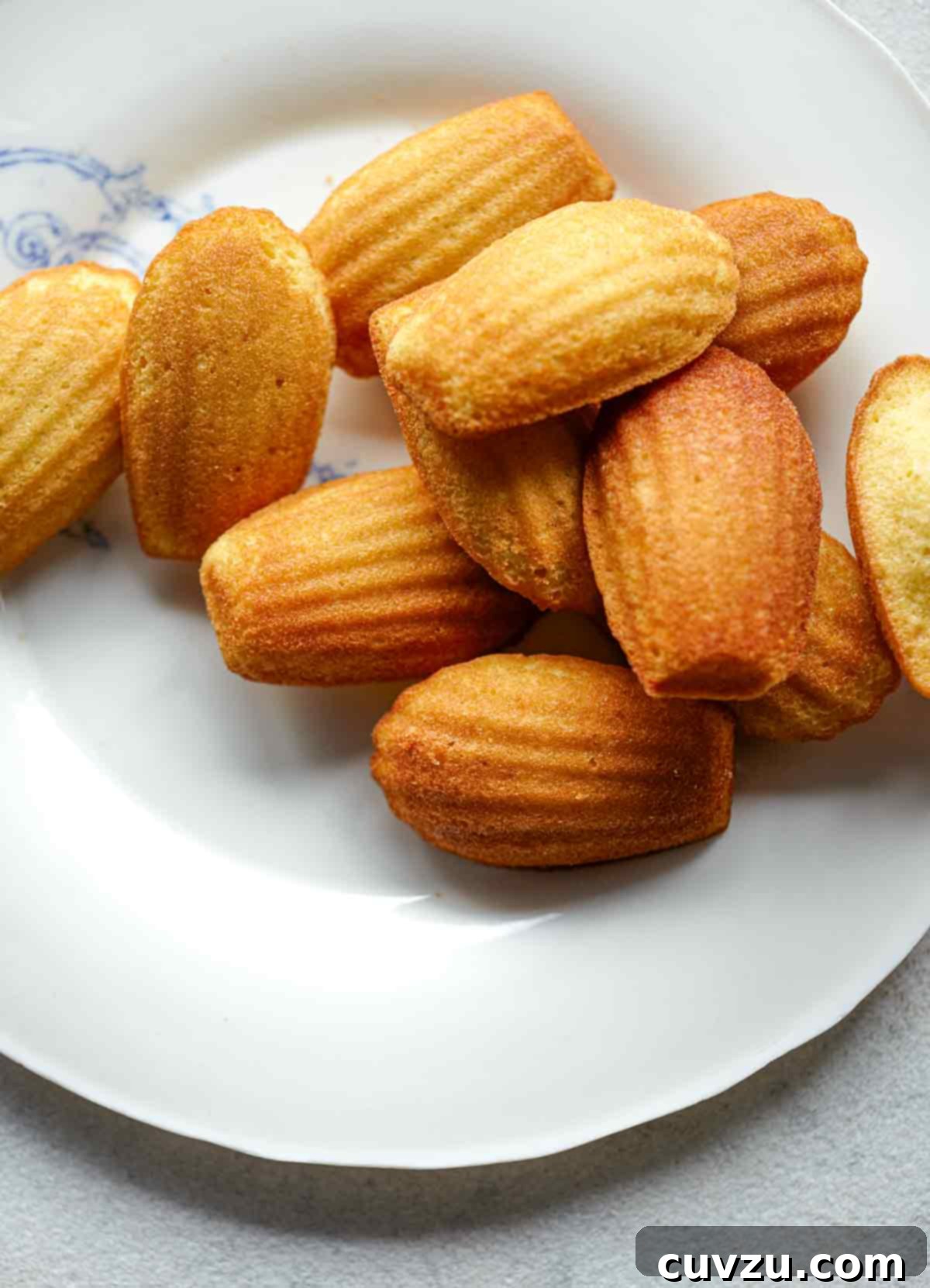
Discover the enchanting world of Madeleines, those exquisite French butter cakes with a distinctive scallop shape and a tender, melt-in-your-mouth crumb. Crafted from a delicate blend of flour, rich butter, fine sugar, a hint of lemon, and aromatic vanilla, these iconic treats are more than just a dessert; they are a timeless emblem of French patisserie, inviting bakers and tasters alike on a culinary journey.
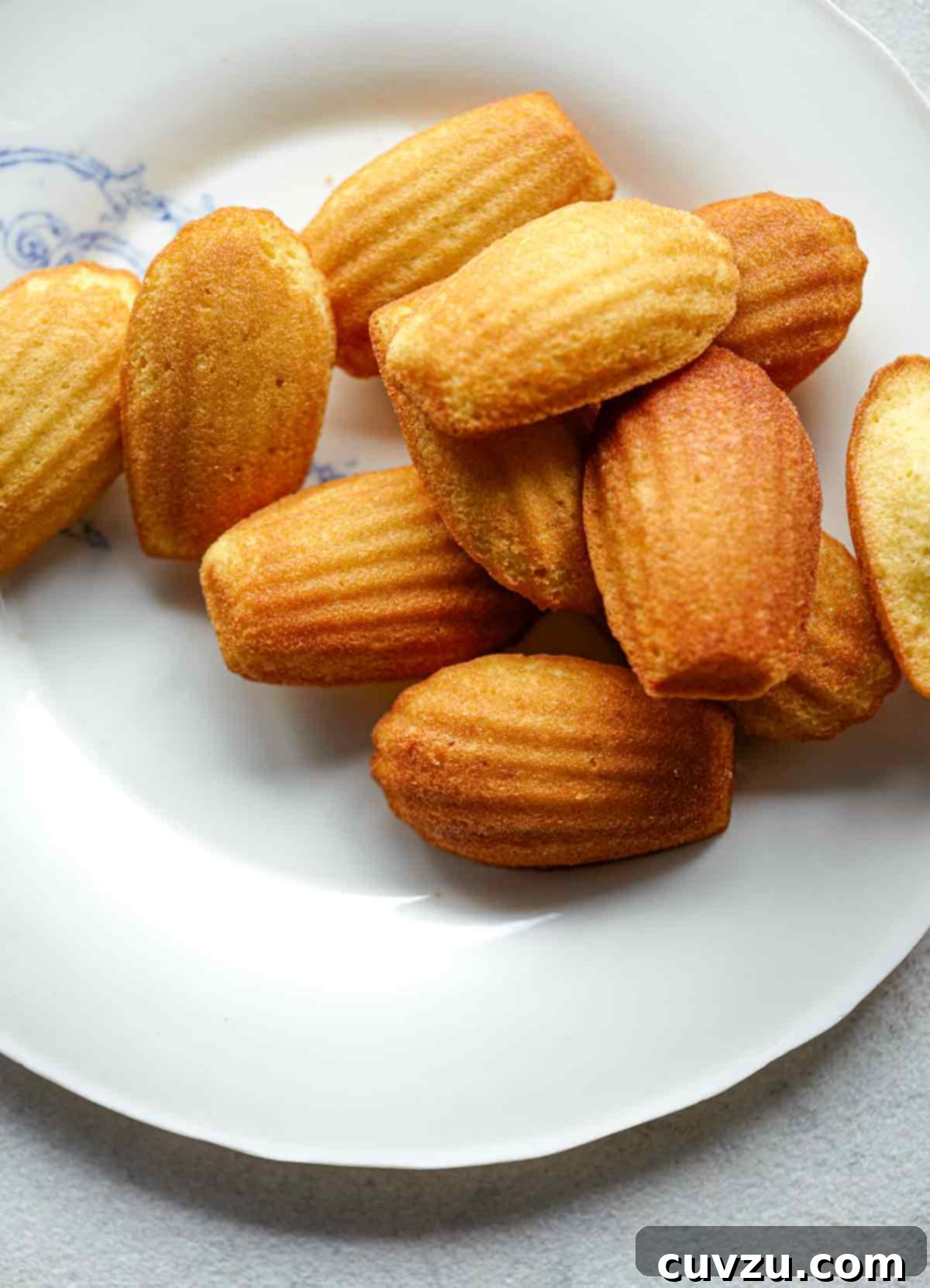
These irresistibly tender mini cakes owe their delicate structure to a special technique known as a génoise batter. This method involves carefully folding melted butter into a light, airy base of whisked eggs, sugar, and flour. But what truly sets a Madeleines apart from a simple sponge cake is its iconic feature: the beautiful, characteristic bosse, or dome, that rises proudly from its center during baking. Achieving this perfect hump is the hallmark of a masterfully baked Madeleine, a testament to the baker’s skill and understanding of the subtle science involved.
For many, the mention of Madeleines immediately conjures images of Marcel Proust’s seminal work, “Swann’s Way,” where the taste of a Madeleine dipped in tea triggers a flood of involuntary memories. This literary connection elevates the humble cake to a symbol of nostalgia and sensory awakening. And while Proust’s “madeleine” might have been a metaphor for memory itself, for true connoisseurs of French baking, our Madeleines is indeed *the* Madeleine—the delicate, buttery pastry that brings pure joy with every bite. If you’re one of those whose heart beats for this quintessential French delight, this recipe, shared by renowned pastry expert Annie Bell, is for you.

Classic French Madeleines
These exquisite Madeleines are classic French butter cakes, meticulously crafted with flour, butter, sugar, lemon, and vanilla. Representing French baking at its finest, they are incredibly tender, delicately sweet, and feature the signature domed top. Perfect for any occasion, these Madeleines offer a taste of timeless French elegance.
Recipe by David Leite
Dessert
French
12 to 24 Madeleines
126 kcal per serving
20 minutes
10 minutes
2 hours (minimum)
2 hours 30 minutes
Equipment
- 2 madeleine pans (traditional scallop shape recommended) or 2 nonstick mini-muffin pans.
Ingredients
- 2 large eggs, at room temperature (essential for proper whisking).
- 1/2 cup superfine sugar (alternatively, finely blitz granulated sugar in a blender until fine but not powdery).
- 1 tablespoon honey (adds a subtle depth of flavor and moisture).
- 1/2 teaspoon vanilla extract (for classic aroma; consider homemade vanilla for best results).
- Pinch of fine sea salt (enhances all flavors).
- 3/4 cup all-purpose flour.
- 1 level teaspoon baking powder.
- 5 3/4 tablespoons unsalted butter, melted, plus extra for greasing the pans.
- Confectioners’ sugar, for dusting (optional, but highly recommended for presentation).
Instructions
- Prepare the Batter: In a large mixing bowl, combine the room temperature eggs, superfine sugar, honey, vanilla extract, and a pinch of fine sea salt. Using an electric mixer on medium-high speed, whisk these ingredients vigorously for 5 to 8 minutes. The mixture should become very pale, thick, and at least double in volume, forming what is known as a ribbon stage. This aeration is crucial for a light Madeleines.
- Incorporate Dry and Wet Ingredients: In a separate small bowl, sift together the all-purpose flour and baking powder. Gently fold this dry mixture into the whisked egg mixture until just combined, being careful not to deflate the air you’ve incorporated. Next, gradually fold in the melted butter until the batter is smooth. Avoid overmixing to prevent a tough texture.
- Chill the Batter: Cover the bowl tightly with plastic wrap and refrigerate the batter for a minimum of 1 hour, or ideally, overnight. This chilling period is vital for developing flavor and, more importantly, for achieving the iconic “bosse” (hump) during baking.
- Preheat Oven and Prepare Pans: Approximately 20 minutes before baking, preheat your oven to a high temperature of 475°F (246°C). Generously butter your Madeleines pans (or mini-muffin pans) and then place the buttered pans into the freezer. The extreme temperature contrast between the cold batter and hot, cold pans is key to the Madeleines’ signature dome.
- Fill and Bake (Initial Phase): Once the oven is preheated and pans are chilled, remove the Madeleines batter from the refrigerator. Give it a gentle stir to ensure consistency. Using a teaspoon or small scoop, fill each mold cavity approximately three-quarters full. Immediately place the trays into the preheated oven. As soon as the pans are in, *reduce the oven temperature to 425°F (218°C)* and bake for 4 minutes. During this initial intense heat phase, you will observe a “dip” forming in the center of the cakes, which is the beginning of the desired domed bump.
- Continue Baking (Second Phase): After the initial 4 minutes, *lower the oven temperature further to 375°F (191°C)*. Continue baking for an additional 3 to 5 minutes. Watch carefully until a beautiful, distinct dome has formed in the center of each Madeleines, the batter is set, and the edges of the cakes are wonderfully golden brown.
- Cool and Serve: Promptly remove the pans from the oven. While still warm, carefully run a thin knife around the edge of each Madeleines to loosen it, then gently remove them from the molds. Allow them to cool slightly on a wire rack. Madeleines are truly at their peak when served slightly warm, offering a delicate texture and rich aroma. If desired, lightly dust with confectioners’ sugar just before serving for an elegant finish. Any leftover Madeleines can be stored in an airtight container for a couple of days and are still delightful, especially for dipping into tea, à la Proust.
Baker’s Notes & Tips
The Secret to the Perfect Madeleine “Bosse” (Dome)
Achieving the coveted “bosse” is perhaps the most defining characteristic of a perfect Madeleine. This delightful hump is primarily a result of a significant temperature differential. By chilling the batter thoroughly and then placing it into a very hot oven with equally cold pans, you create a thermal shock. The cold batter slowly warms, and the exterior sets quickly, trapping steam inside and forcing the center to rise dramatically into that iconic dome. This is somewhat counterintuitive to baking most cakes, where an oven that’s too hot can cause an undesirable upward bolt; here, it’s precisely the desired effect. Allowing the batter to rest for an hour, or even better, overnight in the refrigerator, is crucial for both flavor development and promoting that magnificent rise.
Room Temperature Eggs
Using eggs at room temperature is not merely a suggestion; it’s a technique that greatly impacts the volume and texture of your batter. Room temperature eggs whisk up much easier and incorporate more air than cold eggs, leading to a lighter, more voluminous génoise base. If you’re short on time, simply place your eggs in a bowl of warm tap water for 5-10 minutes before use.
Superfine Sugar vs. Granulated Sugar
Superfine sugar dissolves more quickly and evenly into the egg mixture, contributing to a smoother batter and a finer crumb. However, if you only have granulated sugar on hand, a quick pulse in a blender until it’s finely ground (but not powdered) will work perfectly well.
Chilling the Batter and Pans
As mentioned, the chill is paramount. A well-chilled batter, combined with buttered and frozen pans, helps create that initial crust that allows the interior to push up into a dome. Don’t skip this step!
Don’t Overbake!
Madeleines bake quickly, and their delicate texture can easily be lost if overbaked. Keep a close eye on them during the second baking phase. They should be golden at the edges and spring back lightly when touched. A few extra minutes can turn them from tender to dry.
Adapted From
Annie Bell’s Baking Bible
Buy On Amazon
Nutrition Facts
Calories: 126 kcal
Carbohydrates: 16 g
Protein: 2 g
Fat: 6 g
Saturated Fat: 4 g
Monounsaturated Fat: 2 g
Trans Fat: 0.2 g
Cholesterol: 45 mg
Sodium: 13 mg
Fiber: 0.2 g
Sugar: 10 g
Nutrition information is automatically calculated and should be used as an approximation only.
Tried this delightful recipe? Share your creations with us! Mention @leitesculinaria or tag #leitesculinaria on Instagram. We love to see your baking success!
Insights from Our Recipe Testers
Our dedicated team of recipe testers put this Madeleines recipe through its paces, offering valuable feedback and clever tips to ensure your baking success. Here’s what they discovered:
Dawn English
Dawn found these Madeleines to be wonderfully “warm, buttery, airy, delicate little cakes” and was surprised by their simplicity. She noted that using room temperature eggs for easier whipping and freezing the madeleine molds before baking were excellent tips for ensuring a beautiful rise. Even without superfine sugar, her Madeleines were delicious. Her only suggestion was to let them bake until truly golden brown for a more defined scallop shape.
Elie Nassar
Elie praised the recipe for yielding “wonderful and VERY addictive little cakes with cute bumps” in no time. He appreciated the straightforward vanilla flavor, describing them as “sweet but not cloying, redolent with vanilla, tender, and buttery.” Using a nonstick baking spray, his Madeleines came out effortlessly, and his preferred way to enjoy them is cooled and dipped in black coffee – a truly addictive combination!
Lori Widmeyer
Lori, a proud owner of a madeleine pan, loves finding new recipes for these “pretty little treats.” She noted how the batter, initially thin, thickened considerably after chilling, holding its shape when scooped. She carefully spread the batter to ensure uniform treats, which puffed up beautifully. Lori suggests exploring variations like almond extract, lemon zest, or a chocolate drizzle, highlighting the recipe’s versatility as a “good base.” She confirmed they are perfect for tea parties or lighter desserts.
Tamiko Lagerwaard
Tamiko found these Madeleines to be “delightful, moist, tender little morsels of cake-y heaven.” She praised the interesting oven temperature technique, which helped her achieve the “lovely little dome that has previously eluded me!” As a gluten-free baker, she successfully adapted the recipe using her GF flour blend and added lemon zest, which she highly recommends. She plans to try a chocolate version next, emphasizing their “immediate inhalation” quality.
Larry Noak
Larry described this as a “simple, nice Madeleines recipe” that works perfectly, even in a mini-muffin pan. He noted that the cakes were not overly sweet, making them an ideal accompaniment for his often-sweet coffee. He also speculated that the recipe could easily be adapted to make a simple nine-inch cake with a dusting of confectioners’ sugar, highlighting its versatility.
Sita Krishnaswamy
A seasoned Madeleines baker for over 20 years, Sita was excited by this new addition to her repertoire. She awarded it a “TC” (Tester’s Choice) but with a crucial caveat: bakers should adjust oven temperature. In her oven, the Madeleines became “a bit too brown and a bit crisp.” However, she confirmed that chilling the dough for over 6 hours produced “a fabulous dome and the flavor of the honey came through beautifully.” She considers it a keeper, with a slight oven adjustment.
Martha T.
Martha found the batter for these Madeleines “delicious and came together very easily.” Her lemon zest version was “light and moist,” making it a perfect choice for entertaining. Her only critique was that they tend to harden if left out for more than a couple of hours, becoming better suited for dunking than snacking. This highlights the importance of enjoying them fresh or storing them properly.
Steve Dunn
Steve, a Le Cordon Bleu alumnus who learned Madeleines in Paris, attests that this recipe “stood up quite well” to his tried-and-true method. He strongly recommends buttering and flouring standard (nonstick) molds for easy release. He also shared a clever tip: pipe the chilled batter from a disposable piping bag for a much easier and neater approach than spooning. While his first batch lacked the signature “bosse,” his second, baked after the batter warmed slightly to room temperature, turned out perfectly. He suggests allowing the batter to warm for about half an hour after chilling to ensure that iconic hump. He also plans to add a hint of lemon zest next time for an extra touch of citrus.
Elsa M. Jacobson
Having never made Madeleines before, Elsa was pleasantly “surprised by how easy they were!” She carefully buttered and floured her pans, ensuring easy removal of the perfectly shaped cakes. As a purist, she first tried them unadorned, which she preferred, but found the confectioners’ sugar dusting added a festive touch that remained appealing even the next day. A self-proclaimed tea drinker, she enjoyed them “Proustian fashion” with tea and loved the added “lemony goodness from the zest in the batter,” despite her purist tendencies. Elsa’s experience is a wonderful testament to the recipe’s accessibility for first-time Madeleines bakers.
These collective insights underscore the importance of proper chilling, oven temperature management, and the joy of experimenting with subtle flavor additions. Whether you’re a seasoned baker or new to the world of Madeleines, this recipe provides a fantastic foundation for creating these enchanting French delicacies.