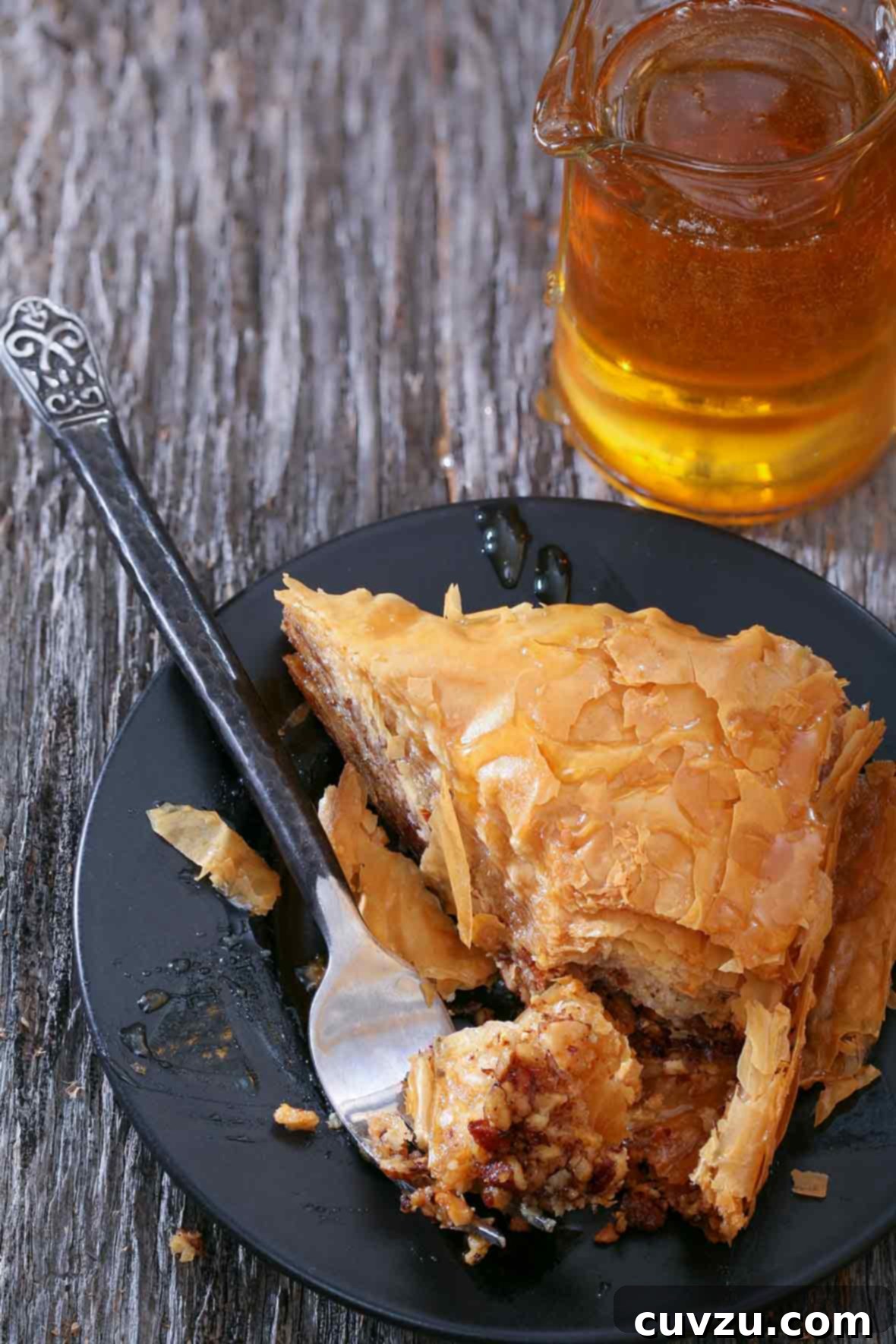
Baklava, a timeless Middle Eastern dessert, finds one of its most celebrated forms in Greek cuisine. This exquisite treat is meticulously crafted from numerous delicate layers of phyllo pastry, generously filled with a fragrant mixture of chopped walnuts, aromatic cinnamon, and sugar, all bound together with golden melted butter. After baking to a crisp, golden perfection, it’s bathed in a luscious honey syrup, creating a symphony of textures and flavors that is truly irresistible. Each bite offers a satisfying crunch followed by a tender, nutty interior and a sweet, sticky finish that lingers delightfully on the palate.
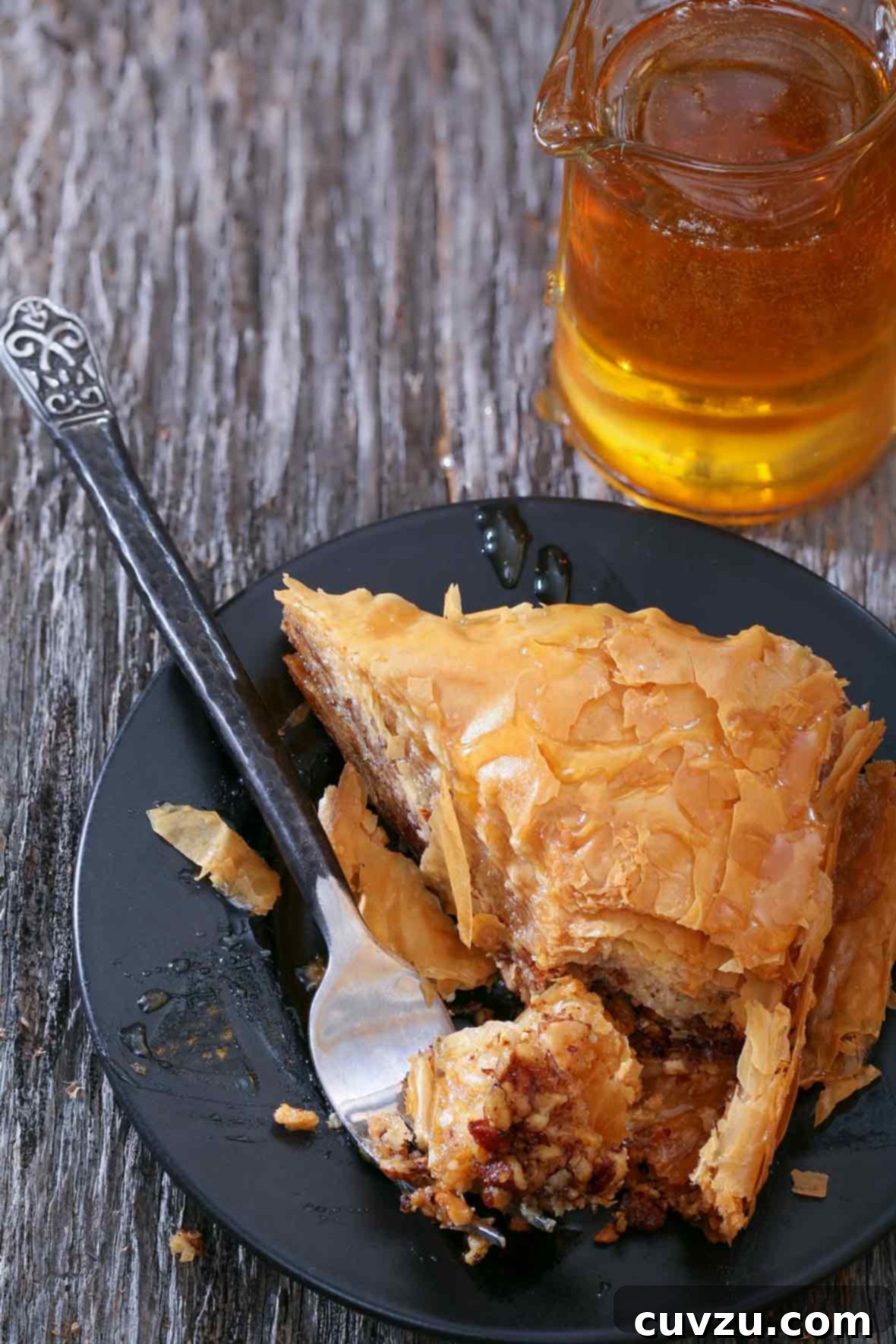
Decades ago, I stumbled upon an unforgettable culinary moment while wandering through the charming backstreets of a Greek town. The air was thick with an intoxicating sweetness, drawing me in until I found its source: a small house where a frail, wrinkled grandmother was expertly pulling sheet pans of baklava from a hot oven. The memory of those crackly shards of phyllo, utterly drenched in honey, remains vivid – it was, without a doubt, the finest baklava I have ever tasted. While this recipe may not be hers, nor will it instantly transport you to the sun-drenched Greek Isles, it promises to deliver a profound sense of satisfaction, touching something deep within your soul. Prepare to embark on a culinary journey that honors the spirit of this cherished Greek tradition.
Authentic Greek Baklava: A Step-by-Step Guide
Greek Baklava stands as a true emblem of Mediterranean hospitality and culinary artistry. This classic dessert isn’t just food; it’s a celebration, a labor of love, and a testament to generations of tradition. Its layers tell a story of careful preparation, rich flavors, and the warmth of shared moments. While often considered a complex pastry, this recipe simplifies the process, making it accessible for home bakers to create a show-stopping dessert that tastes as though it came straight from a Hellenic kitchen.
The Enduring Legacy of Baklava
The origins of baklava are often debated, with roots stretching across the Middle East, the Ottoman Empire, and various Mediterranean cultures. However, its presence in Greek cuisine is undeniable and deeply ingrained. Historically, it was a dessert reserved for special occasions and holidays, symbolizing prosperity and joy. Each country and region has its unique spin on baklava, from the types of nuts used (pistachios, almonds, walnuts) to the spices and syrup variations. Greek baklava typically features walnuts and cinnamon, along with a honey-infused syrup, giving it a distinctive flavor profile that is both comforting and exotic.
The process of making baklava, though seemingly intricate, is a rewarding experience. It involves careful layering, precise baking, and the crucial step of saturating the hot pastry with cool syrup – a technique that ensures maximum absorption and that signature sticky-sweetness without making the phyllo soggy. This recipe draws inspiration from traditional methods, aiming to capture the essence of what makes Greek baklava so beloved: its golden crispness, its aromatic nut filling, and its irresistible honeyed glaze.
Tips for Baklava Success
Achieving perfect baklava requires attention to detail, but it’s far from impossible. Here are some essential tips to guide you:
- Handle Phyllo with Care: Phyllo dough is notoriously delicate and dries out quickly. Thaw frozen phyllo in the refrigerator overnight, then bring it to room temperature for about an hour before using. Keep unused sheets covered with a damp (but not wet) kitchen towel to prevent them from drying and cracking while you work.
- Butter, Butter, Butter: A generous amount of melted unsalted butter is key to baklava’s flaky texture. Don’t skimp! Brushing each layer, or every other layer, ensures even browning and crispness. Some recipes call for clarified butter, which has a higher smoke point and yields an even richer flavor, but regular melted butter works wonderfully.
- The Right Nut Texture: The walnuts should be finely chopped but not pulverized into a paste. You want some texture in the filling. A food processor can make quick work of this, but be careful not to overprocess.
- The Hot and Cold Syrup Rule: This is perhaps the most critical tip for perfectly syrupy baklava. The baklava must be hot out of the oven, and the syrup must be at room temperature (or slightly warm, but definitely not hot). Pouring cool syrup over hot baklava allows the pastry to absorb the liquid without becoming mushy, resulting in that delightful balance of crispy and moist.
- Precise Cutting: Cutting the baklava before baking helps the syrup penetrate all the layers evenly. Use a sharp knife and make clean cuts all the way through to the bottom of the pan. Diamond shapes are traditional and aesthetically pleasing, but squares work just as well.
- Patience is a Virtue: While the baking and preparation are relatively quick, baklava benefits immensely from resting. Allow it to cool completely at room temperature for several hours, or even overnight, for the flavors to meld and the syrup to fully saturate the pastry.
Recipe: Classic Greek Baklava
Greek Baklava
This Greek baklava, a cherished Middle-Eastern dessert, is meticulously made from layers of delicate phyllo pastry. It’s generously filled with a delightful mixture of chopped walnuts, aromatic cinnamon, and sugar, all enriched with melted butter, and finally soaked in a sweet honey syrup.
Authored by David Leite
Course: Dessert
Cuisine: Greek
Servings: 16 to 18 servings
Calories: 361 kcal per serving
Prep Time: 45 minutes
Cook Time: 1 hour
Total Time: 1 hour 45 minutes
Ingredients
For the syrup
- 1 cup granulated sugar
- 1 cup honey
- 1 cup water
- 1 tablespoon fresh lemon juice
For the filling
- 2 cups walnuts, finely chopped but not pulverized
- 1/2 teaspoon ground cinnamon
- 3 tablespoons granulated sugar
- 2 sticks unsalted butter, melted
For the pastry
- 1/2 pound phyllo dough (approximately 20-24 sheets, depending on thickness)
Instructions
Make the syrup
- Combine the granulated sugar, honey, water, and fresh lemon juice in a medium saucepan.
- Bring the mixture to a boil over medium heat, then reduce the heat to a simmer. Let it gently simmer until the syrup thickens slightly and reduces, which typically takes about 12 minutes.
- Remove from heat and set aside at room temperature. The syrup should be cool to the touch and still pourable when you’re ready to use it. If it becomes too thick or solidifies, gently reheat it over low heat until it returns to a pourable consistency.
Make the filling
- In a bowl, thoroughly mix together the finely chopped walnuts, ground cinnamon, and 3 tablespoons of granulated sugar.
- Set the filling mixture aside until needed.
Assemble and Bake the Baklava
- Preheat your oven to 350°F (175°C).
- Lightly brush the bottom and all sides of a 9-by-13-inch baking dish with some of the melted unsalted butter.
- Carefully lay one sheet of phyllo dough in the bottom of the prepared dish. Top with another sheet of phyllo, then lightly brush the surface of the second sheet with melted butter.
- Continue this layering process, adding one sheet of phyllo at a time and brushing every other sheet with butter, until you have a base stack of 6 phyllo sheets.
- Evenly spread one-third of the walnut-cinnamon filling mixture over the top of the buttered phyllo layers.
- Repeat the phyllo layering: place another 6 sheets of phyllo, brushing every other sheet with butter as before. Spread another one-third of the filling evenly over these layers.
- Repeat this process one final time, layering another 6 phyllo sheets (brushing every other with butter), and then spread the remaining one-third of the walnut-cinnamon filling. You should now have three distinct layers of nut filling.
- To complete the top, place the remaining 6 phyllo sheets, again brushing every other sheet with melted butter. Ensure the very top layer of phyllo is also generously brushed with butter.
- Using a very sharp knife, carefully cut through all the layers down to the bottom of the dish. You can create 16 to 18 diamond-shaped sections or simply make 1 1/2-inch square sections. This pre-cutting is crucial for the syrup to penetrate evenly.
- Place the baking dish in the preheated oven and bake for 20 minutes.
- After 20 minutes, remove the baklava from the oven and carefully pour any remaining melted butter evenly across the top.
- Return the baklava to the oven and continue baking for another 25 minutes, or until the top is a beautiful pale golden brown and wonderfully crispy.
- Remove the baklava from the oven and let it sit for about 5 minutes, allowing any sizzling to subside.
- While still warm (but no longer bubbling), gently tilt the pan and carefully pour off any excess butter that may have pooled at the edges.
- Immediately begin pouring the room-temperature honey syrup over the warm baklava. Make sure to pour the syrup in between the pre-cut sections and around the edges, allowing it to soak into all the layers. Be careful to avoid pouring too much directly onto the very top surface, as this can make it soggy.
- Set the baklava aside at room temperature and allow it to cool completely. This resting period is vital for the flavors to meld and for the syrup to fully absorb, typically taking several hours or even overnight.
To serve
- Once completely cool, lift out the individual baklava pieces along the pre-cut lines.
- Serve immediately, or cover and store at room temperature for up to 5 days. Baklava does not require refrigeration.
Serving and Storing Your Homemade Baklava
Baklava is best enjoyed at room temperature, allowing its complex flavors to shine. It pairs wonderfully with a strong Greek coffee, a cup of tea, or a scoop of vanilla ice cream for an indulgent treat. For storage, keep the baklava covered in an airtight container at room temperature. It will remain fresh and delicious for up to 5 days, often improving in flavor as the syrup continues to permeate the layers. Avoid refrigerating baklava, as the cold can cause the phyllo to become stiff and the syrup to crystallize. If you wish to freeze baklava, it’s best to do so before adding the syrup. Wrap the baked and cooled pastry tightly, then thaw and add the warm syrup just before serving.
Beyond the Classic: Exploring Baklava Variations
While this recipe celebrates the classic Greek walnut baklava, the world of baklava offers endless possibilities for customization. Feel free to experiment with different nuts such as pistachios, almonds, or a combination of nuts. You can also play with the spice profile, adding hints of nutmeg, cardamom, or even a touch of orange blossom water or rosewater to the syrup for a more Middle Eastern flair. A sprinkle of orange zest in the nut mixture or the syrup can also add a bright, citrusy note that complements the honey beautifully.
Adapted From
The Armenian Table by Victoria Jenanyan Wise
Buy On Amazon
Recipe Testers’ Reviews
Susan Hillery
Having been spoiled and awed by countless Turkish friends’ excellent baklava, I never thought that I would attempt it myself. This recipe for Greek baklava was so easy and such a gratifying experience, and the baklava was great! Textures of crunchy and chewy are mellowed by a thick, sweet syrup that only got better as it aged.
Another Enthusiastic Tester
I really enjoyed this recipe. It took a day for the flavors to meld to make it taste of authentic baklava. It was extremely easy and sinfully tasty.
Nutrition Information
Serving: 1 portion
Calories: 361 kcal
Carbohydrates: 42 g
Protein: 3 g
Fat: 22 g
Saturated Fat: 8 g
Monounsaturated Fat: 5 g
Trans Fat: 1 g
Cholesterol: 30 mg
Sodium: 72 mg
Fiber: 1 g
Sugar: 33 g
Nutrition information is automatically calculated and should only be used as an approximation. Actual values may vary based on specific ingredients and preparation methods.
We hope you enjoy making and savoring this delightful Greek Baklava. This dessert is more than just a sweet treat; it’s an experience, a taste of rich history, and a testament to the simple joy of home baking. Whether for a special occasion or a quiet indulgence, homemade baklava is sure to impress and satisfy. Happy baking!