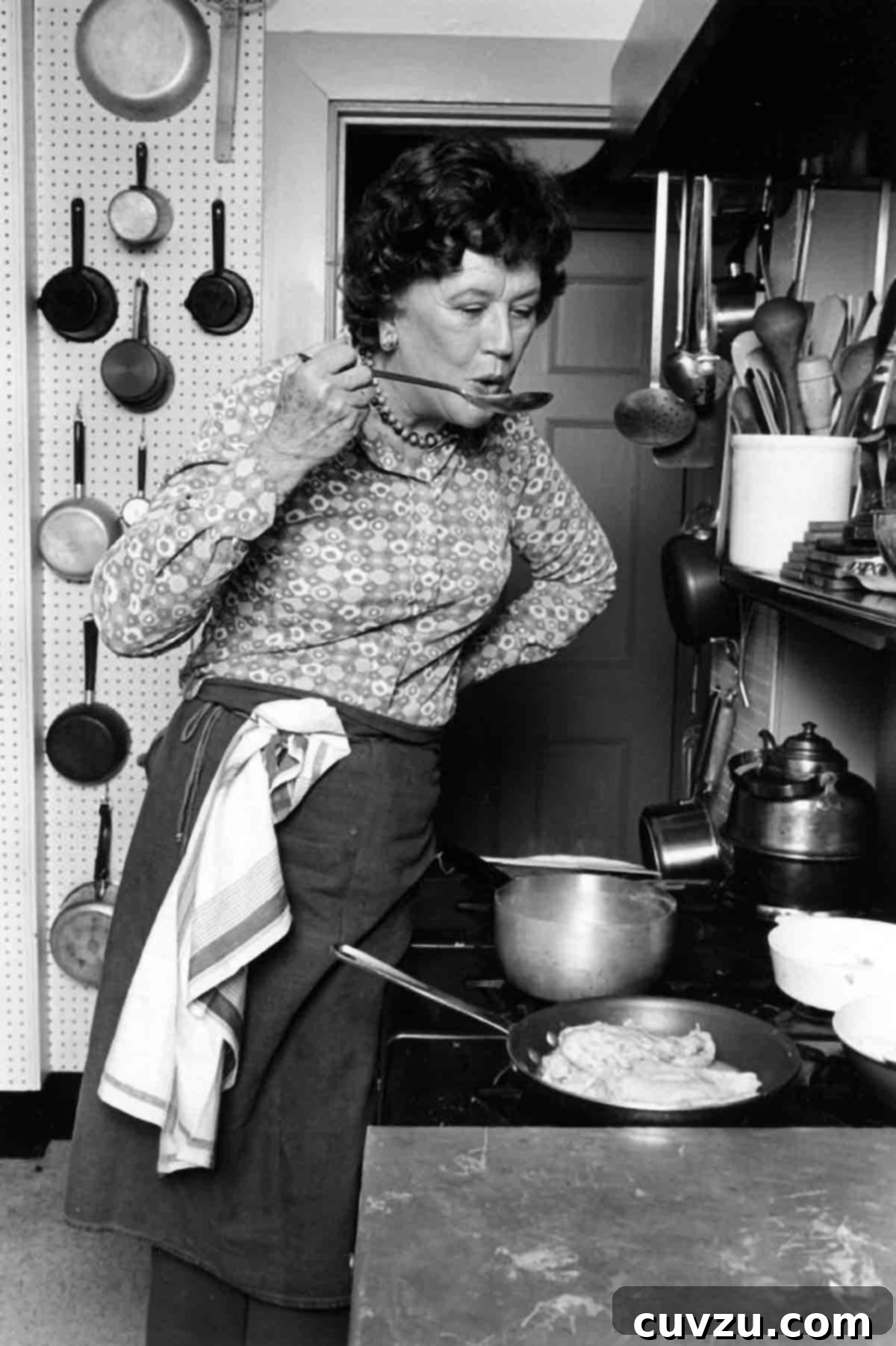
The captivating new HBO Max series “Julia,” which beautifully chronicles the pioneering spirit behind her iconic WGBH television show “The French Chef,” has stirred a profound wellspring of memories for me. These recollections range from the deeply delightful to moments of stark, profound sadness, some even downright bleak. The series, with its vibrant portrayal of Julia Child’s unwavering passion and transformative impact, acts as a powerful lens, bringing my complex past into vivid focus once more.
For me, the essence of Julia Child will forever be a rich tapestry woven with threads of pure joy, genuine delight, pervasive sadness, and crippling anxiety. During my preteen years, I experienced a disquieting disconnect, as if my brain had come unplugged from my very consciousness. My body often felt engulfed by an indescribable, suffocating blackness, an internal void that seemed to swallow all light and hope. All my desperate attempts to articulate this profound despair fell on deaf ears; my words seemed to dissolve before they could convey the depth of my anguish. My loving parents tried their best to understand, to reach me, but after months of witnessing my unexplained distress and feeling utterly at a loss, my father’s gentle but firm words echoed in my ears: “Son, everyone has to cope. You’re just going to have to cope.” His well-intentioned advice, meant to offer strength, instead left me feeling even more isolated.
“Cope.” To this very day, the sound of that word, the very idea it represents, continues to ignite a fierce, enduring hatred within me. It felt like a dismissal, a command to simply endure suffering without genuine understanding or a path to healing. It signified a solitary struggle, a burden I was expected to bear alone.
Two agonizing years of “coping” stretched before me, each day an internal battle. The weight of my undeclared illness became unbearable, driving me to a breaking point where I threatened suicide unless I could finally see a therapist. My parents, shocked and galvanized by the severity of my plea, immediately found me an excellent doctor, a kind and dedicated professional. Yet, despite his best efforts and our many sessions, he never truly uncovered the underlying cause of my profound distress. The true revelation, the diagnosis that finally explained decades of inexplicable pain, would not come for another 20 years or so, when I received the life-altering diagnosis of bipolar II disorder.
This particular essay, originally penned in 2014, marked one of my very first courageous attempts to articulate the complex cascade of emotions and experiences that had defined my life for so very long. It was a raw, honest outpouring, an effort to give form to the formless suffering of my past. The overwhelming response to this story – not just in the comments section but also through a deluge of letters, both electronic and traditional snail mail – profoundly impacted me. It was this powerful connection with readers, a shared understanding that transcended my own experience, that sparked a crucial realization: perhaps I had something truly meaningful to say. This feeling was not unlike the powerful sense of purpose Julia herself must have felt upon learning of the 23 heartfelt letters from her viewers, a testament to her profound impact. Three years later, inspired by this newfound voice, my book, “Notes on a Banana: A Memoir of Food, Love, and Manic Depression,” was published, offering a much deeper dive into my journey. This essay, a foundational piece, appears within its pages almost word for word, a testament to its enduring power and honesty.
Like countless others, I developed a deep and abiding love for Julia Child, primarily for the invaluable culinary lessons she imparted in the kitchen. As I watch the HBO Max series “Julia” now, I find myself laughing alongside The One, my partner, at her plucky perseverance, her endearing clumsiness, and her often trumped-up antics. She was a force of nature, an inspiration in her own right. But beyond the laughter and culinary admiration, I also offer a silent, heartfelt prayer of thanks to her, a gesture conveyed through the wonderful portrayal by Sarah Lancashire. My gratitude extends not just for her culinary legacy, but for what she unknowingly did for the sad, lost boy I once was, offering him a momentary refuge and a glimmer of hope during his darkest hours. Her presence, even on a screen, was a lifeline I never knew I needed.–David
My heavy backpack, laden with school books, lay slumped and unopened against the plush upholstery of my father’s familiar La-Z-Boy recliner. My Top-Siders, worn smooth from countless summer adventures, sat discarded and pigeon-toed near the breezeway door, where I had mindlessly stepped out of them just moments before. Oblivious to the demands of homework or the lure of the outdoors, I curled up on the cool floor directly in front of the television, tucking my head deep into the protective crook of my elbow. This posture was a deliberate shield, designed to prevent my mother from studying my face too closely, from discerning the subtle, tell-tale signs that the overwhelming internal darkness was once again descending upon me.
Outside, carried on the gentle breeze through the open windows, I could distinctly hear the joyous cacophony of the neighborhood kids at play. The cheerful shouts of the Jenningses, the boisterous laughter of the Freeborns, the distant calls of the Medeiroses—all reminders of a world I felt utterly alienated from. Please don’t make me go outside, I silently begged my mother in my head, a desperate plea echoing in the confines of my troubled mind. I just can’t do it. I simply don’t have the energy, the will. The outdoors, typically a haven for children, consistently unsettled me. The vast, bright sky, the meticulously manicured backyard with its lawn like a perfectly crocheted green quilt, the lively street teeming with neighborhood kids—a 12-year-old’s rightful, assumed place—all terrified me. It offered no solace, no pleasure, and instead served as a brutal, constant reminder of just how profoundly troubled I was, how different I felt from everyone else.
With a desperate urgency, I reached out and cranked the clunky dial on our old Motorola black-and-white television, meticulously searching for channel 2, the revered WGBH. Each click of the dial was a small prayer, a hope for temporary escape.
“You’re going to twist that thing right off, David,” my mother admonished gently from across the room, her voice a mix of concern and exasperation. “Then what will we do?”
“Sorry,” I mumbled into my elbow, the word barely audible, my gaze fixed intently on the flickering screen, willing Julia to appear.
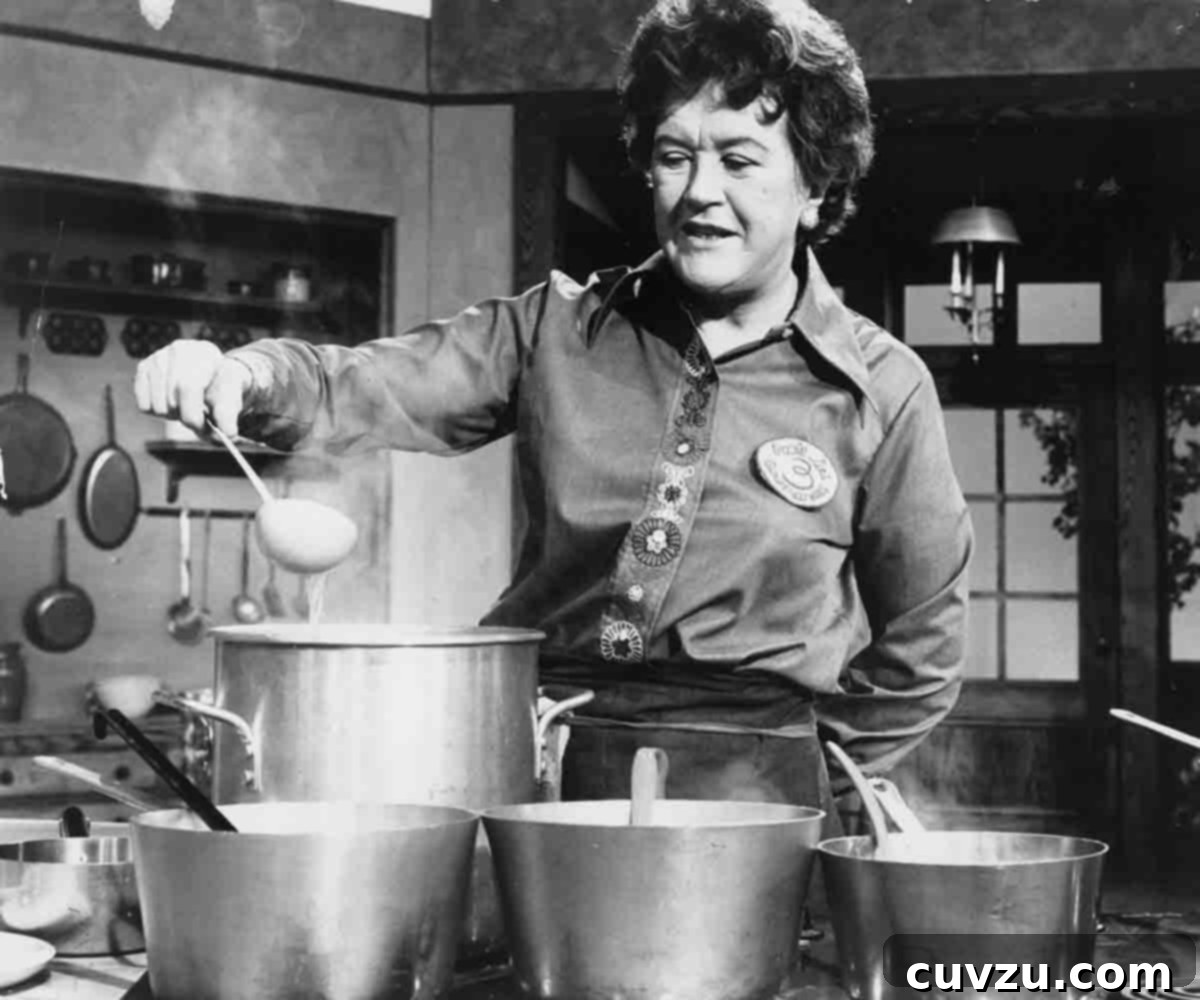
Just then, the familiar, jaunty opening music from The French Chef burst forth from the television’s tiny speaker, miraculously mingling with the rhythmic thonk and hiss of my mother’s iron as she meticulously pressed my father’s underwear in the adjacent room. It was a symphony of domesticity and unexpected comfort. As Julia’s cheerful voice filled the air, the relentless hamster wheel of punitive, self-critical thoughts in my head, which usually spun at a dizzying, suffocating pace, miraculously began to slow. I watched the show, utterly mesmerized, and every so often, the cool, delicate mist from Mom’s spray bottle would arc gracefully over the ironing board, reaching me where I lay on the floor. I would turn my face slightly, welcoming its refreshing coolness. In those moments, I felt something akin to happiness—or, perhaps more accurately, I felt the blessed absence of misery. Julia Child possessed that remarkable effect on me, a rare gift. So too did sleep. Both offered temporary cessation from the unending turmoil. The horrible, pervasive sense of watching the world unfold from the wrong end of a telescope, everything appearing distorted, distanced, and muffled, would momentarily recede. The bowling balls of anxiety that ricocheted through my chest with such brute force, they sometimes physically catapulted me out of movie theaters, out of solemn church services, even away from crowded family dinners, would momentarily quiet. The restless pacing, the constant hand-wringing, the relentless analyzing, and the futile attempts to understand what precisely was wrong with me—all of it paused. While the rest of my day was often spent merely waiting for the blessed relief of going to bed, Julia offered a precious, consistent 30-minute reprieve, a small island of calm in a turbulent sea.
It took my soldiering through an additional 23 more years of this internal hell, engaging with no fewer than four different therapists, before I finally managed to diagnose myself with what I intuitively knew was bipolar disorder. Even then, it took another full year before the medical community, after extensive evaluation, finally concurred with my self-assessment. Their official verdict was succinct: “Bipolar II disorder, most likely with childhood onset.” Perversely, I felt an immense sense of relief, even happiness, upon hearing this. Finally, after decades of suffering in silence and confusion, I could put a name to all of it, to the inexplicable chaos that had defined my existence. “Guess what, The One?” I exclaimed to my partner, a mix of triumph and raw emotion in my voice. “I have bipolar disorder! I’m mentally ill!” It was a declaration, a liberation. But I was also profoundly pissed off. It was one thing to deliver such a devastating, air-sucking punch to the gut of a 35-year-old adult, equipped with cognitive ability, emotional maturity, and a supportive network to process such a life-altering diagnosis. But what about that poor, scared, confused kid, stranded in the psychological wilderness of the 1970s, with no answers and no proper support?
There were, of course, pharmaceutical options available back then, albeit primitive and often misguided. After several frantic visits from my distraught preteen self, our dolt of a family physician, utterly at a loss, finally leaned wearily against the cold metal cabinet in his office, shaking his head in sheer exasperation. “I can prescribe Valium if you want,” he offered, his tone suggesting it was a last resort for an uncooperative patient.
“I’m only 12 years old,” I retorted in disbelief, the absurdity of the suggestion piercing through my fog of despair. He merely shrugged, as if to say, So? What does age have to do with it? I had no clear understanding of what was truly afflicting me, but somehow, instinctively, I knew that pumping me full of pills straight out of a novel like Valley of the Dolls was emphatically not the answer, not the solution I desperately sought.
I immediately jumped off the examination table, a surge of righteous indignation mingling with my usual anxiety. “Come on, Dad,” I urged, turning to my father, whose face was etched with anguish, despairing that no one, not even a doctor, could find relief for his suffering child. In that moment, for the very first time in my young life, I harbored a profound and chilling wish: I wished I were dead. The weight of existence felt too heavy to bear.
There were also the obligatory sleepovers, attempts at normalcy that often backfired spectacularly. Too frequently, the mental distraction I desperately hoped for would unravel, ending in burning humiliation. I’d find myself in the middle of the night, my friends and their bewildered families huddled together in their pajamas, looking on with concern and confusion while I made a frantic call to my father. I would then launch into an elaborate, whispered explanation of how some exotic, sudden stomach virus had inexplicably hit me. (I had, through painful trial and error, learned that flus and viruses were the ultimate, unassailable excuses because, unlike faked fevers, there was no objective way of checking their validity. Plus, they had the added, perverse advantage of making everyone all too eager and happy to get me the hell out of their house, regardless of the hour.)
And there was reading, a supposed escape. Yet, it was rare that I could truly wring any genuine meaning from the words on the page. My mind, a whirlwind of tumultuous thoughts, refused to focus. Instead, I would often stare blankly and absently through the book, meticulously pretending to read, turning pages at what I hoped were appropriate intervals, all so that my parents wouldn’t worry any more than they already did. Sometimes, my mother, ever vigilant, lying next to me on the couch in a shared attempt at quiet companionship, would gently toe me in the leg, a subtle reminder when I forgot to turn the pages, a quiet signal that my pretense was faltering.
Luckily, miraculously though, there was Julia. Show after show, she would playfully fumble with pots and pans, wield a magnificent sword over her famous, perfectly aligned kick line of plump fowl, and thwack pieces of meat with an unapologetic gusto, much like mothers back then might swat the asses of particularly bratty kids when they misbehaved. This uninhibited, authentic display, her sheer joy in the kitchen, was profoundly soothing to my tormented soul. She accomplished something truly extraordinary, something very few people, if any, could manage back then: she helped me forget myself, if only for a brief, precious half-hour.
It was Julia’s unchecked, unbridled joy—a profound sense of happiness that I begged God for every single night of my young life—that truly captivated and mesmerized me. My rapid cycling, those capricious, unpredictable, and utterly exhausting mood swings that I experienced countless times each and every day, would miraculously lift for that sacred half-hour. In her presence, I felt normal. Or, at least, I felt what I imagined normal must be like. Sometimes, I would even feel enough like myself, enough of my own spirit returning, to do a rousing, exaggerated imitation of Julia for my mother. As I tootled along, mimicking her distinctive voice, which rose and plunged with dramatic flair, my mother would fall back against the kitchen door, erupting in genuine laughter. Her fingers, often red and rough from the relentless housework, would burrow gently under her stylish cat-eye glasses to wipe away tears—tears, I now suspect, that were as much from profound relief as they were from pure delight, seeing a flicker of her son’s spirit return.
Oddly, despite the countless hours spent watching, I don’t recall a single specific dish Julia ever made on the show. My memories are not culinary. What I do vividly remember is the floppy “École des 3 Gourmandes” patch, proudly pinned to her blouse, a symbol of her culinary education. I remember my loyal dog, Rusty, a creature with an uncanny ability to sense pain, lying faithfully against my back, offering silent companionship. And I remember that voice—that marvelous, inimitable voice, a sound so swooping, so utterly throttled, so unique, that I always thought it would make the definitive, perfect voice for an animated Mother Goose, narrating tales of wonder.
Now, at 53, I have come to a profound acceptance that my bipolar disorder is as stable as it will ever realistically be—which, when compared to the tumultuous, unpredictable emotions of my preteen years through my late 30s, feels like rock-steady, unwavering ground. I have proper pills to thank for this stability. Not the misguided Valium of my youth, but carefully prescribed medication from a proper, understanding psychopharmacologist. Three times a day, I meticulously flood my system with chemicals, chemicals that I can almost physically feel stroking my nerve endings, coaxing them into a calmer state. Sometimes, these medications gently pull me up, rescuing me from depths where I felt sad and utterly broken, like a rusted car being painstakingly retrieved from the murky bottom of a dirty river. Other times, they whisper soothingly in my ear and gently pat my hand, working their subtle magic until the suffocating irritability, the machine-gun-fast speech, and the grandiose, distorted thinking slowly melt away, dissipating into nothingness.
Over time, I have proactively added my own powerful weapons to my ever-expanding bipolar arsenal. These are not things any shrink can prescribe, nor can any therapist neatly analyze them into a structured treatment plan. These vital tools are, namely, cooking and writing about food. Even on my absolute worst days, when it feels as though some gargantuan, unseen creature is threatening to drag me down, pulling me inexorably through the couch cushions into an abyss of despair, the simple, tangible act of swirling a knob of rich butter in a hot skillet can, almost miraculously, cheer me. And nothing, nothing quite so mercifully bitch-slaps depression for a few precious hours like the utterly frustrating, yet profoundly rewarding and highly improbable act of stringing together words, delicate and precise like pearls on a necklace, and meticulously turning those carefully chosen words into coherent, meaningful stories. It’s a creative battle, and one I often win.
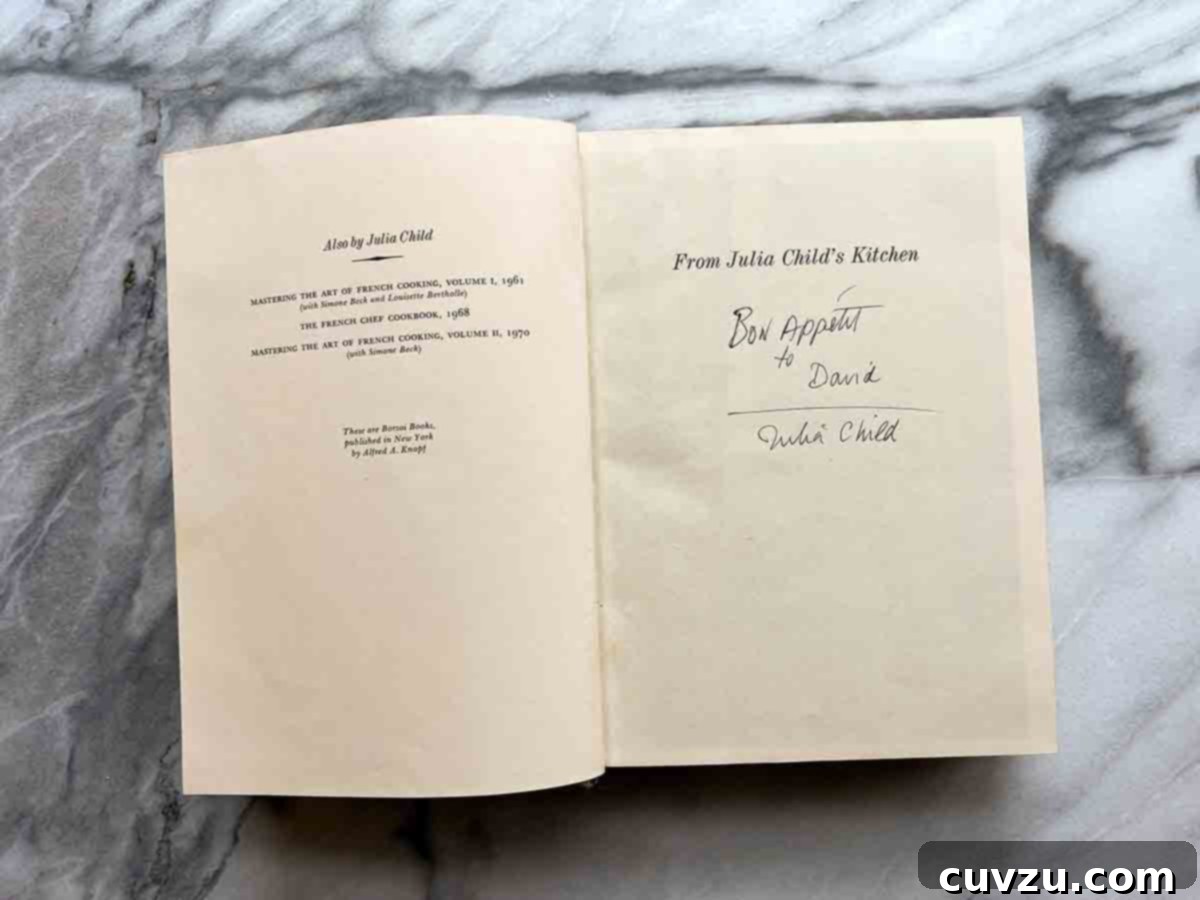
Not long ago, I embarked on the task of clearing out shelves overflowing with cookbooks, intending to donate many of them to our local library. As I sat comfortably on the floor, flipping through each cherished volume, searching for forgotten shopping lists or other random scribbles, I happened upon a beat-up, well-loved copy of Julia Child’s From Julia Child’s Kitchen. There, scrawled on the title page in an unsure, yet distinctive hand, were the words: “Bon appétit to David—Julia Child.” A former therapist of mine, who had befriended Julia, had kindly asked her for this incredible favor years ago. When she signed it all those years ago, I had long since forgotten my afternoon reprieves in front of the TV, the quiet solace she offered. Back then, I still had no idea what the mysterious ‘thing’ was that once held such an iron grip on me; I simply assumed I had outgrown it, that the darkness was behind me. But within a mere few months, it blindsided me again, returning with such brutal force and intensity that I was forced to move out of the apartment I shared with The One and seek refuge in a friend’s house. This agonizing decision mirrored my earlier desperation two decades prior with my father, as I simply couldn’t bear to witness what my newly labeled illness was doing to my partner, the pain it inflicted upon him. Every single night for almost four grueling weeks, immediately after work, I would crawl into my friend’s childhood bunk bed, finding solace in its familiar confines. There, bathed in the golden light of the summer sun streaming gently through the curtains, I read that very book, From Julia Child’s Kitchen, over and over again. It was as if Julia’s beautiful, clear writing somehow tapped my brain like a keg and, for a precious while, managed to drain away the pervasive blackness that threatened to consume me.
“What are you going to do with it now?” The One asked gently, his slipper-clad foot nudging the precious book resting in my lap. I slowly ran my hand reverently over Julia’s distinctive inscription, the words a tactile connection to a pivotal moment. Though it stands as a powerful totem of all that past pain, a reminder of the battles fought, I knew, with absolute certainty, that I could never bring myself to give it away.
“Saving it,” I replied simply, my voice imbued with a quiet conviction. “You could truly say it kind of saved me, in its own way.” He smiled warmly, understanding the depth of my sentiment, and then walked quietly into the kitchen to begin preparing dinner, leaving me with my thoughts and my invaluable literary companion.
It’s tempting, in retrospect, to believe that watching Julia all those formative years ago somehow, consciously or unconsciously, served as the direct catalyst or the underlying reason for my eventual career choice in food writing. But the truth is, it isn’t quite so straightforward. Before I finally found my calling in the world of food writing, my professional path was a winding and varied one. I was, at different stages, a failed graphic designer, an earnest day-care worker, an aspiring actor (which, in reality, primarily meant being a waiter), a receptionist, a somewhat bewildering past-life regressionist (a fascinating story for another time entirely), and a copywriter. Furthermore, during my late 20s and early 30s, food actually transformed into an insidious enemy. Plagued by a severe depressive episode, I completely lost interest in eating, my appetite vanished, and I plummeted to an alarming 169 pounds, sustaining myself with nothing more than a bowl or two of Fiber One cereal for dinner each day. It was a dark period, far from any culinary inspiration.
But what Julia did unequivocally do, for which I will always be eternally grateful, was to impart a profound and life-altering lesson. There, on that nubby brown carpet in front of the flickering black-and-white TV screen in my childhood home, and again, two decades later, alone in that twin bunk bed, poring over her words, she taught me something essential: despite living with bipolar disorder, despite the relentless challenges it presents, happiness is, indeed, possible. Even for me. She was a beacon of joy, demonstrating that even amidst chaos, the creation of beauty and pleasure, and the experience of genuine delight, could exist.