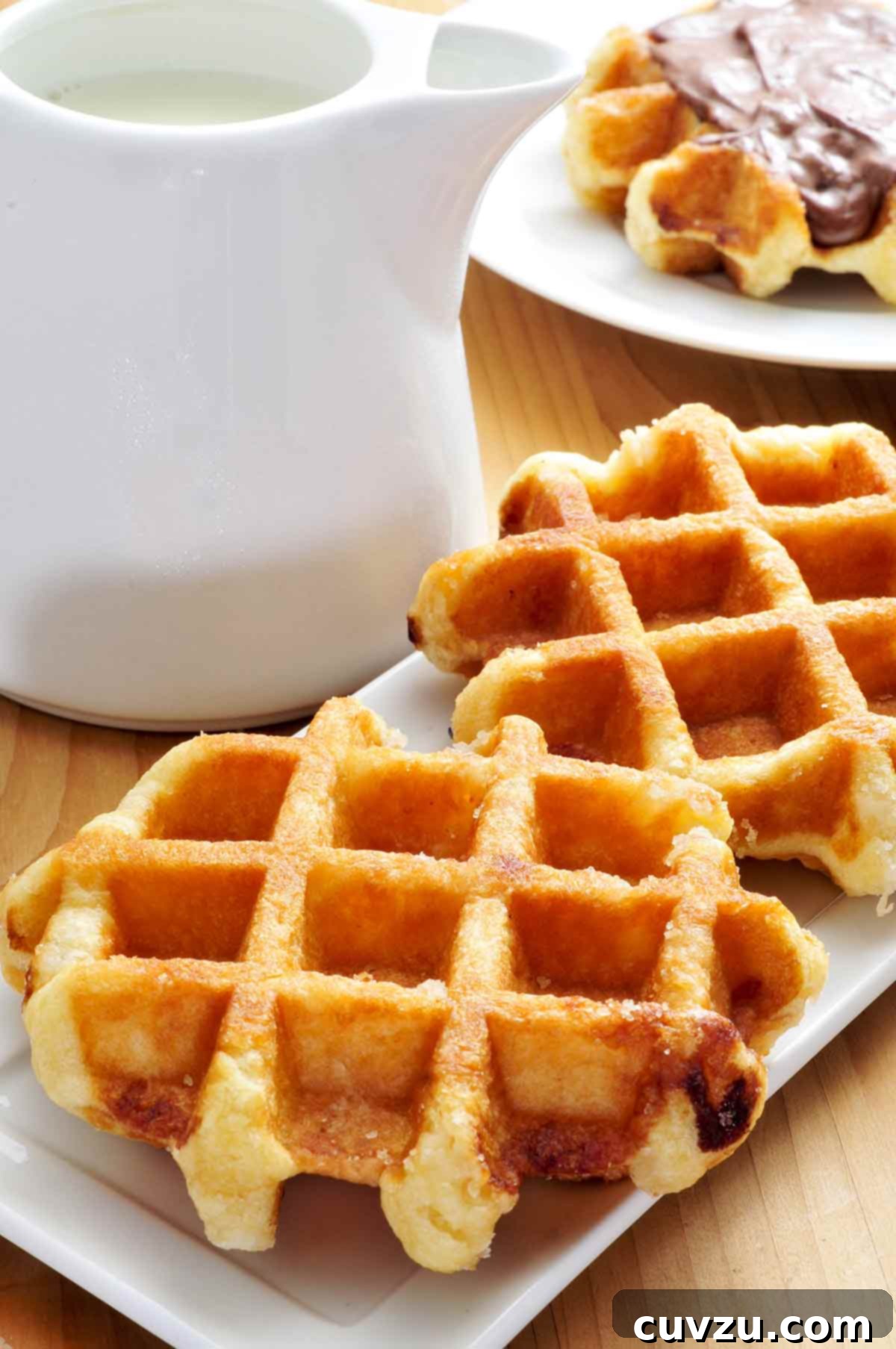
Prepare yourself for a culinary journey to the heart of Belgium with the authentic Liège waffle, a treat that transcends the ordinary. Far from your typical breakfast fare, these Belgian Liège waffles are a testament to patience and craftsmanship, resulting in a unique confection that’s absolutely worth every moment of preparation. What sets them apart? The magic lies in the pearl sugar, which caramelizes beautifully along the crisp, golden edges, and the tender, yeasted dough, making them delightfully lighter yet richer than conventional waffles. This isn’t just a recipe; it’s an invitation to experience a piece of Belgian culinary heritage, right in your own kitchen.
Do you remember those enchanting cartoons where the irresistible scent of a classic apple pie cooling on a windowsill would ensnare an unsuspecting character, drawing them irresistibly towards its sweet source? That vivid imagery perfectly captures my first encounter with the captivating aroma of authentic Belgian Liège waffles. It was an olfactory siren call, a rich, buttery, and subtly sweet perfume that promised something truly extraordinary, something far beyond any waffle I had ever known.
My unforgettable introduction to the true Belgian Liège waffle occurred seven years ago, shortly after my move to Brussels. Eager to immerse myself in the local culture and explore my new surroundings, I ventured out to the bustling weekly farmers market nestled conveniently near my home. It was there, amidst the vibrant stalls and the lively chatter of vendors and shoppers, that a heavenly scent wafted through the air, gently tickling my nose. Like a curious dog, I instinctively twitched my head from side to side, diligently sniffing the breeze, my senses guided by the honeyed aroma until I pinpointed its source. It was a grand white and yellow truck, impressively sized like a well-appointed motor home, meticulously outfitted as a mobile patisserie. One side of the vehicle was ingeniously hinged and propped open, forming an inviting overhead shelter. Beneath this canopy, a gleaming glass display case, positioned above the wheel wells, showcased an array of delicate pastries and exquisite cookies, sparkling like culinary jewels. But my gaze was fixed elsewhere.
Adjacent to a rustic stack of freshly baked baguettes, a sturdy waffle iron stood, majestically steaming and puffing, its heated plates oozing with crusted batter drippings. Without a moment’s hesitation, and pointing a little too enthusiastically at the billowing iron to ensure there was no mistaking my desire, I uttered, “Une gaufre, s’il vous plaît.” A waffle, please. A kind man—who I would later come to know as Gilles through my biweekly pilgrimages—skillfully wielded a utensil that resembled a barbecue fork. With expert precision, he peeled the deeply crenellated confection from the knobs of the iron, delicately folded a piece of wax paper around it, and presented it to me. I received it with both hands, cradling it as if it were a piece of the most fragile glass. This, I instantly realized, was nothing like the versions of “Belgian” waffles I had grown accustomed to in the U.S., often found at diners like IHOP. In my hands was a warm, inviting ginger-brown oblong waffle, roughly the size of a kitchen sponge. Strikingly, there was no maple syrup in sight, nor were there any smiling dollops of whipped cream. I eagerly bit into the dense, sweet, and wonderfully chewy confection, instantly recognizing it as a Liège (pronounced LEE-ezh) waffle. The caramelized crust, glistening with melted pearl sugar, yielded easily to my teeth, and the rich taste of butter and sugar melted on my tongue. It was, without a doubt, love at first bite. My entire understanding of a true Belgian waffle—and quite possibly my waistline—would be forever transformed. This profound culinary awakening led me to understand the nuances of this iconic Belgian street food.
The “Belgian” waffle that gained widespread popularity in America actually has a fascinating backstory. Its origin traces back to the “Bel Gem Waffle,” a creation of Belgian restaurateur Maurice Vermersch, introduced to an eager audience at New York’s 1964 World’s Fair. This innovative dessert quickly became a national craze in the years that followed, making the waffle iron a ubiquitous fixture in American kitchens. The name “Bel Gem” underwent a natural evolution, first morphing into “Belgium,” and then simplifying further to “Belgian,” thereby inextricably linking the flat country of Belgium to the syrup-splattered diner menus found across all fifty states, often topped with an array of sweet additions.
While Vermersch’s interpretation was a delightful introduction for many Americans, it was a distant cousin to the true waffle nirvana I experienced at the Brussels market. His creation was, in fact, patterned after a “Brussels” waffle. This variety is a close relative to the authentic Belgian Liège waffle but bears a closer resemblance to the American version in its lighter, airier texture. Leavened with both yeast and egg whites, Brussels waffles are characteristically fluffier than their denser Liège counterparts. In their namesake city, they are typically served stacked high and adorned with a lavish assortment of toppings, including decadent chocolate sauce, generous dollops of whipped cream, and fresh, ripe strawberries. While delicious, they represent a different facet of Belgium’s rich waffle tradition.
However, for many, myself included, the most captivating and truly bewitching type of waffle in Belgium is the indulgent, doughy diva I first encountered that day in the bustling market: the authentic Belgian Liège waffle. Named after the town of Liège in southeast Belgium, these waffles are a culinary masterpiece, celebrated for their distinct texture and flavor. They are meticulously cooked on an extremely hot iron, a crucial step that allows the generous chunks of pearl sugar embedded in the batter to caramelize into a glistening, crunchy crust. This creates an irresistible shell that perfectly encases the buttery, vanilla-scented, cake-like interior. In Belgium, Liège waffles are traditionally eaten by hand, a convenient and satisfying street food, and notably, they are almost never consumed for breakfast. Despite this cultural norm, I confess to indulging in them morning, noon, and night whenever the craving strikes. Around Brussels, it’s a common sight to find street vendors expertly preparing and serving these hot-off-the-iron delicacies from their charming vans, strategically parked at nearly every market and major shopping area. I have a particular fondness for the vans positioned in front of the city’s most beautiful landmarks and panoramic vistas, where the experience of enjoying a fresh Liège waffle is elevated by the stunning backdrop. This is the ultimate pearl sugar waffle experience.
One truly needs no excuse to indulge in a delightful Liège waffle—at least, I certainly don’t! However, if you’re looking for a reason to celebrate, mark your calendars for August 24. This date commemorates the anniversary of the first U.S. patent for a waffle iron. While this patent wasn’t specifically for the heavy, cast-iron appliance used to craft an authentic gaufre Liège, it serves as a wonderful historical nod to the beloved culinary tool. And rest assured, a good quality home waffle iron will absolutely suffice for making this recipe. While mastering this recipe for authentic Liège waffles requires a bit more sophistication than simply popping a frozen toaster waffle into a slot, it’s considerably less daunting than, say, baking a multi-tiered wedding cake. The effort, trust me, is profoundly rewarding. If the thought of making them from scratch feels a little overwhelming right now, don’t despair. The growing popularity of this Belgian street food means there’s a good chance a Liège waffle truck will soon be setting up shop near you. You’ll know it’s there. Just follow that unmistakable, billowing cloud of sweet, buttery aroma. That, my friends, is the irresistible call of a true pearl sugar waffle.–Kimberley Lovato
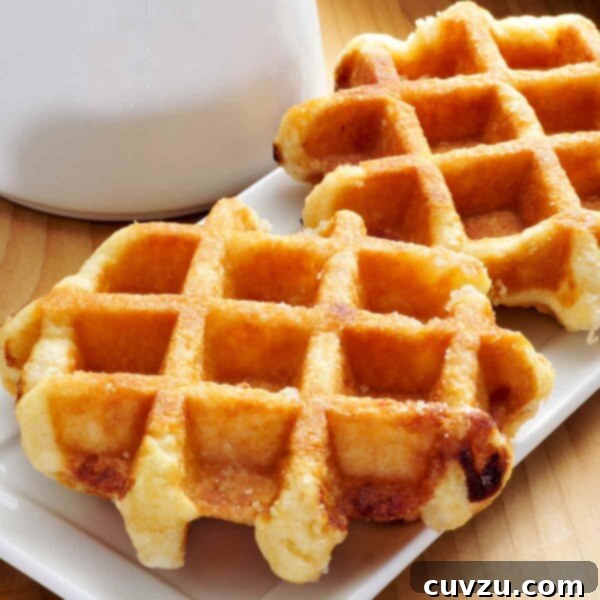
Liège Waffles
Kimberley Lovato
Saved
Breakfast
Belgian
5
waffles
557
kcal
1 hour
30 minutes
16 hours
Ingredients
-
1 1/2 teaspoons active dry yeast -
1/4 cup scalded whole milk*, [110°F to 115°F (43°C to 46°C)] -
2 tablespoons plus 2 teaspoons warm water, [110°F to 115°F (43°C to 46°C)] -
2 cups bread flour, plus more for dusting -
1 large egg, room temperature, lightly beaten -
1 tablespoon plus 1 teaspoon light brown sugar -
3/4 teaspoon salt -
8 1/2 tablespoons (4 1/4 oz) unsalted butter, room temperature -
1 tablespoon honey -
2 teaspoons vanilla extract -
3/4 cup Belgian pearl sugar, (Lars Own brand is an excellent choice) or sugar cubes that you’ve coarsely crushed in a mini chop or a food processor
Instructions
-
In the bowl of a stand mixer, combine the yeast, milk, and water until the yeast is just moistened—a quick swirl for a few seconds will do. Incorporate the egg and two-thirds cup of the flour, mixing only until they are just combined. Gently sprinkle the remaining flour over the mixture, but do not stir. Cover the bowl and allow it to stand until the batter visibly bubbles up through the flour mantle, which typically takes between 75 to 90 minutes.
-
With your stand mixer running on low speed, add the brown sugar and salt to the batter, mixing just until they are fully combined. Continue with the machine running, then add the honey and vanilla extract, ensuring they are well incorporated. Gradually add the unsalted butter, two tablespoons at a time, mixing for 4 minutes on medium-low speed. Remember to scrape down the sides of the bowl once or twice during this period to ensure even mixing. Allow the dough to rest for 1 minute, then resume mixing for an additional 2 minutes. The dough should become sticky and cling to the sides of the bowl during the final minute of mixing, and then, in the last 30 seconds, it should begin to form a cohesive ball around the paddle attachment. If this doesn’t occur, let the dough rest for another minute and mix for an additional 2 minutes. Regardless of whether extra mixing is needed, proceed to the next step once a soft dough is formed.
-
Transfer the dough into a large, clean bowl and very lightly sprinkle it with a touch of flour. Cover the bowl securely with plastic wrap and let the dough rise at room temperature for a full 4 hours. This extended rise is crucial for developing the rich flavor and characteristic texture of the Liège waffles.
-
After the initial rise, cover the dough once more and place it in the refrigerator for 30 minutes. This chilling period will make the dough easier to handle and prepare for the next steps.
-
Gently stir the dough down by pressing on it to carefully deflate it. Scrape the dough onto a piece of plastic wrap, then gently press it into a long, rectangular shape. Fold this rectangle over onto itself in thirds, much like you would fold a letter, to create a compact square of dough. Wrap it tightly in plastic wrap, weigh it down slightly (I often use two heavy dinner plates for this), and refrigerate it overnight. This overnight refrigeration allows the flavors to deepen and the dough to firm up, making it ideal for incorporating the pearl sugar the following day.
-
The next day, retrieve the cold, firm dough from the refrigerator and place it in a large bowl. Add all of the Belgian pearl sugar to the bowl. It will appear to be a substantial amount of sugar, and that’s precisely as it should be for authentic Liège waffles. Using your hands, thoroughly mix the pearl sugar into the dough until the distinctive chunks are evenly distributed throughout. Once mixed, divide the dough into 5 equal-sized pieces. Shape each piece into an oval ball, resembling a small football without the pointed ends. Place these shaped dough balls on a baking sheet, cover them loosely with plastic wrap, and allow them to rise for precisely 90 minutes. This final rise gives the waffles their airy yet chewy interior.
-
If you are fortunate enough to own a professional-grade waffle iron (typically made from cast iron and weighing over 20 pounds), preheat it to precisely 365° to 370° F (185° to 187°C). This temperature is critical as it’s the maximum heat before the pearl sugar begins to burn. Cook each waffle for approximately 2 minutes. For those with a regular home waffle iron, preheat your iron to 375° F (190°C) and cook for 4 to 5 minutes. Be mindful that many standard waffle irons can reach temperatures well over 550° F (287°C) at their highest setting. To prevent the pearl sugar from burning and sticking, I highly recommend placing the dough on the hot iron and then immediately unplugging it or turning the temperature dial all the way down for the cooking duration. This allows the waffle to cook through and the sugar to caramelize without scorching.
-
Once cooked, allow the freshly made Liège waffles to cool for a few minutes before indulging. For an authentic Belgian street food experience, you can wrap them in waxed paper, if desired, and enjoy them by hand.
Notes
*What is scalded milk?
In older recipes, you’ll frequently encounter calls for “scalded milk,” a practice less common in modern cooking but one with historical significance. This instruction harks back to an era when milk was not universally pasteurized. Consequently, while your great-aunt Annie’s biscuit recipe might no longer require scalding for health safety, the technique still serves a purpose. At its most fundamental, scalding milk involves heating it to a temperature of 180°F (82°C) until small bubbles form around the edges, then allowing it to cool to a specific range of 110°F to 115°F (43°C to 46°C). Historically, this process effectively killed harmful bacteria and deactivated an enzyme that could interfere with the thickening of certain recipes, particularly those involving yeast or dairy. Even with today’s pasteurized milk, scalding remains beneficial for several reasons: it helps activate yeast more effectively, allows butter to melt and incorporate smoothly into doughs, and can be used to infuse subtle flavors from aromatics like vanilla beans or citrus zest. Furthermore, scalded milk develops a distinctly different, slightly sweeter, and richer flavor profile compared to plain, room-temperature milk, contributing a unique depth to your Liege waffle recipe.

An LC Original
View More Original Recipes
Explore More with AI
Substitutions
Scale
Summarize
Nutrition
Serving:
1 waffle
Calories:
557 kcal
Carbohydrates:
81 g
Protein:
9 g
Fat:
23 g
Saturated Fat:
14 g
Trans Fat:
1 g
Cholesterol:
92 mg
Sodium:
375 mg
Fiber:
2 g
Sugar:
43 g
Nutrition information is automatically calculated, so should only be used as an approximation.
Tried this recipe?
Mention @leitesculinaria or tag #leitesculinaria!
Recipe Testers’ Reviews
Leanne Abe
This is, without a doubt, the best Liège waffle recipe I have ever attempted. The resulting waffle boasts a perfectly balanced sweetness, accompanied by a rich, buttery, and subtly malty flavor that hints at yeast without being overpowering. The exterior achieves an exquisite crispness and delightful sugary crunch, while the interior offers a satisfying chewiness, punctuated by occasional bursts of crunchy, melted pearl sugar. It’s a truly exceptional experience.
Be prepared for a significant amount of non-active time required for this recipe; this extended waiting period is absolutely essential for the optimal development of the dough’s complex flavors and desirable texture. For the pearl sugar, I experimented with both authentic pearl sugar and sugar cubes coarsely crumbled in a food processor. While genuine pearl sugar undeniably yields the best results, I would still happily enjoy a waffle made with the crushed sugar cubes. The instructions recommend mixing the sugar in by hand, but I found that gently kneading the sugar into the dough was an easier and more efficient method.
I set my waffle iron to approximately three-quarters of its maximum heat setting and verified the temperature with an infrared thermometer, aiming for around 370°F. At this precise temperature, the waffles cooked beautifully in just two minutes per oval-shaped piece of dough. While making five waffles might seem like a lot of effort, their richness and generous size mean they are easily split into quarters, making them perfect for sharing. A small note on cleanup: the generous amount of sugar and butter in the dough did leave a slight residue in my waffle iron, but a quick clean with a pastry brush and warm water on the still-warm iron easily took care of it. This Liège waffle recipe truly shines!
Linda Pacchiano
This Belgian Liège waffles recipe certainly demands a significant lead time, involving several rounds of proofing and an essential overnight refrigeration period. However, every minute of work and every hour of waiting are unequivocally worth it when you are rewarded with five absolutely magnificent waffles. These are more akin to exquisite pieces of fine pastry than what we typically categorize as “waffles” in America. The depth of flavor and texture achieved is truly unparalleled, making this recipe a standout for authentic pearl sugar waffles.
I utilized a regular home waffle iron and was able to maintain a consistent temperature of 360°F. At this heat, each dough ball required precisely five minutes to cook. The iron reached a perfect temperature, allowing for the creation of a beautifully caramelized sugar crust on the exterior, while simultaneously cooking the interior of the waffle to a delightful, brioche-like texture. As I didn’t have commercial pearl sugar on hand, I created my own by crushing sugar cubes with a meat mallet, which worked surprisingly well. My only minor critique would be that some of the melted sugar tended to stick to the waffle iron, making the cleanup process somewhat challenging. I suspect that using actual pearl sugar, which is specifically designed for this application, might mitigate this issue and result in an even smoother cleanup experience.