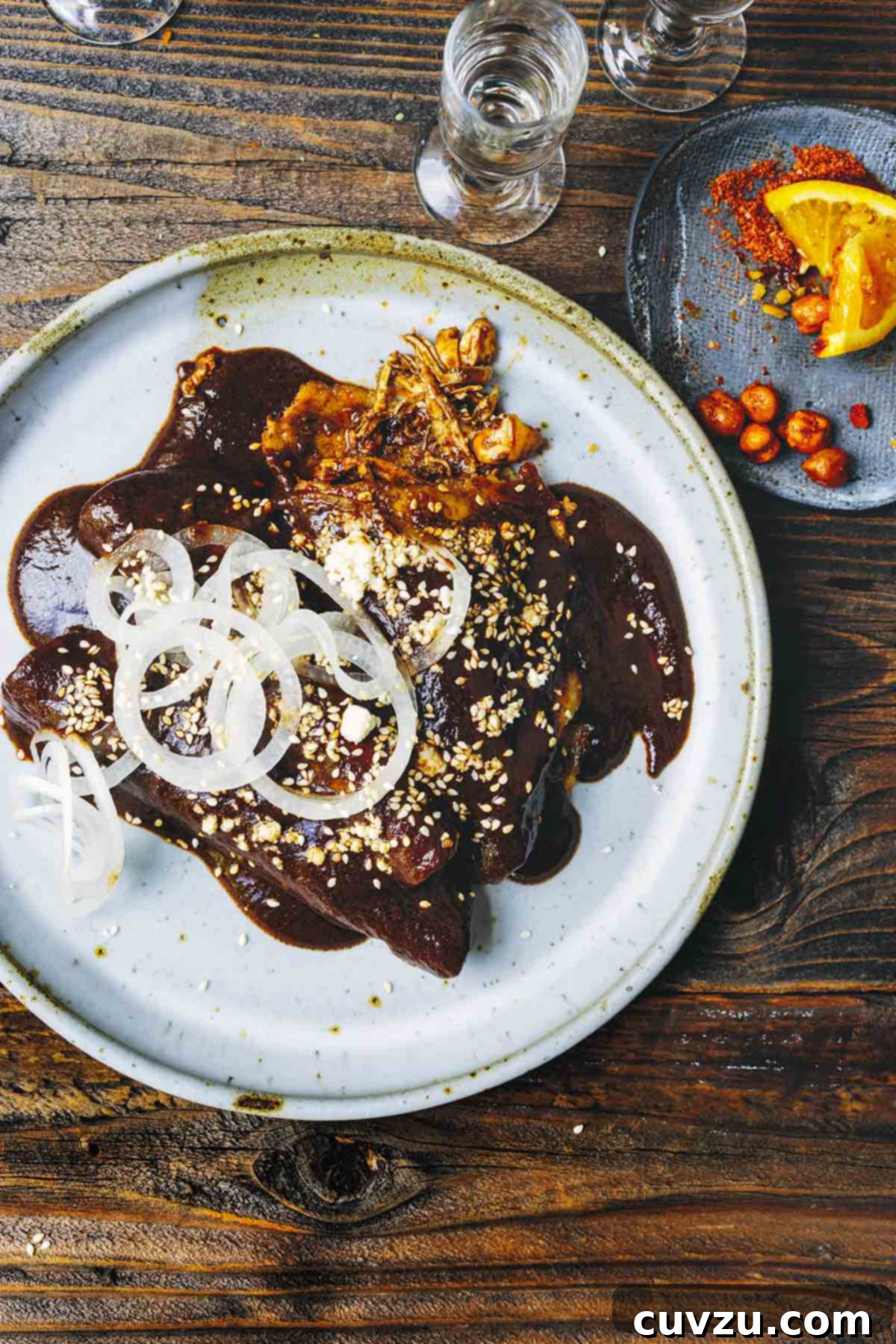
Authentic Enchiladas de Mole Poblano: A Culinary Journey to Puebla
Embark on a remarkable culinary adventure with these exquisite Enchiladas de Mole Poblano, a quintessential Mexican celebration dish. This recipe guides you through creating succulent chicken-stuffed tortillas, generously enrobed in a profoundly rich and complex chocolate and chile mole sauce. It’s a taste of tradition, directly from the heart of Mexico.
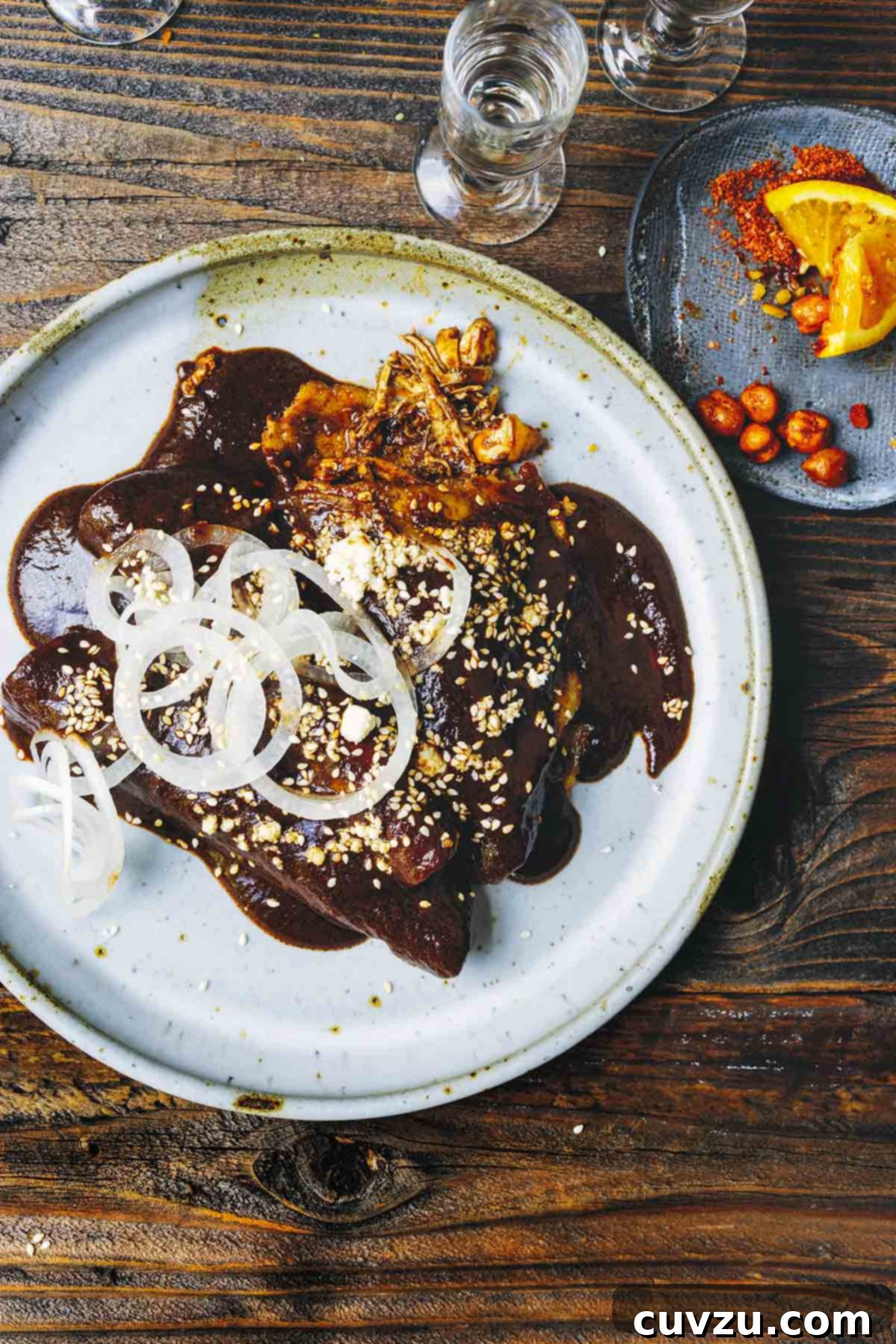
Hailing from Puebla, Mexico, where its creation is often reserved for significant festive occasions, Mole Poblano is more than just a sauce – it’s a testament to culinary heritage and dedication. As culinary authors Gonzalo Guzmán and Stacy Adimando explain, while this dish demands considerable effort and patience, the resulting depth of flavor is truly unparalleled. Each spoonful tells a story of tradition, bringing a unique blend of sweet, savory, and spicy notes to your palate. This recipe promises not just a meal, but an experience that transforms any gathering into a memorable celebration. Prepared with passion by Angie Zoobkoff, let’s dive into the art of making this magnificent dish.
Understanding Mole Poblano: A Symphony of Flavors
Mole Poblano stands as one of Mexico’s most iconic and revered sauces, a culinary masterpiece characterized by its incredibly complex flavor profile. It is a harmonious blend of dried chiles, nuts, seeds, spices, fruits, and a touch of chocolate, all meticulously ground and simmered to create a sauce unlike any other. The name “Mole” itself, derived from the Nahuatl word “mōlli,” signifies a “sauce” or “concoction,” hinting at the intricate nature of its preparation.
What makes Mole Poblano so special? It’s the delicate balance. The chiles—such as mulato, pasilla, chiles negros, and ancho—provide a deep, earthy foundation with varying degrees of mild heat. Ingredients like almonds, peanuts, and pepitas contribute richness and a subtle nuttiness, while dried fruits like raisins and prunes introduce a natural sweetness that beautifully offsets the chiles. Aromatic spices such as coriander and anise seeds, along with a hint of cinnamon, weave in warmth and complexity. Finally, Mexican chocolate is added, not to make the sauce overtly sweet, but to deepen its color, thicken its consistency, and impart a subtle, bittersweet finish that rounds out all the other flavors. This intricate dance of ingredients results in a sauce that is simultaneously spicy, sweet, savory, and profoundly satisfying.
Preparing Mole Poblano from scratch is a labor of love, a process that requires patience and attention to detail. However, the reward is an intensely flavorful, velvety sauce that elevates simple chicken and tortillas into a truly gourmet experience. It’s a culinary journey that connects you directly to the vibrant traditions of Mexican cuisine, making it perfect for special occasions or whenever you wish to indulge in an extraordinary meal.
The Culinary Journey: Why Make This Authentic Mole Poblano?
In a world of quick meals and convenience foods, choosing to make an authentic Mole Poblano from scratch is a deliberate and incredibly rewarding decision. This isn’t just about cooking; it’s about engaging in a rich cultural tradition and experiencing flavors that simply cannot be replicated by store-bought alternatives. Each step, from toasting the chiles to simmering the sauce, contributes to a depth and authenticity that is truly unparalleled.
This recipe provides a genuine taste of Puebla, guiding you through the traditional methods that have been honed over centuries. You’ll discover how individual ingredients transform and meld, creating layers of flavor that evolve throughout the cooking process. The act of toasting the chiles until they blister, roasting the nuts and seeds to unlock their aromas, and slowly simmering the blended sauce until the oils rise to the surface are all essential steps that build the characteristic complexity of true mole.
While it requires dedication, the process is therapeutic and deeply satisfying. The aroma that fills your kitchen as the mole simmers is an experience in itself. And when you finally sit down to enjoy these Enchiladas de Mole Poblano, you’ll taste the difference that patience, quality ingredients, and traditional techniques make. It’s a meal that not only nourishes the body but also feeds the soul, connecting you to the heart of Mexican gastronomy. Prepare to impress your family and friends with a dish that is both a culinary feat and a delicious celebration of heritage.
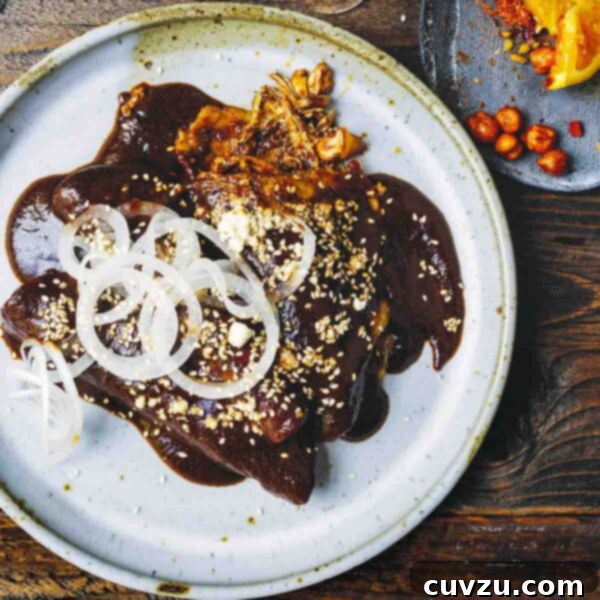
Enchiladas de Mole Poblano Recipe
These authentic Enchiladas de Mole Poblano are a traditional Mexican celebration dish, featuring soft corn tortillas stuffed with succulent chicken and lavishly coated in a deeply flavorful chocolate and chile mole sauce. A true culinary masterpiece from Puebla.
Recipe by David Leite
Ingredients
For the Flavorful Chicken
- One (3- to 4-pound) whole chicken
- 1/2 medium white onion
- 4 cloves garlic
- 2 bay leaves
- 1 tablespoon kosher salt
For the Rich Mole Poblano Sauce
- 4 dried mulato chiles, stemmed and seeded
- 2 dried pasilla chiles, stemmed and seeded
- 2 dried chiles negros, stemmed and seeded
- 1 dried ancho chile, stemmed and seeded
- Boiling water, for soaking chiles
- 1/2 cup sesame seeds
- 1/2 cup almonds
- 3/4 cup peanuts
- 3/4 cup pepitas (pumpkin seeds)
- 3/4 cup golden raisins
- 1/2 cup pitted prunes
- 3/4 teaspoon coriander seeds
- 1/4 teaspoon anise seeds
- 1/4 small bread roll, thinly sliced, or equivalent soft white bread (about 1⁄4 cup)
- 1/4 soft corn tortilla (optional, for texture and thickening)
- 1/4 cup plus 3 tablespoons rice bran oil or canola oil, divided
- 1/2 plantain, sliced into 1⁄2-inch (12-mm) thick rounds
- 1 large white onion, chopped
- 4 cloves garlic, minced
- 1 1/2 cups canned diced tomatoes and their juices
- 5 medium tomatillos, husked and coarsely chopped
- 1 chipotle in adobo (for a smoky, mild heat)
- 1/2 cinnamon stick
- 1 tablespoon granulated sugar
- 1 1/2 disks Mexican chocolate, chopped (look for brands like Ibarra or Abuelita)
- Kosher salt, to taste
- Fifteen (6-inch) soft corn tortillas, for assembly
For Serving and Garnish
- Toasted sesame seeds, for garnish
- Crumbled queso fresco, for garnish
- Sliced white onion, thinly sliced, for garnish
Instructions
Part 1: Prepare the Tender Chicken
- In a generously sized pot, place the whole chicken. Add enough cold water to just cover the chicken completely. Incorporate half of a white onion, 4 cloves of garlic, 2 bay leaves, and 1 tablespoon of kosher salt. These aromatics will infuse the chicken and broth with essential flavor.
- Bring the contents of the pot to a robust boil over high heat. Once boiling furiously, reduce the heat to a gentle simmer. Allow the chicken to cook for approximately 45 minutes, or until the meat is thoroughly cooked through and easily separates from the bone. During the simmering, periodically skim off any impurities, fat, or foam that surfaces, ensuring a clear and flavorful broth.
- Carefully remove the cooked chicken from the pot, placing it on a clean surface or platter. Reserve all the precious cooking liquid; this will be the base of your mole. Let the chicken cool down until it is comfortable enough to handle without burning your hands. Once cooled, expertly pull and shred all the meat from the bones, discarding the bones and skin.
- Pass the reserved chicken cooking liquid through a fine-mesh strainer into a separate, clean container, discarding any solids. This rich, clarified broth is vital for achieving the perfect mole consistency. Both the shredded chicken and the strained broth can be prepared up to 2 days in advance and stored separately in the refrigerator, making your mole day much smoother.
Part 2: Crafting the Exquisite Mole Poblano Sauce
- Preheat your oven to 350°F (180°C). This will be used for toasting the nuts and seeds.
- In a large, dry skillet (without any oil), place all the dried chiles: mulato, pasilla, chiles negros, and ancho. Toast them over high heat, turning them frequently with tongs, for 2 to 5 minutes. The goal is to darken them and make them slightly blistered, but be extremely careful not to burn them, as this will impart a bitter taste to your mole.
- Promptly transfer the toasted chiles to a heatproof bowl. Pour boiling water over them until they are fully submerged. Let them soak for 15 to 20 minutes, or until they have rehydrated and become soft and pliable.
- While the chiles are soaking, arrange the sesame seeds, almonds, peanuts, pepitas, golden raisins, pitted prunes, coriander seeds, anise seeds, the thinly sliced bread roll, and the optional corn tortilla piece (if using) onto a small rimmed baking sheet. Roast this mixture in the preheated oven for about 15 minutes, stirring occasionally to ensure even toasting. Keep a watchful eye to prevent burning; the nuts and seeds should achieve a golden, aromatic toast. Remove from the oven and allow to cool.
- Return the same large skillet to medium heat and add 2 tablespoons of the rice bran or canola oil. Once the oil shimmers, add the sliced plantain rounds. Fry them, turning the slices periodically and gently pressing down with a spatula, until they achieve a beautiful golden-brown color on all sides, typically 5 to 10 minutes. Transfer the fried plantain slices to a small bowl.
- In the same skillet, warm another 2 tablespoons of oil over medium heat. Add the chopped large white onion and the minced 4 cloves of garlic. Season lightly with kosher salt. Cook, stirring occasionally, until the onions become soft and translucent, which should take about 5 minutes.
- Stir in the canned diced tomatoes with their juices and the coarsely chopped tomatillos. Add another pinch of salt. Bring the mixture to a boil, then reduce the heat to maintain a gentle simmer. Cover the skillet and let it cook for 15 minutes, allowing the flavors of the vegetables to meld and soften.
- Drain the softened chiles, discarding the soaking water. Place the drained chiles in a high-speed blender. Add the cooled, roasted contents from the baking sheet (sesame seeds, nuts, fruits, spices, bread, tortilla). Begin blending, gradually adding the reserved chicken cooking liquid as needed, until the mixture is exceptionally smooth and resembles a thick, uniform paste. You will likely use between 1 1/2 and 3 cups of liquid to achieve this consistency.
- Add the fried plantain slices, the cooked onion-tomato-tomatillo mixture, and the chipotle in adobo to the blender. Continue blending until the mole paste is incredibly smooth and velvety. If your blender is on the smaller side or appears too full, blend the mixture in batches, or transfer the contents to a large pot and use an immersion blender to achieve the desired smoothness.
- In a large, deep pot, warm the remaining 3 tablespoons of oil over high heat until it shimmers and is quite hot. Carefully remove the pot from the heat. With extreme caution and swiftness, pour the entire contents of the blender into the hot oil all at once. Be prepared for aggressive sputtering as the mole hits the hot oil – this is a crucial step for flavor development.
- Return the pot to high heat and cook the mole, stirring constantly to prevent it from sticking to the bottom, for 10 minutes. This process, known as “sazonar,” deeply develops the flavors. Add the cinnamon stick and approximately 2 cups of the reserved chicken cooking liquid. Bring the mole to a gentle simmer.
- Continue to cook the mole for another 15 minutes, allowing the flavors to meld further and the sauce to thicken. Then, stir in the granulated sugar and the chopped Mexican chocolate. Cook for an additional 2 to 3 minutes, stirring continuously until the chocolate is completely melted and fully incorporated into the sauce. Taste the mole and adjust the seasoning with kosher salt as needed. Let the mole simmer gently for at least 30 minutes, or until you observe a thin layer of oil rising to the surface. This is the traditional indication that the mole is perfectly finished and its myriad flavors have harmonized.
- When you are ready to serve, gently combine the shredded chicken meat with a generous amount of the warm mole sauce in a separate pan or bowl. Heat gently until the chicken is thoroughly warmed through and well-coated with the rich sauce.
Part 3: Assemble and Serve the Delicious Enchiladas
- Preheat a clean, large skillet or griddle over medium heat. Working in small batches, place the soft corn tortillas in a single layer on the hot surface. Cook each tortilla for 3 to 4 minutes, flipping once, until they are heated through, softened, and pliable enough to roll without breaking.
- As they are warmed, stack the tortillas on a platter, cutting board, or clean work surface and cover them with a clean kitchen towel. This will keep them warm and prevent them from drying out.
- For each enchilada, spoon approximately 1/4 cup of the chicken-mole mixture in a neat line down the center of a warm tortilla.
- Carefully fold the tortilla in half over the filling, or roll it tightly into a tube shape to securely enclose the delicious contents.
- Arrange the prepared enchiladas on individual serving plates, typically 2 to 3 per person. Lavishly ladle more of the warm, rich mole sauce over the top of each enchilada, ensuring they are thoroughly covered.
- Garnish generously with a sprinkle of toasted sesame seeds, a crumble of fresh queso fresco, and a few delicate slices of white onion. Serve immediately and savor this authentic Mexican masterpiece.
Chef’s Notes & Tips for Perfect Mole Poblano
- The Art of Toasting Chiles: One of the most critical steps for a flavorful mole is properly toasting the dried chiles. Be diligent to toast them just until they darken and become fragrant, but avoid burning them at all costs, as this will introduce an unpleasant bitterness to your finished sauce.
- Achieving Silky Smoothness: A hallmark of excellent mole poblano is its velvety texture. If your blender struggles to achieve this, process the sauce in smaller batches. An immersion blender can also be a valuable tool for ensuring a perfectly smooth consistency after the initial blending. Don’t underestimate the importance of this step.
- Patience is Key: Mole poblano is a dish that truly rewards patience. The longer it simmers, the more the complex flavors deepen, meld, and transform. Do not rush the final simmering stage; waiting for the thin layer of oil to rise to the surface is a traditional and reliable sign that your mole is perfectly finished and its flavors have fully harmonized.
- Make Ahead Advantage: To make the preparation more manageable, both the shredded chicken and the mole sauce can be prepared up to 2 days in advance and stored separately in airtight containers in the refrigerator. This significantly reduces the cooking time on the day you plan to serve.
- Embrace Leftovers: You might find yourself with extra mole sauce, and this is a wonderful problem to have! Leftover mole freezes beautifully and can be used for a variety of other delicious dishes such as chicken or turkey mole tacos, sopes, quesadillas, or even as a rich, savory sauce for roasted vegetables.
Perfect Pairings for Your Enchiladas de Mole Poblano
Enchiladas de Mole Poblano are a complete and satisfying meal on their own, but a few thoughtful accompaniments can elevate the dining experience further. Consider serving them alongside a simple side of fluffy white rice, which provides a neutral canvas for the rich mole and helps to absorb every drop of its incredible flavor. A light, refreshing salad with a vinaigrette dressing can offer a welcome contrast to the mole’s richness. For drinks, traditional Mexican beverages like horchata or agua de jamaica (hibiscus iced tea) complement the flavors beautifully. If you prefer something alcoholic, a crisp Mexican lager or a smooth Añejo tequila can be excellent choices to enhance the meal.
Adapted From
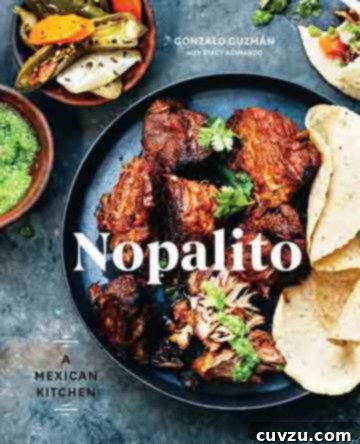
Nopalito
This exquisite recipe is thoughtfully adapted from the acclaimed cookbook “Nopalito,” a celebrated resource for authentic Mexican recipes and profound culinary insights, bringing traditional flavors directly to your kitchen.
Buy On Amazon
Nutrition Facts
Nutrition information is automatically calculated and should be used as an approximation.
- Serving: 1 portion
- Calories: 1464 kcal
- Carbohydrates: 144 g
- Protein: 51 g
- Fat: 80 g
- Saturated Fat: 15 g
- Monounsaturated Fat: 36 g
- Trans Fat: 0.2 g
- Cholesterol: 82 mg
- Sodium: 2677 mg
- Fiber: 19 g
- Sugar: 39 g
What Our Recipe Testers Said: Real-World Experiences
Our dedicated team of recipe testers meticulously follows each recipe, offering invaluable insights and feedback. Here’s what they had to say about their experience preparing these authentic Enchiladas de Mole Poblano:

Greg Crawford
For me, the greatest joy in cooking comes from savoring the delicious results of my efforts. This enchiladas de mole poblano recipe truly put that belief to the test, and I’m thrilled to report it passed with flying colors, despite a few moments of uncertainty during the process. I knew from the outset that this recipe was going to be involved – not overly complicated, but certainly demanding in terms of time and dedication. Yet, when every step was completed and the meal was served, the entire experience proved to be profoundly rewarding and utterly worth every minute spent in the kitchen. The complex, layered flavors of the finished mole were simply sublime.
The magic of mole lies in its intricate blend of diverse flavors, drawing from a wide array of ingredients including nuts, fruits, aromatic spices, and a touch of chocolate. To truly achieve this depth, one must meticulously build these flavors, allowing them to harmonize into a cohesive, rich sauce. Given the sheer number of components, I spent nearly an hour on my “mise en place” – preparing and organizing all the ingredients – before I even began the cooking process. This preparatory step was absolutely essential for a smooth workflow.
During the blending stage, the tomato mixture pushed my blender to its limits, almost overflowing, but I managed to get the entire volume processed. To ensure an extra smooth consistency, I decided to transfer the blended sauce to another pot and give it an additional blitz with my immersion blender, which worked wonderfully. This recipe offered a fantastic opportunity to taste along the way, truly allowing you to observe how the flavors gradually develop and deepen, evolving into that distinctive, delicious mole.
I opted for Mexican chocolate with a 70% cacao content, having several choices available and initially unsure which would be best. While my finished mole didn’t turn out as dark as the picture, after approximately 3.5 hours of dedicated work, we were treated to a truly scrumptious meal. I’m already looking forward to enjoying the flavorful leftovers!

Johnisha L.
This is precisely the kind of recipe that rewards patience with a truly magnificent outcome. The mole sauce itself is incredibly rich, wonderfully fruity, and boasts a velvety texture with numerous layers of flavor. I believe the flavors truly transform and deepen as the sauce rests. During the cooking process, the taste of peanuts was quite prominent, which initially gave me a slight pause as I wasn’t anticipating a primary peanut flavor. However, I decided to wait until the following day to serve the enchiladas, and upon tasting, I could distinctly perceive the beautiful balance of the dried fruits (especially the raisins and prunes), alongside the almonds and pepitas. The wait was absolutely worth it.
Be prepared to keep a close eye on the sauce during its final simmering stages, as it has a tendency to sputter and can be a bit lively! I traditionally prepare enchiladas by rolling, saucing, and then baking them casserole-style with a generous amount of cheese. This recipe, however, suggests a different approach, where cheese is used sparingly as a garnish. I actually prefer this method, as it results in a lighter dish, allowing the inherent richness and complexity of the mole sauce to truly shine without being overshadowed by heavy cheese. While baking enchiladas can soften the tortillas and allow them to deeply absorb the sauce overnight, this “à la minute” assembly provides a different, equally appealing experience, with tortillas that maintain a slightly more toasted texture.
You will undoubtedly have a substantial amount of mole sauce leftover with this recipe, likely enough for two chickens. I plan to freeze my extra mole and am curious to see how well it preserves its incredible flavor for future meals.
Tried this recipe?
We’d love to see your culinary creations! Share your enchiladas de mole poblano with us by mentioning @leitesculinaria or tagging #leitesculinaria on Instagram!