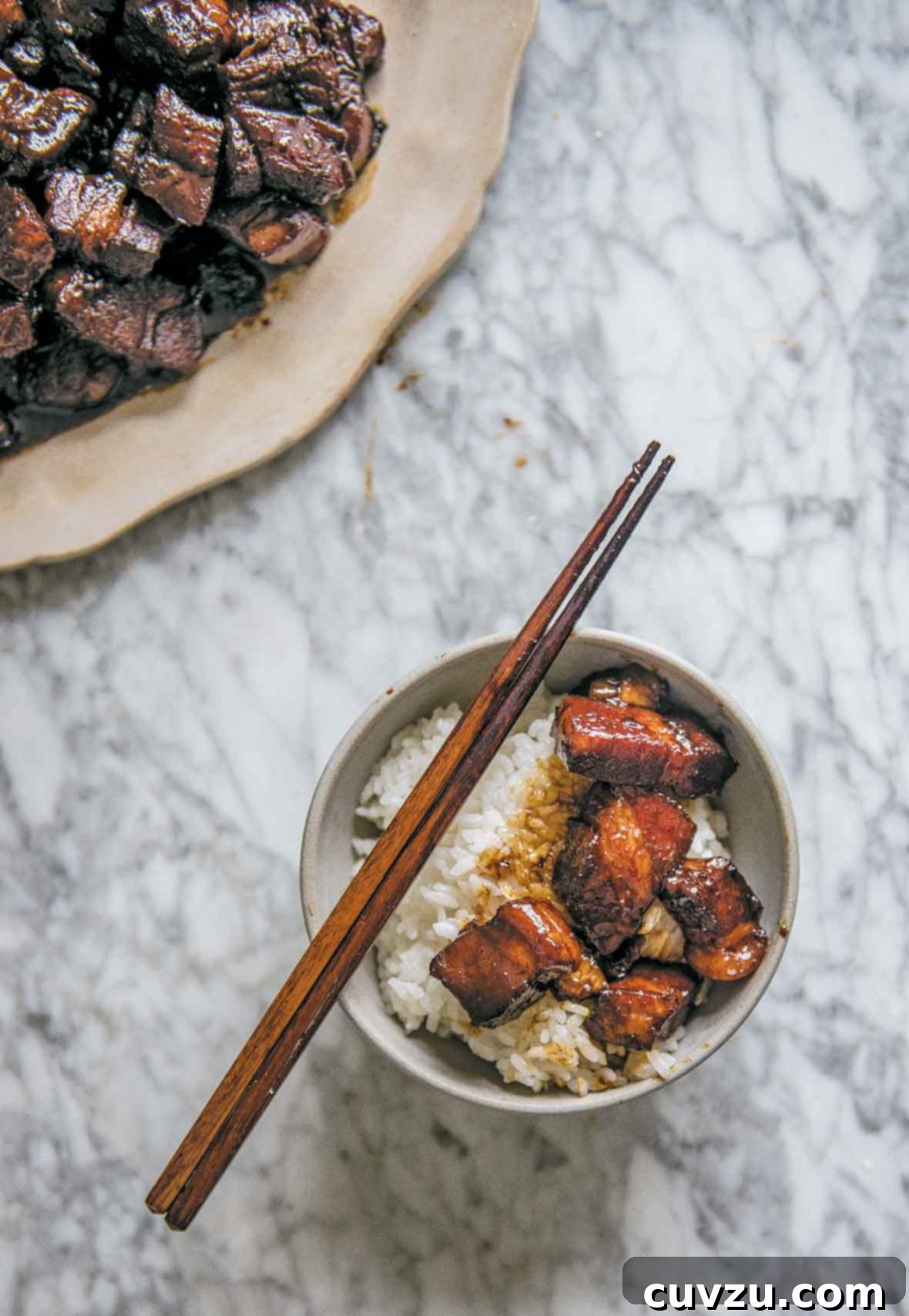
Red cooked pork, a quintessential Chinese dish also known as Hong Shao Rou, stands as a testament to the beauty of slow-cooked comfort food. This beloved culinary masterpiece features incredibly tender, succulent pork belly (or shoulder) luxuriating in a rich, glossy, and deeply flavorful red-brown sauce. The sauce, a harmonious blend of soy sauce, aromatic ginger, pungent garlic, fragrant rice wine, and a touch of sweetness from sugar, is what gives the dish its signature hue and irresistible appeal.
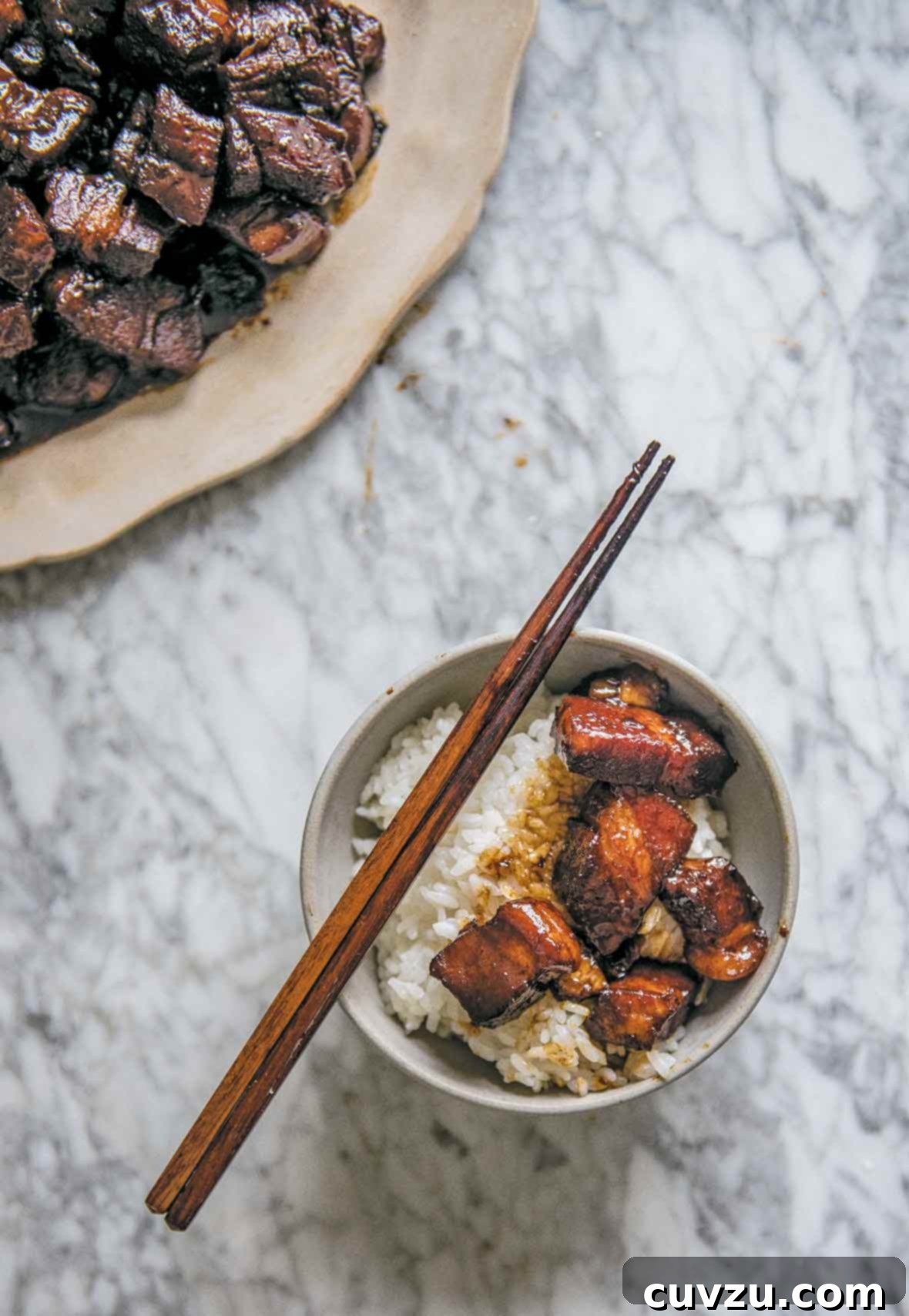
Hong Shao Rou isn’t just a dish; it’s an experience. Each bite delivers a symphony of sweet, savory, and subtly spiced notes, a richness that transforms simple ingredients into an extraordinarily satisfying Chinese classic. It’s a dish cherished across generations, often gracing family tables during celebrations and everyday meals alike. The magic lies in the braising process, which renders the pork incredibly tender, almost melting in your mouth, while the sauce develops an unparalleled depth of flavor that lingers delightfully on the palate.
Our recipe testers raved about this version, praising its full-on richness and the perfect balance of flavors. As one tester, Jenny Howard, succinctly put it, “Our testers couldn’t get enough of the sweet, salty, subtly spiced sauce that bestows full-on richness to such a simple, yet superbly satisfying, Chinese classic.” This sentiment echoes across many kitchens, making Red Cooked Pork a staple for those seeking authentic Asian flavors and comforting meals.
The Cultural Significance and Allure of Hong Shao Rou
Hong Shao Rou holds a special place in Chinese culinary tradition. While specific regional variations exist—from Shanghai’s sweeter rendition to Hunan’s spicier take—the core appeal remains consistent: fall-apart tender pork in a captivating, glossy sauce. It’s often associated with prosperity and good fortune, making it a popular choice for Lunar New Year feasts and other festive gatherings. For many, it evokes a sense of home, tradition, and the comforting flavors of childhood. The careful balance of flavors and textures, combined with the enticing aroma that fills the kitchen, makes it a truly irresistible dish for any occasion.
Unlocking Flavor: What Is Dark Soy Sauce?
This recipe, like many authentic Chinese dishes, calls for both light (regular) soy sauce and dark soy sauce. Understanding the difference between these two is key to achieving the signature taste and appearance of red cooked pork.
Dark soy sauce is a rich, thicker, and less salty variant compared to its light counterpart. Its distinctive characteristics come from its longer aging process and the addition of molasses or caramel, which contributes to its deep, dark color and slightly more viscous consistency. It’s not primarily for saltiness, but rather for imparting that beautiful, deep, mahogany glaze to the pork, as well as a more complex, subtle sweetness and umami depth. You can often find dark soy sauce in well-stocked grocery stores, Asian supermarkets, or readily available online.
If dark soy sauce isn’t available, don’t despair! You can easily create a suitable substitute. Simply use an equal amount of light (regular) soy sauce and add about a teaspoon of molasses (or a pinch of brown sugar) to approximate the rich color and deeper flavor. While it may not be identical, this substitution will still yield a delicious and visually appealing dish.
Crafting Perfection: The Art of Red Cooked Pork
The beauty of Hong Shao Rou lies in its straightforward yet precise cooking method. It’s a braising technique that transforms humble pork into a luxurious dish. Here’s a closer look at the steps that make this recipe shine:
- The Pork Foundation: The choice of pork is crucial. Pork belly, with its layers of tender meat and melt-away fat, is traditional and highly recommended for its richness. Alternatively, pork shoulder offers a leaner option while still achieving great tenderness through slow cooking. The initial blanching step is vital for cleanliness, removing impurities and ensuring a clear, flavorful braising liquid.
- The Caramelization Revelation: This step is where the “red” in red cooked pork truly begins. Melting sugar with water to create a caramel provides the initial glossy coating and deep color for the pork. It’s a delicate process; the sugar quickly transitions from a light amber to a rich brown, so constant vigilance is required to prevent burning, which would impart a bitter taste. This caramel not only colors the pork but also infuses it with a subtle sweetness that balances the savory notes of the soy sauce.
- Aromatics Unleashed: Fresh ginger, garlic, and star anise are the soul of the sauce. Their brief sauté with the caramelized pork releases their intoxicating aromas, building the foundational flavor profile of the dish. Star anise, in particular, adds a warm, licorice-like spice that is characteristic of authentic Chinese braises.
- The Slow Braise: The long, gentle simmer is paramount. This allows the tough collagen in the pork to break down slowly, resulting in meat that is incredibly tender and succulent. It’s a patient process, but the reward is pork that practically melts in your mouth, infused with all the rich flavors of the braising liquid. A minimum of one hour is good, but for maximal sublime tenderness, extending the braise up to two hours is highly recommended by our testers.
- The Perfect Glaze: After the pork is tender, the final step involves reducing the cooking liquid. This process concentrates the flavors and thickens the sauce, creating that desirable glossy, clingy glaze. It’s important not to reduce it too much; you’ll want plenty of that irresistible sauce to spoon generously over your rice and pork. A taste test at this stage allows for final adjustments of sweetness or saltiness to suit your preference.
Explore More Delicious Pork Recipes:
- Vietnamese-Style Caramelized Pork
- Braised Pork in Red Chile Sauce
- New Mexican Red Pork Chili
- Chinese Roast Pork
Red Cooked Pork
David Leite
PIN
Mains
Chinese
4
to 6 servings
301
kcal
15
1
45
2
Ingredients
-
2
pounds
pork belly or pork shoulder or a combination,
cut in 3/4- to 1-inch (2- to 2.5-cm) chunks -
1/4
cup
granulated sugar,
plus more to taste -
2
tablespoons
plus 2 to 3 cups water -
3 to 4
scallions,
cut on the diagonal into 2-inch (5-cm) lengths (about 1/4 cup sliced) -
3 to 4
garlic cloves,
smashed, or 1 tablespoon minced garlic -
1
inch
piece ginger root,
sliced into 6 to 8 circles -
3
whole star anise -
1/3
cup
Shaoxing rice wine,
dry sherry, or sake -
3
tablespoons
light (regular) soy sauce,
plus more to taste -
3 to 4
teaspoons
dark soy sauce* (see NOTE above) -
Cooked rice,
for serving
Instructions
-
Bring a large pot of water to a boil over medium-high heat. Add the pork and gently boil for about 10 minutes, skimming off any scum as it forms on top of the water. Drain the pork and rinse to remove any remaining scum. This crucial step cleanses the pork and results in a clearer, richer sauce.
-
In a large wok or cast-iron skillet over medium-high heat, combine the sugar and 2 tablespoons water and stir until it dissolves. Tilt the wok or skillet to swirl the mixture, without stirring, just until it bubbles and begins to turn slightly darker in certain spots, typically 4 to 5 minutes. Exercise extreme caution during this step, as the sugar can quickly transition from a perfect golden brown to burnt black in mere seconds, which would impart an undesirable bitter flavor.
-
Add the pre-boiled and rinsed pork to the caramelized sugar mixture. Cook, stirring frequently, until the pork is beautifully browned on all sides and releases a fragrant aroma, usually about 4 minutes. The caramel will adhere to the pork, beginning the process of its signature “red” coating.
-
Introduce the scallions, smashed garlic, sliced ginger, and whole star anise. Toss these aromatics with the pork for 1 to 2 minutes, allowing their flavors to bloom and infuse. Then, pour in the Shaoxing rice wine (or dry sherry/sake), both light and dark soy sauces, and enough water to just cover the pork, approximately 2 to 3 cups. Stir gently to combine all ingredients. Cover the wok or skillet and reduce the heat to low, allowing the pork to simmer ever-so-gently until it is fork-tender. This braising process should take at least 1 hour, but for optimal, melt-in-your-mouth tenderness and deeper flavor, we recommend cooking for up to 2 hours.
-
Once the pork has reached your desired tenderness, assess the consistency of the cooking liquid. If you prefer a thicker, more concentrated sauce, carefully transfer the tender pork to a plate. Return the wok or skillet to medium-high heat and simmer the sauce, uncovered, stirring occasionally, until it reduces to your preferred consistency, which typically takes 10 to 15 minutes. Be mindful not to reduce the sauce too much, as you’ll want ample amounts of this flavorful glaze to generously coat both the pork and your accompanying rice. Taste the sauce and, if necessary, adjust with additional soy sauce for saltiness or sugar for sweetness. Spoon the succulent pork and rich sauce over freshly cooked rice. Leftovers can be refrigerated or frozen and gently reheated, often tasting even better the next day as the flavors continue to meld.
Adapted From
A Common Table
Buy On Amazon
Discover More with Our Guides
Ingredient Substitutions
Scaling Recipes
Recipe Summaries & Analysis
Exploring Dietary Options for Red Cooked Pork
While traditional Red Cooked Pork is rich in flavor and ingredients like pork belly and soy sauce, it’s possible to consider variations for different dietary needs:
- Gluten-Free: The primary ingredient to watch is soy sauce. Opt for tamari or a certified gluten-free soy sauce alternative. Ensure any other sauces or additives are also gluten-free.
- Vegetarian/Vegan: This dish can be reimagined with firm tofu, tempeh, or substantial mushrooms (like king oyster or shiitake) cut into chunks. The cooking method would involve browning the substitutes, then braising them in the same flavorful sauce base. You’d also need to replace the pork belly with a plant-based alternative.
- Dairy-Free: Red Cooked Pork is naturally dairy-free, making it a great option for those with dairy sensitivities.
- Lower Sodium: Use low-sodium light and dark soy sauces. You might need to adjust the balance of sugar and other aromatics to maintain flavor depth.
Important Note: While these suggested adjustments are informed by careful research, neither David Leite nor his recipe testers have prepared or tasted the recipe with these specific modifications. Results may vary.
Creative Ingredient Substitutions for Red Cooked Pork
Sometimes you need to make a dish work with what you have, or you want to experiment with different flavor profiles. Here are some creative substitutions for this recipe:
- Pork Cut: While pork belly is traditional for its richness, pork shoulder (boneless or bone-in) is an excellent alternative, offering a leaner but still tender result. Pork spareribs can also be used for a slightly different texture and presentation.
- Shaoxing Rice Wine: Dry sherry is the most common and effective substitute. Sake can also work, providing a similar umami depth. In a pinch, a dry white wine with a splash of rice vinegar can be used, though the flavor profile will be slightly different.
- Star Anise: If you don’t have star anise, a small pinch of five-spice powder can offer a similar aromatic complexity, but use sparingly as it’s potent. A bay leaf or a tiny piece of cinnamon stick might also add warmth.
- Ginger and Garlic: While fresh is always best for these aromatics, garlic powder and ground ginger can be used in smaller quantities (e.g., 1/2 tsp ground ginger for 1 inch fresh, 1/2 tsp garlic powder for 1 clove). The fresh flavor, however, is highly recommended.
- Sugar: While granulated sugar is specified for caramelization, brown sugar can also be used, adding a slightly deeper, molasses-like note to the caramel.
A quick note: The ingredient substitutions provided are based on thorough research. However, this particular version of the recipe has not been personally tested by David Leite or his team of recipe testers with these modifications, so results may vary.
Expert Tips for Scaling This Recipe
Scaling a recipe like Red Cooked Pork is generally straightforward, but a few considerations can ensure success:
- Pork Quantity: You can easily double or halve the pork. Ensure your pot is large enough to accommodate the increased volume without overcrowding, which can hinder browning and tenderization.
- Liquid and Seasoning: When scaling, maintain the ratio of liquid (rice wine, soy sauces, water) to pork. For seasoning, always start with slightly less soy sauce and sugar than the calculated amount for larger batches. It’s easier to add more later than to correct an overly salty or sweet dish. Taste and adjust during the final reduction phase.
- Cooking Time: While the ingredients scale linearly, the cooking time might not. Larger batches might require slightly longer braising times to achieve the same tenderness, but keep the heat low and slow. Smaller batches might cook slightly faster. Always check for tenderness.
- Pot Size: Use a pot that allows the pork to sit relatively snugly but with enough surface area for the sauce to reduce effectively.
Important Note for All Scaled Recipes: While these calculations are carefully considered, David and his recipe testers have NOT tested the recipe at these scaled quantities. Because of that, carefully monitor cooking times and make necessary adjustments.
Summarize and Analyze Key Insights from This Red Cooked Pork Recipe
This Red Cooked Pork recipe from Leite’s Culinaria offers a simple yet incredibly rewarding approach to a classic Chinese dish. Key insights include:
- Accessibility: The recipe demystifies Hong Shao Rou, making it approachable for home cooks who might assume it’s complicated.
- Flavor Depth: Emphasizes the crucial role of both light and dark soy sauces, along with careful sugar caramelization, to build its signature sweet, savory, and umami profile.
- Technique Focus: Highlights essential techniques like blanching the pork for cleanliness, slow braising for tenderness, and sauce reduction for a perfect glaze.
- Adaptability: Provides practical advice on dark soy sauce substitution, making the recipe flexible for different pantries.
- Enhanced Leftovers: The consensus from testers is that the dish tastes even better the next day, indicating flavors meld and deepen over time.
This summary and analysis are based on the content provided by Leite’s Culinaria.
Nutrition
Serving:
1
portion
Calories:
301
kcal
Carbohydrates:
17
g
Protein:
30
g
Fat:
10
g
Saturated Fat:
3
g
Monounsaturated Fat:
5
g
Cholesterol:
93
mg
Sodium:
1114
mg
Fiber:
1
g
Sugar:
13
g
Nutrition information is automatically calculated, so should only be used as an approximation.
Tried this recipe?
Mention @leitesculinaria or tag #leitesculinaria!
Insights from Our Recipe Testers
Our team of dedicated recipe testers consistently praised this Red Cooked Pork recipe for its incredible flavor and surprisingly simple preparation. Their experiences offer valuable insights for anyone embarking on this culinary journey.
Mardi Michels
Mardi was genuinely surprised by how easily this flavorful dish came together with relatively few ingredients. She strongly recommends not over-reducing the sauce, as its richness is best savored generously with rice. Mardi used boneless rib-end chops and dry sherry, along with a light soy sauce and molasses substitution. She noted that while it tasted great on the day it was made, she wished for a bit more sauce for the excellent leftovers.
Barb P.
Barb served this dish on a cold night to a warm reception, highlighting the beautiful balance between ginger’s heat, sugar’s sweetness, and the fragrant star anise. She used pork shoulder cut into 1-inch chunks and braised it for a full hour and a half, resulting in “melt-in-your-mouth tender” pork. Barb, like Mardi, opted for dry sherry. The limited leftovers were a clear sign of its popularity, and they reheated perfectly for lunch the following day.
Henry Tsai
As a fan of Red Cooked Pork who previously thought it too complex to make at home, Henry was delighted to find this recipe to be a simple path to “deep, rich, and flavorful pork.” He wholeheartedly agreed that serving it with rice is essential for an amazing combination. Henry highly recommends stewing for closer to 2 hours for maximum tenderness, though he found it delicious even after just one hour. He also confirmed that using all light soy sauce with a molasses substitute works perfectly. He noted that the intense flavor means it can easily serve more than 6 people with rice, and confirmed that the flavors indeed improve with time.
Elie Nassar
Elie described the Red Cooked Pork as a “very deeply flavored stew that is very simple to make.” He used a combination of pork shoulder and belly, noting his personal preference for the belly, while his family favored the leaner shoulder. He highlighted the addictive quality of the dish, attributing it to the rich meat, salty sauce, and the aromatic blend of star anise and ginger. After 2 hours of cooking, the meat was perfectly tender. He cleverly kept it in the turned-off pot until dinner, resuming the recipe closer to mealtime. Elie suggested the recipe comfortably serves 4, and potentially 6, depending on accompanying dishes.
Jenny Latreille
Jenny confessed her past mistake of never having cooked pork shoulder, realizing what a fantastic cut it is through this recipe. She found the instructions easy to follow, giving her confidence even with an unfamiliar meat cut. She confirmed the dish delivers on taste, agreeing that leftovers are even better. Her batch yielded 6 generous servings, with plenty for dinner and subsequent lunches. Unable to find dark soy sauce, Jenny used the recommended substitution with molasses and loved the resulting flavor, planning to continue with it until she can source dark soy sauce.