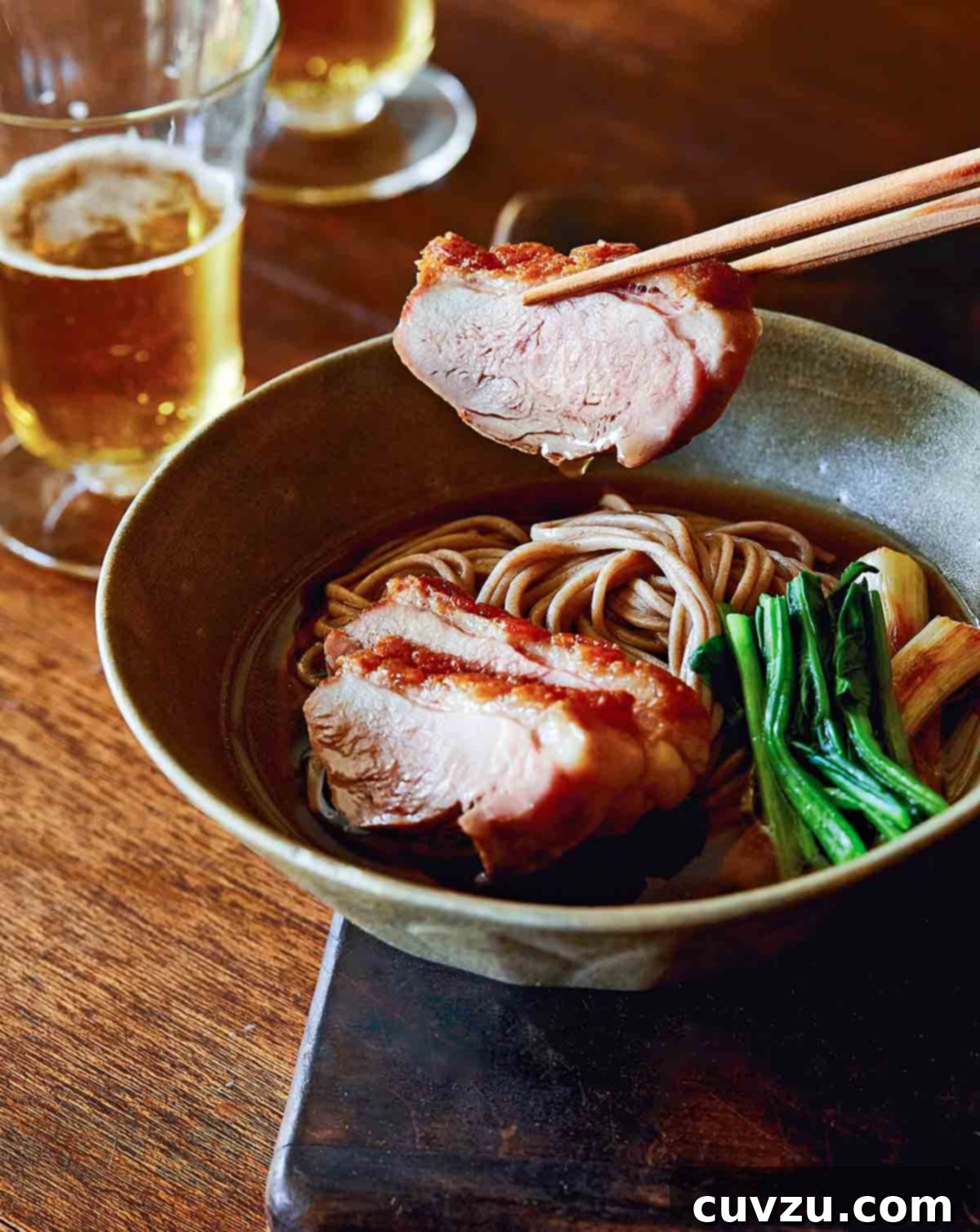
Authentic Duck Soba: A Heartwarming Japanese Tradition for Any Season
Embrace the rich flavors and comforting embrace of Duck Soba (Kamo Nanban Soba), a deeply satisfying Japanese noodle dish that marries savory duck breast with a delicate dashi broth, crisp soba noodles, and fresh greens. While traditionally revered for New Year’s Eve celebrations in Japan, its soul-warming qualities make it a perfect culinary escape for any cold day or simply whenever you crave a bowl of profound deliciousness.
More Than Just a Meal: The Significance of Soba
Duck soba, known as Kamo Nanban Soba, is a culinary masterpiece that delivers a symphony of textures and tastes. It features tender, crisp-skinned duck breast, robust soba noodles, fresh spinach, and sweet fried scallions, all harmoniously bathed in a meticulously seasoned dashi broth. This dish is not merely food; it’s an experience, a slurpable bowl of goodness that connects you to centuries of Japanese culinary artistry.
In Japan, soba holds a special place, particularly during Ōmisoka, New Year’s Eve. The tradition of eating Toshikoshi Soba (year-crossing noodles) at midnight symbolizes a wish for longevity, as the long, thin noodles represent a long life. It also signifies letting go of the past year’s hardships, as soba noodles are easily cut, metaphorically “cutting off” any misfortune. The addition of duck elevates this traditional dish, providing a luxurious depth and richness that is cherished by many.
As Angie Zoobkoff, a passionate culinary enthusiast, notes, “We can understand why it’s revered as a New Year’s Eve tradition in Japan as we feel pretty darn lucky each time we’re fortunate enough to partake of it. (And it really is all about your perspective, isn’t it?)” This sentiment perfectly captures the essence of duck soba – a dish that makes any moment feel special.
Duck Soba Recipe
David Leite
Mains
Japanese
2
servings
2084
kcal
30
1
15
1
45
Ingredients
For the Dashi Broth
Dashi is the foundation of many Japanese dishes, providing a delicate umami flavor. Making it from scratch ensures the freshest, most authentic taste for your soba.
- 8 cups water
- One (5-by 10-inch) sheet kombu (or enough smaller pieces to make a similar size rectangle)
- 4 cups tightly packed bonito flakes (katsuobushi)
For the Seasoned Spinach (Ohitashi)
This simple yet flavorful spinach side dish adds a touch of green and a refreshing contrast to the rich duck and noodles.
- 1 pound regular or baby spinach, chopped (or other tender, leafy green like bok choy)
- 1/2 cup dashi (prepared from the previous step)
- 2 tablespoons low-sodium or regular soy sauce
- 2 teaspoons mirin (Japanese sweet rice wine)
For the Duck Soba Bowl
The star of the show, perfectly seared duck breast, combined with bouncy soba noodles and a savory broth, creates an unforgettable meal.
- 1 (about 5 ounces) skin-on duck breast
- Kosher salt, to taste
- 4 scallions, cut into 2-inch (5-cm) lengths
- 3 cups dashi (prepared)
- 3 tablespoons plus 1 teaspoon low-sodium or regular soy sauce
- 1 tablespoon plus 1 teaspoon mirin
- 7 ounces dried soba noodles
- 1/2 cup seasoned spinach (ohitashi), prepared
Instructions
Step 1: Master the Dashi Broth
Creating your own dashi is a foundational skill in Japanese cooking and truly enhances the flavor of your duck soba. This delicate broth requires minimal effort but delivers maximum umami.
-
In a large pot, bring 8 cups of water to a gentle simmer over high heat. The key here is “gentle”—avoid a rolling boil as it can extract bitterness from the kombu. Once simmering, remove the pot from the heat and carefully add the kombu sheet. Allow it to steep for exactly 5 minutes. This gentle steeping extracts the sweet, savory essence of the kombu.
-
After 5 minutes, add the tightly packed bonito flakes to the pot. Cover the pot with a lid and let it sit undisturbed for 15 minutes. During this time, the heat from the water will gently infuse the bonito flakes, releasing their distinct smoky, fishy umami into the broth.
-
Strain the finished broth through a fine-mesh strainer into a clean bowl or container. Pressing the solids too hard can result in a cloudy or bitter dashi, so simply let it drip naturally. Allow the dashi to cool completely. Once cooled, you can cover and refrigerate this flavorful base for up to 2 days or freeze it for several months, making future Japanese meals quick and easy.
Step 2: Prepare the Seasoned Spinach
This simple spinach side dish, known as Ohitashi, adds a fresh, vibrant, and slightly sweet-savory element to your soba, balancing the richness of the duck.
-
First, prepare an ice bath: fill a large bowl halfway with ice water. This is crucial for stopping the cooking process and preserving the spinach’s bright green color. Bring a separate pot of generously salted water to a rolling boil.
-
Add the chopped spinach to the boiling water. Cook just until it wilts, which will be 1 to 2 minutes. Baby spinach will cook faster, while tougher, mature leaves may need the full 2 minutes. Immediately drain the spinach in a colander, then plunge it into the prepared ice bath to rapidly cool it down and halt further cooking.
-
Once the spinach is completely cool to the touch, drain it again thoroughly. Use your hands to squeeze out as much excess water as possible. This step is important to prevent the seasoned spinach from becoming watery. Transfer the squeezed spinach to a small mixing bowl.
-
In the bowl with the spinach, stir in the 1/2 cup of reserved dashi, 2 tablespoons of soy sauce, and 2 teaspoons of mirin. Mix well to ensure the spinach is evenly coated. Cover the bowl and refrigerate for at least an hour before serving to allow the flavors to meld and the spinach to absorb the seasoning.
Step 3: Assemble the Perfect Duck Soba
With your dashi and spinach ready, the final steps involve preparing the star of the dish – the duck breast – and bringing all the components together for a truly magnificent bowl of soba.
-
Begin by preparing the duck breast. Using a sharp knife, score the skin of the duck breast diagonally every 1/4 inch (6 mm). Be very careful to cut only through the skin and fat, not into the meat itself. Repeat this process in the opposite direction to create an appealing crosshatch pattern. This scoring helps render the fat more efficiently, resulting in beautifully crispy skin.
-
Season both sides of the duck breast generously with 1 teaspoon of kosher salt. Allow the duck to rest at room temperature for about 20 minutes. This helps the salt penetrate the meat and brings the duck closer to cooking temperature, promoting even cooking.
-
Place a medium skillet over medium heat. Add 1/4 cup of water to the cold pan. Place the duck breast into the pan, skin side down. Cook until the water has completely evaporated, which typically takes 6 to 10 minutes. The water helps to slowly render the fat without burning the skin. Continue to cook, still skin side down, until the skin is beautifully browned and crisp, another 10 to 15 minutes. This slow rendering is key to achieving that irresistible crispy skin. Flip the duck breast so it’s skin side up and cook to your desired doneness: approximately 3 minutes for a perfect medium-rare, or about 5 minutes for medium-well. Transfer the cooked duck breast to a cutting board and let it rest for a few minutes before slicing – this allows the juices to redistribute, ensuring a tender result.
-
While the duck rests, carefully drain most of the rendered duck fat from the skillet, leaving just a thin coating. Return the skillet to medium heat. Add the cut scallions and cook them until they are lightly browned and wilted, about 2 to 5 minutes. These caramelized scallions add a wonderful sweetness and char to the final dish.
-
Meanwhile, bring 6 cups of water to a boil in a medium pot and season it liberally with salt. This will be for cooking your soba noodles.
-
In a separate saucepan over high heat, combine the remaining 3 cups of prepared dashi, 3 tablespoons plus 1 teaspoon of soy sauce, 1 tablespoon plus 1 teaspoon of mirin, and 1 teaspoon of salt. Bring this mixture to a gentle simmer. This will be your rich and flavorful soba broth.
-
Cook the soba noodles in the boiling salted water according to the package instructions. Soba cooks quickly, typically in just a few minutes, so watch them closely to avoid overcooking. Once al dente, drain the noodles well and divide them evenly between two large serving bowls.
-
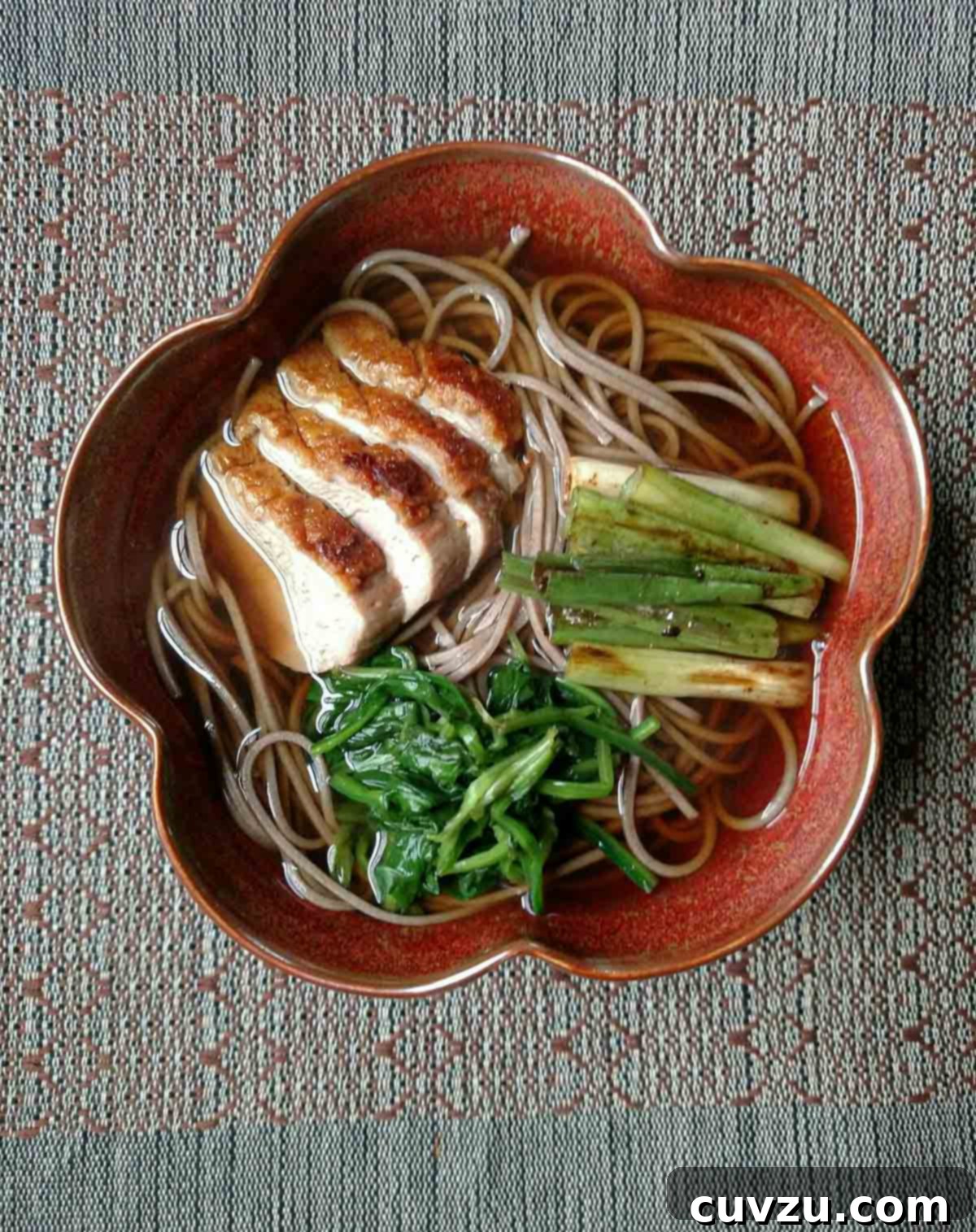
Thinly slice the rested duck breast on a slight diagonal. Ladle the simmering dashi broth generously over the soba noodles in each bowl. Arrange the thinly sliced duck and the browned scallions on top. Finish by adding a spoonful of the seasoned spinach (ohitashi) to each bowl. Serve immediately and enjoy the harmonious blend of flavors and textures.

Adapted From
The Gaijin Cookbook
Buy On Amazon
Nutrition
Serving:
1
serving
Calories:
2084
kcal
Carbohydrates:
94
g
Protein:
350
g
Fat:
4
g
Saturated Fat:
1
g
Monounsaturated Fat:
1
g
Cholesterol:
317
mg
Sodium:
5991
mg
Fiber:
6
g
Sugar:
6
g
Nutrition information is automatically calculated, so should only be used as an approximation.
Tried this recipe?
Mention @leitesculinaria or tag #leitesculinaria!
Insights from Our Recipe Testers
Our team of dedicated recipe testers rigorously evaluates each dish, ensuring clarity, accuracy, and delicious results. Here’s what they had to say about this delightful Duck Soba recipe:
Chiyo Ueyama
Having lived in Japan for many years, I’ve had my share of soba, especially on New Year’s Eves. While duck dishes might not be the most common, Kamo Nanban, or duck soba with charred scallions, is indeed a cherished Japanese dish, and this rendition with spinach ohitashi is exceptionally good! The gentle dashi beautifully balances the richness of the duck, and I particularly enjoyed the delicate crunch of the scallions and spinach contrasting with the smooth soba noodles.
It’s worth remembering that, much like other Asian noodle soups, soba is quick to eat, but preparing it with a homemade broth can be a slow, meditative ritual. This recipe, however, executed perfectly without needing any traditional nitpicking.
For those making their own dashi, if you can’t find large sheets of kombu (which can be rare), simply gather enough smaller pieces to roughly match the specified size. When selecting bonito flakes, I recommend avoiding the very fine, garnish-like flakes. I used hanakatsuo, which are wider shavings that include the darker meat near the fish’s spine, providing a much deeper, more robust flavor. Just like chicken stock, I divided any leftover dashi into small jars and froze it for later use. Don’t discard the used kombu or bonito! The kombu can be thinly julienned and added to salt and sugar pickles, while the spent bonito still holds enough flavor to enhance fried rice or vegetable stir-fries, adding an interesting twist.
Valerie Shiba
As a Japanese-American, eating toshikoshi soba every New Year’s Eve is a cherished family tradition, so this recipe was perfect for the occasion. My family isn’t overly strict with traditions, which allowed me to comfortably prepare this non-traditional duck soba version.
Around New Year’s, Japanese grocery stores typically stock nama-soba (fresh soba), which I would have loved to use for an even more authentic texture. However, I used some excellent dried soba given to me by my mother, which worked wonderfully. The beauty of this recipe is that both the dashi and the spinach ohitashi can be prepared ahead of time, significantly reducing the active cooking time on the day. This meant the only truly time-consuming part was cooking the duck, which was a new experience for me.
Since I’m pregnant, I aimed for a medium to medium-well doneness for the duck. I cooked it at a slightly higher heat than medium, and the result was surprisingly good. I was intrigued by the method of starting the duck in a pan with water; I wonder if this is a typical Japanese technique for rendering duck fat? It certainly seemed effective!
I don’t recall ever having soba with duck before, so this was a delightful twist on a classic. The broth for the soba was lightly seasoned, which I thoroughly enjoyed, allowing the rich flavors of the dashi and duck to shine through. Overall, I found this to be an excellent dish that I believe would make my mom proud. Despite my initial intimidation about cooking duck breast for the first time, the recipe was straightforward and yielded fantastic results.