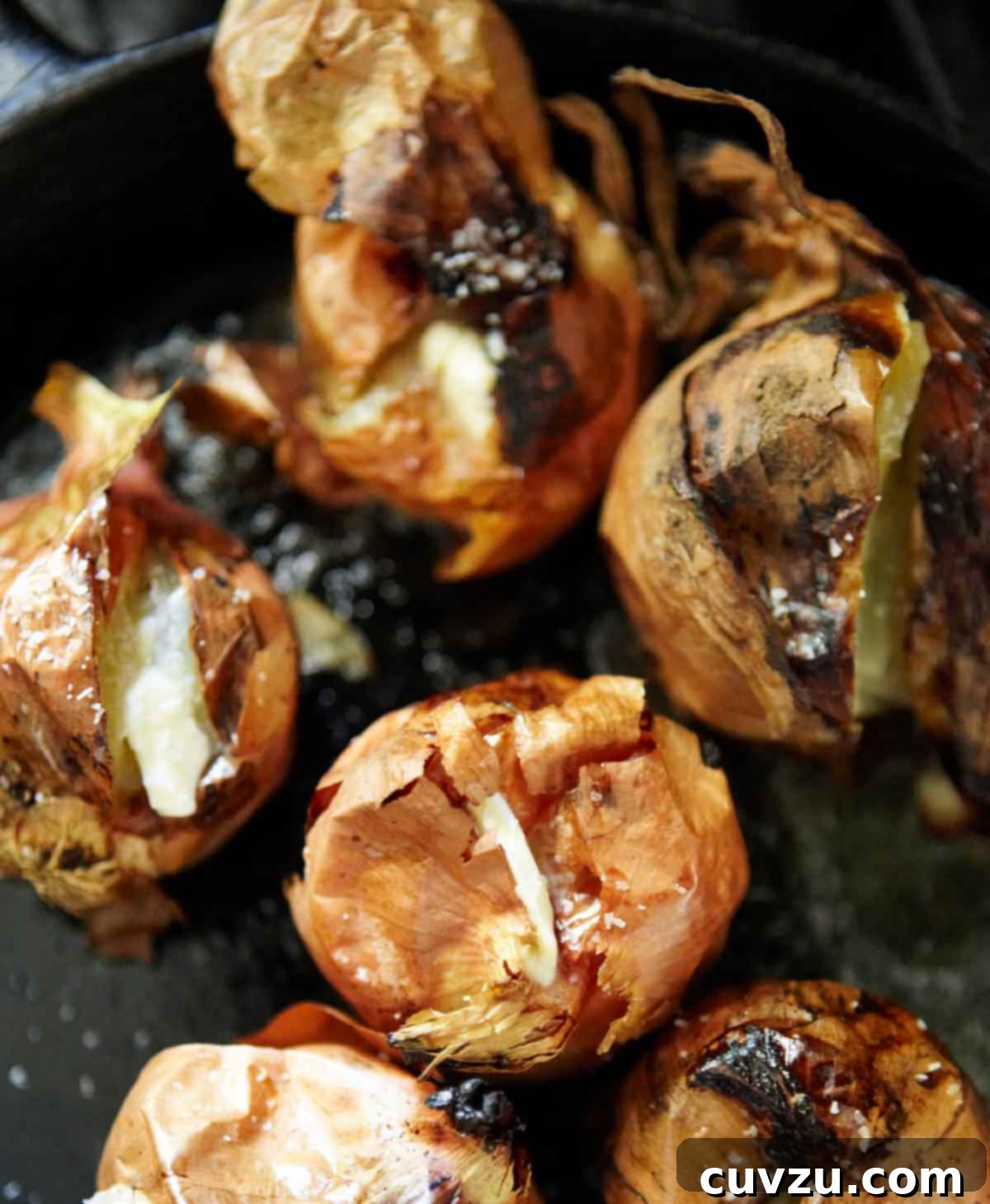
Effortless Elegance: The Magic of Whole Roasted Onions
Discover the surprising simplicity and incredible flavor of whole roasted onions. This method transforms humble onions into a tender, mellow, and inherently sweet side dish or versatile ingredient with remarkably little effort. Forget the tears and endless chopping; these onions practically cook themselves, emerging from the oven with a rich, inviting aroma and a silky texture that will redefine your appreciation for this kitchen staple. We’ll show you exactly how long to roast them to achieve perfection, ensuring a delightful experience every time.
Featured Review
A bit skeptical, I tried it on one onion. It was wonderful! I will no longer slave over a hot wok for half an hour to get sort of good onions. I will use your recipe in the oven! Thank you!
Ken J.
Imagine this: you take unpeeled onions, place them on a baking sheet, and slide them into a hot oven. That’s it. No peeling, no chopping, no sautéing. Later, you retrieve gloriously sweet, incredibly tender, and wonderfully mellow onions, ready to impress with their rich flavor and surprisingly effortless preparation. It’s a culinary revelation that proves simplicity often yields the most profound results.
While whole roasted onions may not achieve the intense, deep caramelization and sugary sweetness of their meticulously caramelized cousins, they unequivocally outshine them in terms of ease and convenience. Furthermore, their versatility is boundless, making them an invaluable addition to nearly any meal. This isn’t just a recipe; it’s a testament to how effortlessly you can coax superb flavor from basic ingredients.
The Unexpected Elegance of Roasting Onions Whole
The magic of roasting onions whole lies in the natural process that unfolds within their papery skins. Encased in their protective layers, the onions steam and soften in their own juices, slowly transforming their pungent raw flavor into a delightful sweetness. The high heat of the oven encourages a gentle caramelization of their natural sugars, intensifying their depth of flavor without requiring constant stirring or monitoring. This method not only minimizes prep time but also ensures a uniformly tender interior and a beautifully mellow taste that complements a wide array of dishes.
Selecting the Perfect Onion for Roasting
One of the beauties of this incredibly flexible technique is that it welcomes almost any type of onion you have on hand. However, understanding the characteristics of different varieties can help you tailor the results to your preference. Each onion type offers a unique profile when roasted:
- Yellow Onions: These are your workhorse onions, offering a balanced sweetness and robust flavor when roasted. They soften beautifully and develop a lovely golden hue.
- White Onions: Often milder than yellow onions, white onions become exceptionally tender and sweet, with a delicate flavor that’s perfect for a subtle accompaniment.
- Red Onions: While they retain a slight firmness compared to yellow or white onions, red onions offer a beautiful color and a distinct, slightly pungent flavor that mellows wonderfully with roasting. A drizzle of balsamic vinegar after roasting perfectly complements their character.
- Sweet Onions (e.g., Vidalia, Walla Walla): As their name suggests, these onions are naturally higher in sugar content, leading to a more pronounced caramelization and an intensely sweet, almost dessert-like flavor when roasted. They become incredibly creamy and melt-in-your-mouth tender.
- Shallots: Smaller and more delicate than standard onions, shallots roast quickly and become incredibly sweet and garlicky. They are excellent for finer dishes or as a concentrated flavor burst.
- Pearl Onions: These tiny onions are fantastic for roasting whole, offering charming presentation and a burst of sweet flavor. They’re perfect as a garnish or a small, flavorful bite.
Don’t hesitate to experiment with different varieties to discover your personal favorite. The key is to keep an eye on them during roasting, as larger, denser onions will naturally require more time than smaller, sweeter ones.
Elevate Your Plate: How to Use Whole Roasted Onions
Once roasted, these sweet, tender orbs of goodness are incredibly versatile. You can enjoy them simply as they are, allowing their natural sweetness to shine through. Or, for a touch of culinary flair, “gussy them up” with an array of complementary flavors as soon as they emerge from the oven. Their mellow sweetness acts as a perfect canvas for both savory and slightly tangy additions.
Simple Enhancements:
- A generous pat of butter, melting into the warm layers.
- A dollop of rich crème fraîche for creamy indulgence.
- A drizzle of high-quality olive oil for a fruity, peppery note.
- A splash of tangy balsamic or sherry vinegar to balance the sweetness.
- A crumbling of robust blue cheese for a sharp, savory contrast.
- A sprinkling of fresh thyme leaves or chopped rosemary for aromatic depth.
Creative Combinations:
- A lot of freshly ground black pepper for a subtle kick.
- A dash of your favorite hot sauce for a fiery zing.
- A luxurious combination of butter, blue cheese, and crème fraîche for ultimate decadence.
- Honey butter for an even sweeter, richer flavor profile.
- Fresh curly parsley leaves for a bright, herbaceous finish.
Beyond enjoying them whole, roasted onions can be chopped and incorporated into countless other dishes, lending their spectacular loveliness and depth of flavor to other ingredients. Their soft texture and concentrated sweetness integrate beautifully into various culinary creations.
Savory Applications:
- Pile them high on juicy burgers.
- Fold them into flavorful tacos or burritos.
- Layer them in gourmet sandwiches or paninis.
- Mix them into hearty whole-grain side dishes like couscous, farro, or quinoa.
Main Dish Pairings:
- Whisk them into pan sauces or gravies for an instant flavor boost.
- Serve alongside succulent grilled chicken or other poultry.
- Accompany a perfectly cooked roast beef.
- Complement a tender roasted pork loin.
- Excellent on homemade pizza or flatbreads.
The possibilities are truly endless, limited only by your imagination. These roasted onions are a testament to how a simple technique can yield an ingredient that elevates everything it touches.
More Mouth-Watering Onion Recipes
Red Wine Onions
2 hrs
Quick Pickled Red Onions
4 hrs 10 mins
Big Batch Caramelized Onions
7 hrs
Portuguese Onions, Chestnuts, and Bacon
30 mins
Share Your Experience
If you make this recipe, or any dish on LC, consider leaving a review, a star rating, and your best photo in the comments below. We love hearing from you!
Featured Review
This recipe is simple and to the point. You really can’t go wrong. The onions I chose—sweet Spanish onions—were on the large side, so the roasting time took a few extra minutes. I wasn’t a fan of pulling off the skins, but other than that, the onions were a hit. I had a fresh baguette from the farmers market, and we served the onions on it, along with a mild goat cheese spread.
Amy C.
Whole Roasted Onions
Our goal is to make recipes accessible, using minimal ingredients and manageable techniques. Some dishes are so simple they barely qualify as recipes, and this whole roasted onion is a perfect example of that philosophy.
By David Leite
Ingredients
- Onions*, as many as you please, unpeeled (see notes for variety suggestions)
- Salt, to taste
Instructions
- Preheat Oven: Preheat your oven to 425ºF (218°C).
- Roast Onions: Arrange as few or as many unpeeled whole onions as desired on a rimmed baking sheet. For easier cleanup, line the baking sheet with aluminum foil or parchment paper. Roast for a minimum of one hour, or longer, depending on the size of your onions. The onions are done when their papery skins are deep golden brown and slightly blistered, and the inner layers feel yielding and tender when pierced with the tip of a sharp knife.
- Serve: To serve, carefully use a knife to slice horizontally across the very top of each roasted onion, discarding this top portion or adding it to your compost. Sprinkle generously with salt. Diners can then easily unpeel the softened onion layers themselves, discarding the papery skins as they go.
Notes
*What kind of onions can I roast?
The true beauty of this recipe lies in its adaptability. You can use almost any type of onion you have available, and each will offer a slightly different, yet delicious, result. Sweeter varieties like Vidalia or other sweet Spanish onions will caramelize more readily and become intensely sweet. Red onions will retain a bit more of their characteristic bite and structure, pairing wonderfully with a drizzle of balsamic vinegar. Don’t overlook smaller options; shallots and tiny pearl onions are also fantastic candidates for roasting whole, offering concentrated flavor and elegant presentation.
Experiment with different types to find which ones you love most! Remember that cooking times will vary slightly depending on the size and density of the onions.
Adapted From

Cooking in the Moment
Buy On Amazon
Explore More with AI
Substitutions
Scale
Summarize
Nutrition
Serving: 1 serving
Calories: 15 kcal
Carbohydrates: 4 g
Protein: 1 g
Fat: 1 g
Saturated Fat: 1 g
Monounsaturated Fat: 1 g
Sodium: 2 mg
Fiber: 1 g
Sugar: 2 g
Nutrition information is automatically calculated, so should only be used as an approximation.
Tried this recipe?
Mention @leitesculinaria or tag #leitesculinaria!
Recipe Testers’ Reviews
Alexander Cowan
Simplicity at its finest! I opted to roast these whole onions on my outdoor gas grill. I heated the entire grill with all four burners blazing, then turned two of them off, and the other two down to low. This kept the temperature at a steady 450°F. I placed the unpeeled onions directly on the side with no flame and grilled for just over an hour until they were soft to the touch.
After cooling a bit, I sliced them up, sprinkled them with salt, and ate the onions right on the spot. I couldn’t believe how sweet and tender these were. I chopped up what leftovers I had with grilled broccoli and grilled tomatoes, tossed with prepared couscous, lemon juice, olive oil, feta, and salt and pepper. This is what I like to call a “bounty salad”—essentially anything that’s leftover from the farmers market, grilled and chopped into a salad. These were the perfect addition to the mix and will be a perfect addition to any burger, taco, burrito, sandwich, light snack—well, you get the point.
Karen Depp
This whole roasted onions recipe is so simple, it’s sinful. Just plop a bunch of whole onions on a baking sheet for an hour, and there you have it. Perfectly creamy, delicious, steaming onions ready to be eaten alongside whatever else was in the oven or on the grill. Perfect with just some butter, salt, and lots of black pepper.
Anna Scott
This was such a wonderful recipe—what a thrill to put an onion in the oven by itself and let it roast. I used red and yellow onions just to test the difference. They both turned out wonderful and caramelized.
The cooking times were right on. After they were ready, I drizzled them with olive oil, 1 tablespoon of butter, 1/2 teaspoon of salt, and 1 tablespoon of thyme. This recipe really makes you feel Italian. Loved it!
Tracey G.
When I first saw this whole roasted onions recipe, my initial reaction was, “this needs to be a recipe?” I skipped right over it. After thinking about it again, I decided that maybe I was missing out on something so obviously good. That hunch was correct.
This recipe really strikes a trifecta of cooking goodness—easy enough to do, makes the house smell good, and tastes amazing. Don’t limit yourself to adding just one of the toppings Reusing suggests. I stuffed one onion with crème fraîche, blue cheese, and butter. Heaven.
Kristin Cole
I’ll admit, I cry, cry, cry when I cut onions—big time, to the point where I try to avoid them whenever possible. So when I see a recipe that involves absolutely no chopping of onions, I’m ecstatic! This whole roasted onions recipe couldn’t have been easier, and it filled my kitchen with delightful aromas.
I didn’t have the patience to chop the roasted onions and add them to a proper dish so instead, I just stood over my cutting board slicing off pieces and drizzling them with balsamic vinegar and sea salt. I also slathered some with honey butter. Definitely hit the spot.
Bette Fraser
I followed the recipe exactly, and although the skins didn’t blister, I don’t think that’s an issue. I topped the onions with some excellent balsamic and a bit of blue cheese. They were divine!
Leanne Abe
This is such a simple way to prepare onions, but you end up with soft, sweet ones that just slip out of their skins. Obviously, small onions will take less than an hour, but mine took a good hour to soften all the way through. I sliced a bit off the bottom (so they’d sit flat), then sliced off the tops.
I used a bit of butter and let it melt through the layers, then sprinkled on some salt. The onions don’t get caramelized edges like roasted chunks of onions do, but the texture is very velvety. I could see olive oil and vinegar being a nice touch, too.
Jyoti D.
This recipe gives you a lot of bang for the amount of work required. I roasted the onions for 1 hour and 10 minutes. After I pulled them out of the oven, I sliced off their tops and added a pat of butter to each. I let them cool slightly before peeling and quartering.
I drizzled on a little bit of balsamic vinegar and sprinkled them with freshly ground black pepper. It made for a very nice side dish. I could see using them on pizza.
Linda Pacchiano
These onions are so simple to prepare and absolutely delicious! I used Vidalia onions. They made their own sweet syrup as they baked. Salt is definitely needed at the table since there’s no way to add seasoning during the baking process. I sprinkled them with salt and drizzled them with a little olive oil (a nice-tasting finishing oil).
These onions could be a side dish with anything—beef, fish, pork, poultry, etc. One suggestion is to slice off a thin part of the root end before baking to help the onion sit flat in the pan.
Abigail Corn
This was a delicious “salad.” It took about an hour since my onions weren’t very large. After baking, I let them cool for a while and then cut them into quarters. I placed them on a plate and added olive oil, balsamic, salt, pepper, and some fresh, curly parsley leaves. It was excellent—it looked nice, and was very tasty with grilled chicken and other sides for dinner.