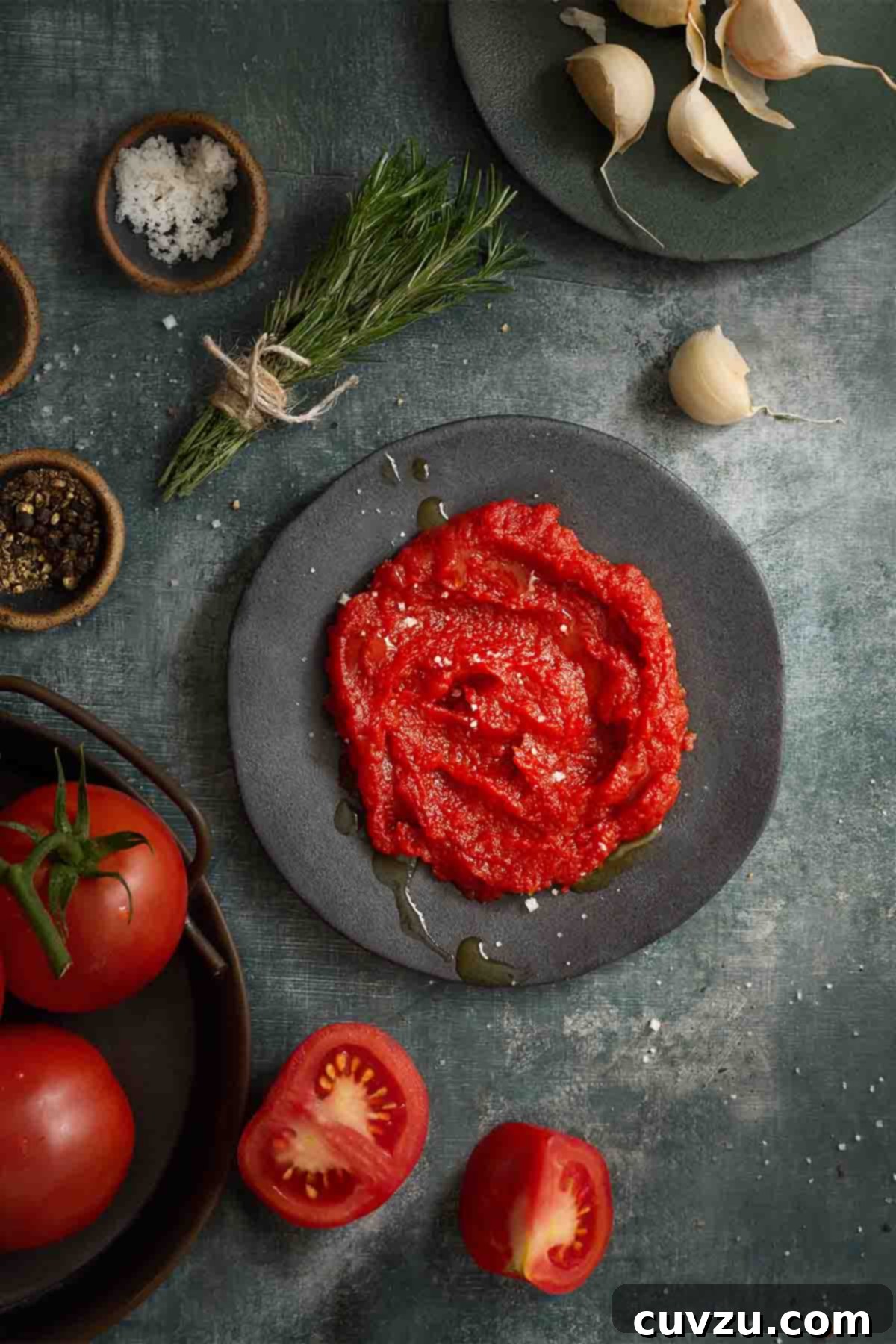
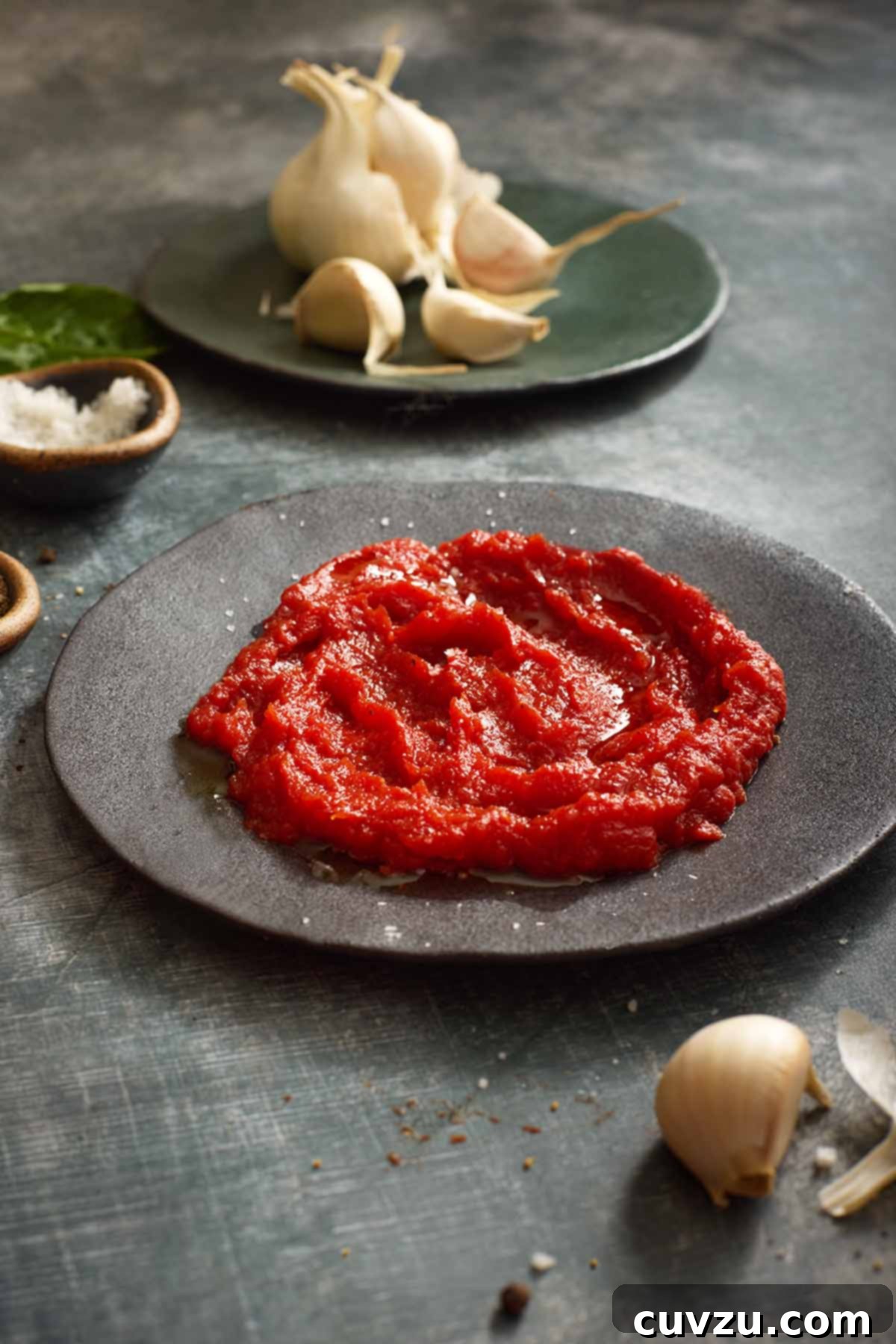
Homemade tomato paste offers a profound culinary experience, a world apart from its canned counterparts. It’s surprisingly simple to create and an excellent method to preserve an abundance of fresh, ripe tomatoes. With just a few basic ingredients—tomatoes, salt, olive oil—and a trusty food mill, you can capture the essence of classic Italian flavors. While it requires a bit of time, the deep, mellow, caramelized richness of your own conserva will undeniably elevate your cooking, making it a truly worthwhile endeavor.
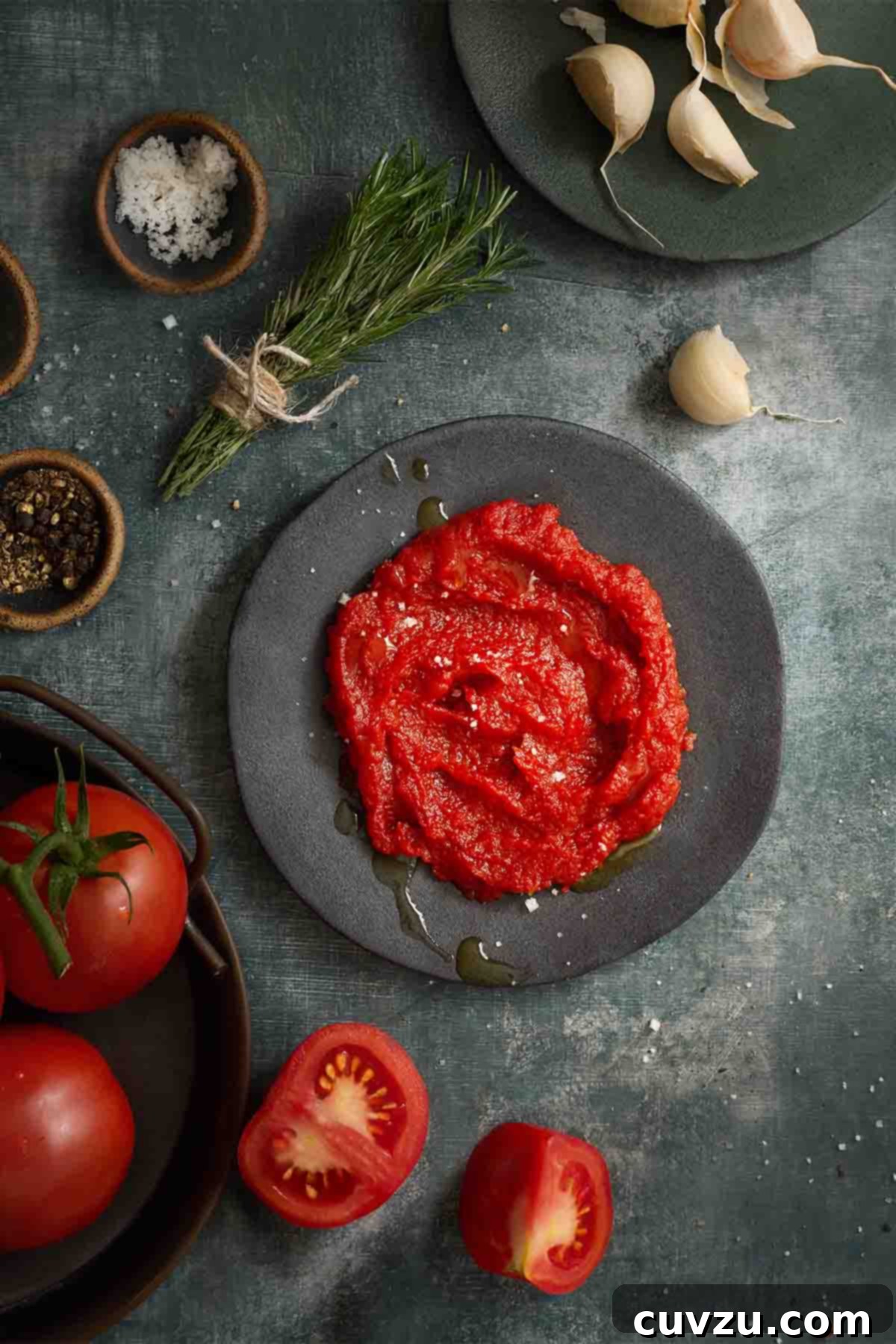
Quick-Answer Box: Homemade Tomato Paste Essentials
- What it is: A deeply flavorful, highly concentrated paste crafted by slow-roasting fresh, ripe tomatoes. It boasts a mellow, caramelized sweetness and an unparalleled depth of flavor unmatched by store-bought versions.
- Why you’ll love it: This recipe is remarkably straightforward and transforms a summer harvest into a potent, versatile staple. It’s perfect for enriching sauces, soups, and stews year-round, adding an authentic, robust tomato essence.
- How to make it: Begin by boiling and milling fresh tomatoes into a smooth purée. Then, gently simmer the purée to reduce its volume, followed by spreading it thinly on a baking sheet and slow-roasting until it achieves a wonderfully thick, concentrated consistency.
Every year, as the late summer sun ripens the tomato vines to perfection, I revisit this cherished recipe for homemade tomato paste. Over time, I’ve refined the process, adapting it from Rosetta Costantino’s original in her captivating cookbook, My Calabria. While Rosetta’s recipe specifically called for the revered San Marzano tomatoes, which are difficult to source authentically outside of Italy, I’ve simplified it to work with any variety of tomato—provided they are incredibly ripe. This ripeness is paramount; it’s the secret to achieving that deep, sweet, and complex flavor profile that defines exceptional homemade tomato paste.
Another modification I made addresses the practicalities of modern kitchens. Rosetta advised using non-aluminum baking sheets to prevent a metallic taste from the tomatoes’ acidity reacting with the metal. Since most home kitchens, including mine, commonly feature aluminum pans, I found a simple solution: a silicone baking mat. Not only does it effectively prevent any unwanted metallic flavors, but it also makes spreading the thick paste effortless and greatly reduces the risk of burning, ensuring a beautifully consistent product every time. Finally, I adjusted the amount of kosher salt, finding Rosetta’s original measure a bit too generous for my palate. This subtle reduction allows the natural sweetness of the caramelized tomatoes to truly shine through.
This recipe is an invitation to embrace the season’s abundance. It’s the perfect opportunity to visit your local farm stand and seek out those “second” tomatoes—the ones with slight blemishes or irregular shapes that are often sold at a discount. These often overlooked treasures are bursting with flavor and ideal for transformation into a rich paste. For instance, acquiring a 15-pound box for a mere $10 can yield enough paste for this recipe, with plenty left over for a batch of homemade tomato sauce that freezes beautifully. The result is a homemade paste with an incomparably deep, caramelized flavor that utterly surpasses any canned or tubed alternative. It’s not merely a substitute; it’s a revelation, guaranteed to become a sensational staple in your pantry.
Featured Review
I am obsessed with this recipe. Making tomato paste from fresh tomatoes is amazing to me. Thank you so much! I can now feel better about what I am feeding my family.
Shannon

The Magic Behind This Homemade Tomato Paste Recipe
This recipe has remained a favorite for over 15 years, and its enduring success lies in its clever two-stage cooking process. The initial simmering of the purée on the stovetop is crucial for rapidly evaporating a significant amount of water, which immediately begins the flavor concentration. However, the true transformation occurs during the low-and-slow oven roasting. This gentle, dry heat doesn’t merely thicken the purée; it actively caramelizes the natural sugars within the tomatoes. This caramelization process develops an amazingly rich, mellow sweetness and profound depth of flavor that simple boiling could never achieve. By adding the salt after this initial reduction phase, you gain complete control over the final seasoning, ensuring a perfectly balanced and incredibly flavorful tomato paste.
A Glimpse into the History of Tomato Paste
The tradition of concentrating tomatoes into a rich paste is deeply rooted in culinary history. In regions like Calabria, Italy, tomato paste—known locally as conserva—is still prepared using ancient methods. Rosetta Costantino describes how the purée is traditionally dried under the intense Mediterranean sun. This method, termed conserva al sole (preserves in the sun), involves spreading tomato purée thinly on large wooden boards and leaving them outdoors for three to four days. Each night, these boards are brought inside to protect the precious paste from dew. The relentless sun’s heat and dry air gradually evaporate the moisture, transforming the purée into a deeply flavored, shelf-stable paste, perfect for preserving the summer’s bounty for the long winter months.
This beautiful tradition, however, is entirely dependent on very specific climatic conditions: sustained, dry heat often exceeding 100ºF (38ºC) with minimal humidity. For those of us not fortunate enough to live in the dreamy, sun-drenched Calabrian climate, this recipe ingeniously harnesses the controlled heat of the oven. The oven replicates the gentle, prolonged drying effect of the sun, allowing home cooks everywhere to achieve that same wonderful depth of flavor and concentration, bringing a taste of Italian tradition right into their kitchens.
Essential Ingredients for Perfect Tomato Paste
- Tomatoes: The Heart of the Paste
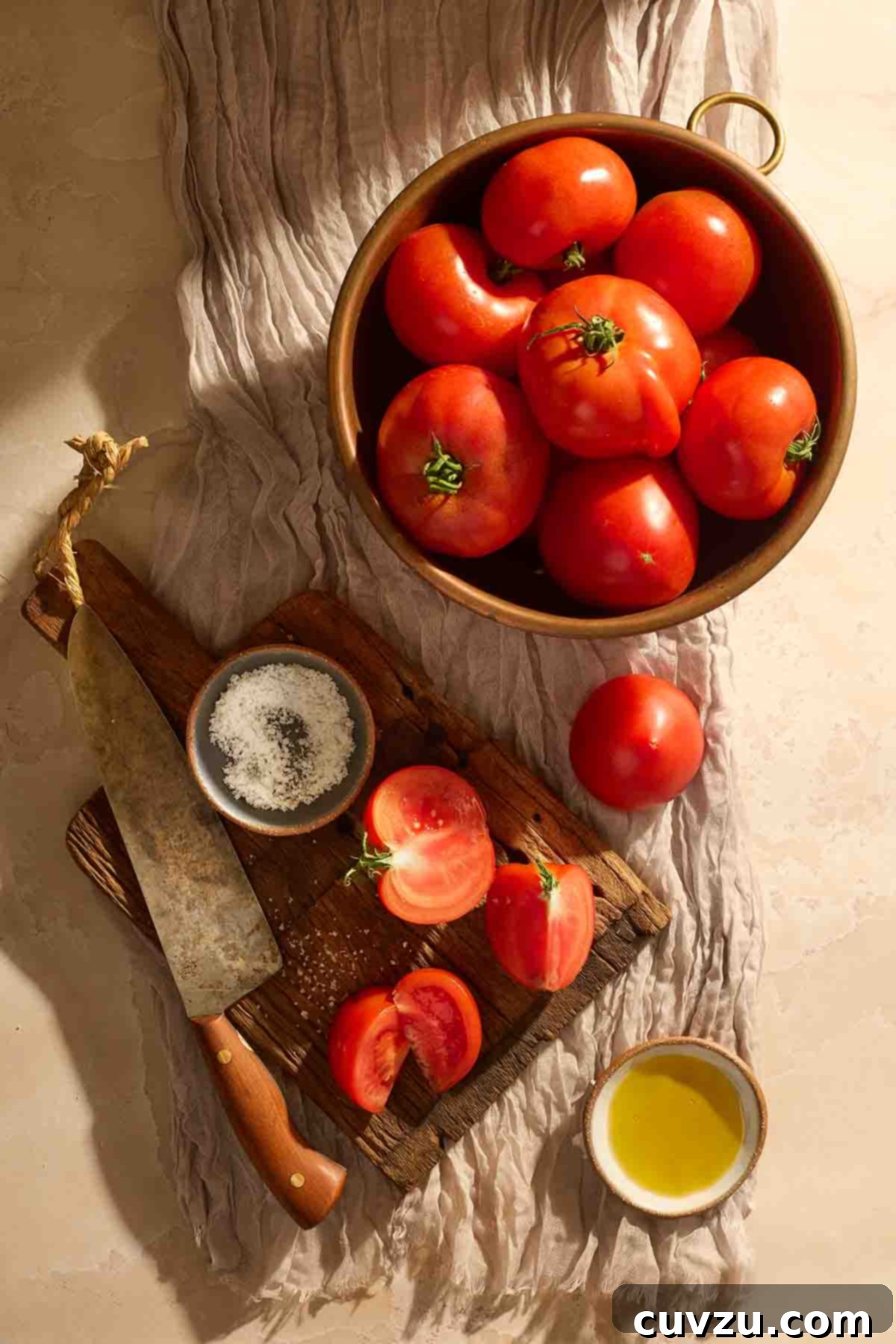
For the absolute best tomato paste, seek out plum tomatoes at your local farm stand or farmers market. Their lower water content and meaty texture make them ideal for concentration. If plum tomatoes aren’t available, any very ripe, flavorful tomato variety will work beautifully. The key is *extreme* ripeness. Avoid those pale, cottony supermarket tomatoes at all costs; they simply lack the vibrant flavor and natural sugars necessary for a truly outstanding paste. Choosing ripe tomatoes is the single most important factor for success. - Olive Oil: The Preserver and Flavor Enhancer
Extra-virgin olive oil serves a dual purpose in this recipe. A generous half-inch layer of oil on top of your finished paste creates an effective airtight seal, protecting it from spoilage and extending its shelf life in the refrigerator. Additionally, if you’re not using a silicone mat, a thin coating of olive oil on a non-aluminum baking sheet (such as nonstick or stainless steel) prevents the paste from sticking and aids in even roasting. - Kosher Salt: The Flavor Balancer
Salt is vital for enhancing the natural sweetness and depth of the tomatoes. I’ve found that 10 grams of kosher salt offers the perfect balance, allowing the rich tomato flavor to shine without overpowering it. However, seasoning is always a personal preference. The table below provides common salt measurements for a 10-gram reference. Feel free to adjust the amount to suit your taste, adding more as needed during the process.
| Salt Type | Approximate Amount for 10g |
|---|---|
| Diamond Crystal Kosher Salt | 1 tablespoon |
| Morton’s Kosher Salt | 2 teaspoons |
| Table Salt (fine-grain) | 1 1/2 teaspoons |
Exciting Variations for Your Homemade Tomato Paste
While classic homemade tomato paste is a masterpiece in itself, don’t hesitate to experiment with these simple variations to tailor the flavor to your preferences:
Ignite the Heat: Spicy Tomato Paste
For those who enjoy a little kick, transform your paste into a fiery condiment. Simply add 1 to 2 teaspoons of crushed red pepper flakes to the purée when you incorporate the salt. Adjust the quantity based on your desired level of spice—a true chilehead might even go for a bit more!
Garlic Lover’s Dream: Infused Garlic Paste
Elevate the savory notes of your tomato paste by infusing it with fresh garlic. Finely chop 6 to 8 cloves of fresh garlic (or more, if you’re a true garlic aficionado). Toss the chopped garlic into the pot along with the tomatoes at the very beginning of step 2. As the tomatoes simmer and roast, the garlic will soften, mellow, and meld its aromatic essence deeply into the paste, creating a rich, garlicky foundation for your dishes.
Herbaceous Undertones: Aromatic Tomato Paste
Consider adding a few sprigs of fresh rosemary, thyme, or oregano to the pot with the tomatoes during the initial simmering stage. Remove the sprigs before milling the tomatoes. The gentle infusion of these herbs will add subtle, complex aromatic layers to your finished paste without overpowering the natural tomato flavor.
Visual Step-by-Step Guide: Crafting Homemade Tomato Paste
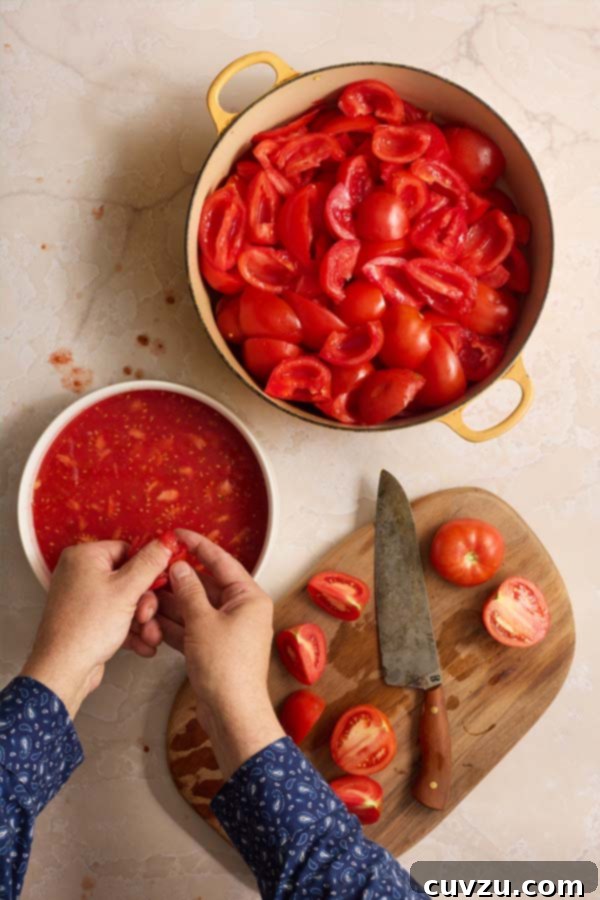
- Prepare the Tomatoes: Begin by carefully coring your ripe tomatoes. Then, cut them in half. If you are working with particularly large tomatoes, quarter them to ensure even cooking and easier handling in subsequent steps.
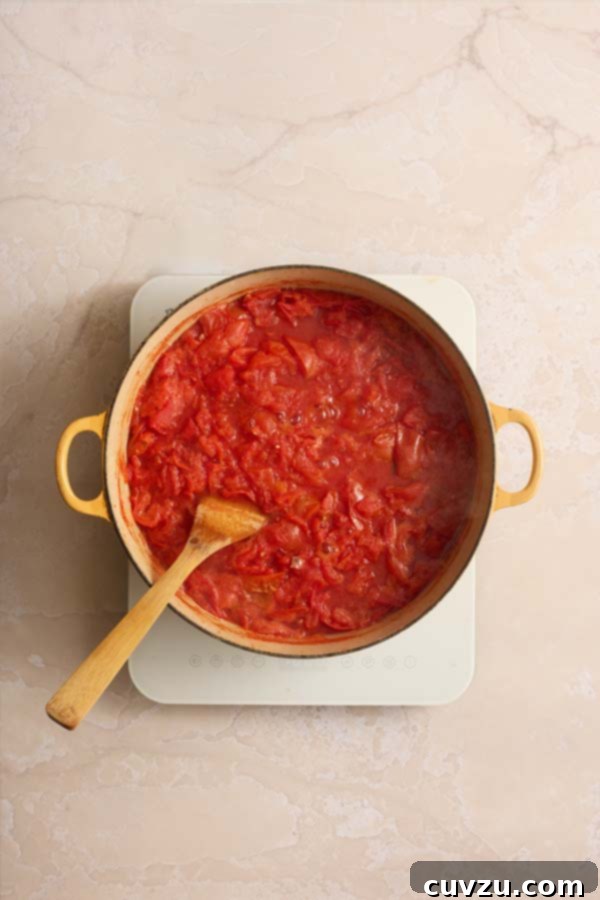
- Cook Down the Tomatoes: Place the prepared tomatoes into a large pot. Bring them to a vigorous boil over high heat. Continue to cook, stirring occasionally, until the tomatoes begin to break down significantly and release their natural juices. This usually takes about 10 minutes.
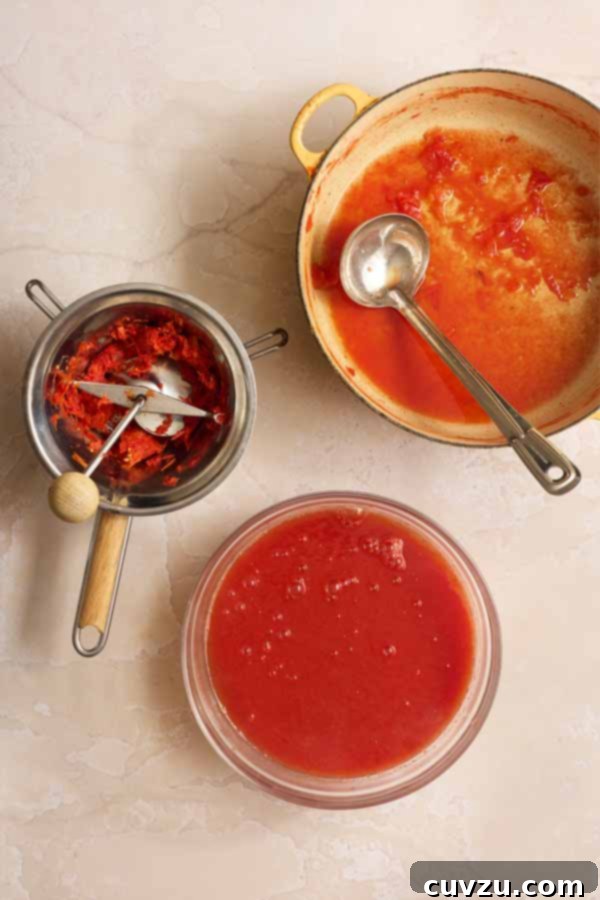
- Mill into Purée: Set up a food mill, fitted with its fine disk, over a large bowl. Carefully pass all of the cooked tomatoes through the mill. This process will efficiently separate the smooth juice and pulp from the skins and any remaining seeds, yielding a perfectly smooth tomato purée.
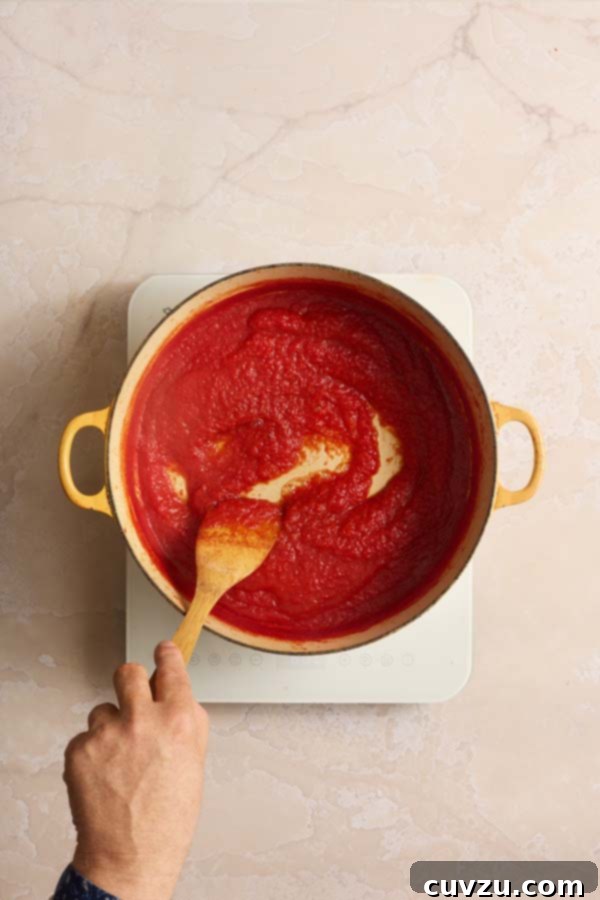
- Reduce on Stovetop: Return the smooth tomato pulp and juice to the same pot. Bring it back to a boil over high heat, then reduce the heat to a medium-low simmer. Stir frequently to prevent sticking, and continue to simmer until the purée has significantly reduced, reaching a volume of approximately 1 quart. This reduction can take anywhere from 45 minutes to 1 1/2 hours, depending on your tomatoes’ water content.
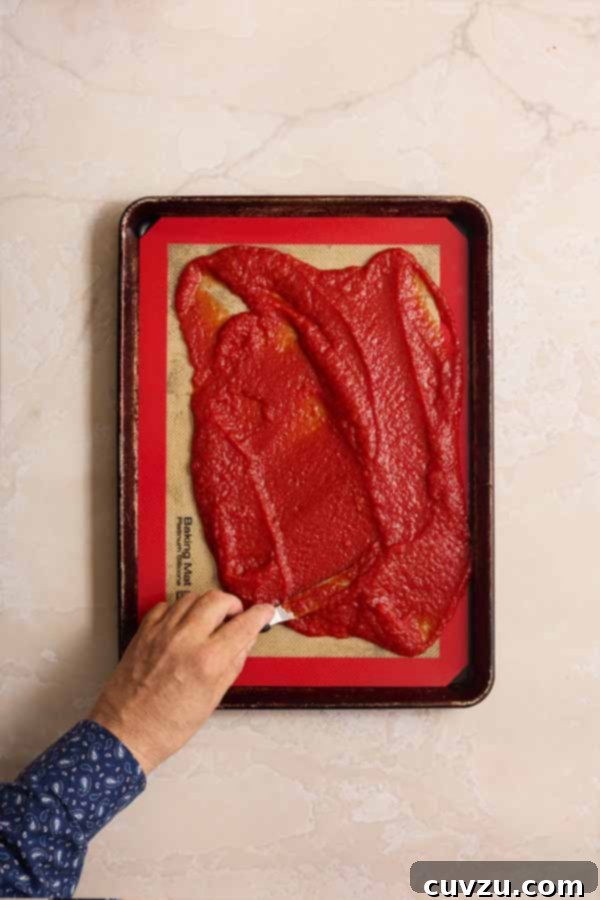
- Initial Oven Roast: After the stovetop reduction, spread the still-thick tomato purée evenly across a baking sheet lined with a silicone mat or parchment paper. Place it in a preheated 200°F (93°C) oven and roast for an initial 20 minutes to further dry and concentrate the flavors.

- Continue Roasting to Perfection: Return the baking sheet to the oven and continue roasting. It’s crucial to stir the paste and re-spread it evenly every 20 minutes. This ensures uniform drying and prevents burning. Continue this process for approximately 3 more hours, or until the paste is wonderfully thick, highly concentrated, and slightly sticky to the touch.
- Cool and Store: Allow the finished tomato paste to cool completely to room temperature. Once cooled, spoon it into a clean, sterilized jar, pressing it down firmly to eliminate any air pockets. Top the paste with a ½-inch layer of extra-virgin olive oil to create an airtight seal. Cover the jar tightly and refrigerate. The homemade tomato paste will keep beautifully in the refrigerator for up to a month.

Your Homemade Tomato Paste Questions, Answered
Canning homemade tomato paste is an excellent way to extend its shelf life for many months, but it’s best done with larger batches. A single batch of this recipe yields about 1 pint, which is generally not enough to justify the time and effort of canning. I highly recommend scaling up the recipe significantly, starting with at least 20 pounds of tomatoes—40 pounds would be even better—to produce a quantity that makes the canning process truly worthwhile.
For canning, half-pint (8-ounce) Ball jars are the ideal size for convenient portioning. The most crucial step for food safety is adding acid to each jar before filling. This is non-negotiable for low-acid foods like tomatoes. Here’s a simplified process:
- Add 1/2 tablespoon of bottled lemon juice OR 1/8 teaspoon of citric acid directly to each hot, empty half-pint jar.
- Spoon the hot-from-the-oven paste into the jars, leaving a 1/2-inch headspace. Remove any air bubbles with a clean knife or spatula, wipe the rims clean, and secure with lids and bands until “fingertip tight.”
- Process the jars in a boiling water canner for 45 minutes, making sure to adjust the processing time based on your altitude.
Once the jars have cooled undisturbed for 12 to 24 hours, check the seals. The lid should be concave and not “pop” when pressed in the center. Any jars that haven’t sealed properly should be refrigerated and used within a month.
Absolutely, you can use frozen tomatoes to make homemade tomato paste! The main difference you’ll encounter is that freezing breaks down the cell walls of the tomatoes, causing them to release a significant amount of water upon thawing. This means your initial purée will be much thinner than if you started with fresh tomatoes. But don’t worry, this is easily remedied. Simply simmer the purée for a longer period during the stovetop reduction phase. The exact duration will depend on how watery your thawed tomatoes are. Continue reducing the purée until it thickens sufficiently, leaving a clear trail at the bottom of the pot when you draw a spoon across it, and the trail holds for several seconds. The extended simmering ensures you still achieve that rich, concentrated flavor.
The best tomatoes for paste are those that are intensely red, firm, and heavy for their size, with a noticeable fragrance. Overripe tomatoes that are slightly soft are often ideal as they’re bursting with natural sugars and flavor. Heirloom varieties or specific paste tomatoes like Roma or San Marzano are excellent choices, but any truly ripe, flavorful tomato will yield delicious results. Avoid any tomatoes that are pale, hard, or have green shoulders, as these lack the necessary sweetness and depth.
Homemade Tomato Paste: Pro Tips & Troubleshooting
☞ Accelerate Reduction with a Wide Pot or Fan
The time it takes for your tomato purée to reduce on the stovetop can vary significantly based on the juiciness of your tomatoes. To speed up the evaporation process and cut down on simmering time, opt for the widest, shallowest pot you own—an enamel-coated pot works beautifully. A wider surface area allows more steam to escape efficiently. For an even faster reduction, position a fan to blow *above* the pot (never directly at the flame!). This gentle airflow significantly hastens evaporation without compromising the quality or flavor development of your purée.
☞ Maintain an Oil Seal for Longevity
Once your homemade tomato paste is jarred and refrigerated, its enemy is air exposure, which can lead to mold. To prevent this, always ensure your paste is covered with a layer of olive oil. After each use, tamp down the paste with the back of a spoon to eliminate any air bubbles and create a smooth, level surface. Then, add a fresh drizzle of olive oil to fully submerge the paste. This simple step creates an effective barrier, keeping your precious conserva fresh for longer.
☞ Embrace “Ugly” Fruit for Exquisite Paste
Don’t be swayed by perfectly uniform supermarket tomatoes when making paste. Those blemished, oddly shaped, or slightly bruised tomatoes often found at farmers’ markets are actually perfect for this recipe! These “ugly” fruits are typically riper and packed with more flavor and natural sugars. Simply cut out any black spots or bruised areas, chop them up, and toss them into the pot. Their imperfections vanish in the cooking process, leaving you with a beautifully rich and flavorful paste.
☞ Achieve Even Roasting with Careful Spreading
During the oven roasting phase, precise spreading is critical. Use an offset spatula or the back of a spoon to ensure the purée is spread into an ultra-thin, even layer (about 1/8 inch thick) across the entire baking sheet. Pay meticulous attention to consistency; thin spots can quickly burn, introducing an undesirable bitter flavor to your otherwise sweet and rich paste. Respreading evenly every 20 minutes helps achieve a uniform, caramelized texture.
Culinary Applications: How to Use Homemade Tomato Paste
This concentrated gold is more than just an ingredient; it’s a flavor powerhouse, ready to infuse unparalleled depth into your culinary creations. With its rich, complex taste, it’s far superior to any store-bought paste. I use it generously to “zhuzh up” and elevate a wide array of dishes, from classic soups, sauces, and stews to more adventurous preparations.
It’s an indispensable component in my favorite authentic Italian tomato sauce, providing a robust backbone of flavor. I also find it incredible in Portuguese red-pepper paste, where its umami notes complement the sweet peppers perfectly. Whenever a recipe calls for tomato sauce made from paste, this homemade version ensures an incredible result. Imagine stirring it into Nach Waxman’s extra-tender brisket, where it contributes to a deeply savory braising liquid, or enhancing the classic richness of Julia Child’s coq au vin. It’s also magnificent in a stunning beef braised in red wine, adding layers of sweet and savory complexity to the sauce.
Beyond traditional European dishes, its versatility knows no bounds. Stir a spoonful into your favorite dips for an unexpected boost of flavor. Use it as a secret ingredient to craft a truly exceptional homemade barbecue sauce. For a quick and flavorful side, add it to grains like rice or quinoa, imparting a vibrant color and a delightful smack of concentrated tomato essence. From enriching casseroles to deepening gravies, this homemade tomato paste will become your go-to ingredient for adding that authentic, irreplaceable tomato punch.
Optimal Storage for Homemade Tomato Paste
Proper storage is key to preserving the freshness and quality of your homemade tomato paste, allowing you to enjoy its rich flavor for an extended period.
Refrigerator Storage (Up to One Month):
To store in the fridge, spoon the cooled paste into a clean, airtight jar. Using the back of a spoon, firmly tamp down the paste to remove any trapped air bubbles, which can cause spoilage. Level the surface, then drizzle a generous ½-inch layer of extra-virgin olive oil over the top. This oil acts as an effective seal, protecting the paste from oxidation and mold. Secure the lid tightly. Stored this way, your homemade tomato paste will maintain its peak freshness for up to one month in the refrigerator.
Freezer Storage (Up to One Year):
For longer-term preservation, the freezer is your best friend. There are a couple of convenient methods for freezing:
- Ice Cube Trays: Spoon the paste into an ice cube tray, filling each compartment. Once frozen solid, pop out the cubes and transfer them to a zip-top freezer bag.
- Parchment-Lined Baking Sheet: Alternatively, spoon individual tablespoon-sized mounds of paste onto a parchment-lined baking sheet. Freeze until firm, then transfer these frozen rounds to a zip-top freezer bag.
Label the bag with the date and store it in the coldest part of your freezer. Frozen tomato paste will retain its superb quality for up to a year. When needed, simply thaw the desired portion in the refrigerator or add it directly to hot dishes.
Explore More Easy DIY Condiment Recipes
Homemade Old Bay Seasoning
5 mins
Homemade Yellow Mustard
1 hr 45 mins
Homemade Mayonnaise
10 mins
Pico de Gallo
45 mins
Share Your Experience: Write a Review
If you’ve tried this recipe, or any other delightful dish from Leite’s Culinaria, we’d love to hear from you! Please consider leaving a review, a star rating, and even your best photo in the comments section below. Your feedback and culinary adventures inspire us.–David
Featured Review
I’ve never made tomato paste, but had a bumper crop of San Marzano tomatoes this year. I struggle buying tomato paste because I use a tablespoon and the rest always goes bad, so when I found this recipe I decided to try it. I’m so glad I did!! It was so simple, and though it does take time, most of the time was hands off. It was perfect for a rainy fall day. The final product is absolutely amazing, and I love that I won’t have to worry about wasting it anymore! And I just blended the skins and any remaining seeds into the paste instead of using a food mill with no problem. I will use this recipe every year.
Danielle
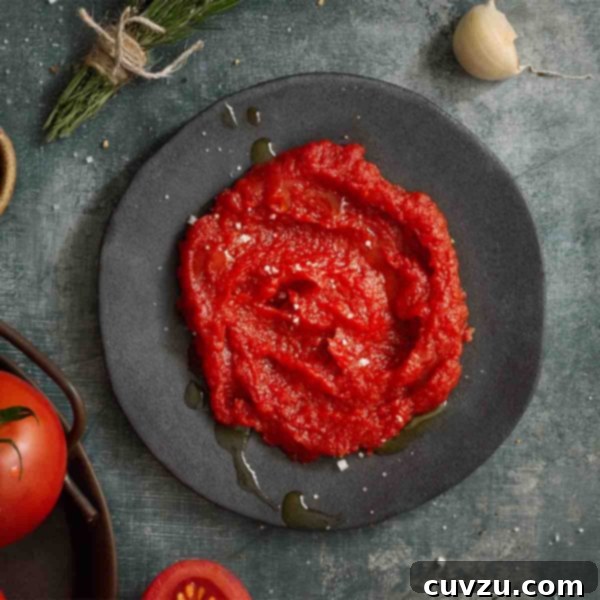
Homemade Tomato Paste (Conservas di Pomodori)
David Leite
Equipment
-
1-pint canning jar
-
Food mill
-
Silicone baking sheet or parchment
Ingredients
- 10 pounds very ripe plum or regular tomatoes, cored, halved, or quartered if large.
- 1 to 2 tablespoons Diamond kosher salt, depending on personal preference (see chart above)
- Extra-virgin olive oil
Instructions
-
Using your fingers, scoop out and discard the seeds from the 10 pounds very ripe plum or regular tomatoes. This step reduces excess water content and seed presence in the final paste.
-
Place the prepared tomatoes in a wide 8-quart stainless steel or enamel pot. Bring them to a strong, roiling boil over high heat, stirring occasionally to prevent sticking, until the tomatoes soften considerably and generously release their juices. This should take about 30 minutes.
-
Set up a food mill, fitted with its fine disk, over a large bowl. Carefully process the cooked tomatoes through the mill to thoroughly remove all skins and any remaining seeds. This yields a silky-smooth purée.
-
Pour the smooth tomato purée back into the same pot. Return it to a boil over high heat, then reduce the heat to medium-low to maintain a steady simmer. Stir frequently to prevent scorching, and continue to simmer until the purée has reduced significantly, reaching a volume of about 1 quart (946 ml). This reduction typically takes between 45 to 90 minutes, depending on the initial water content of your tomatoes.
-
Stir in the kosher salt, adding it a teaspoon at a time. Taste after each addition and continue to add up to 2 tablespoons or more, adjusting to achieve your desired flavor balance.
-
Preheat your oven to 200ºF (93ºC). If your oven has a convection setting, activate it for more efficient drying. Position an oven rack in the center of the oven.
-
Line an 18-by-13-inch rimmed baking sheet with a silicone baking mat or parchment paper. Spread the thickened tomato purée into a thin, even layer across the entire baking sheet using a spoon or spatula. Ensure consistent thickness for even drying.
☞ TESTER TIP: If you are using a coated or nonstick baking pan, you can lightly grease the pan with some extra-virgin olive oil instead of using a baking sheet liner.
-
Carefully slide the baking sheet into the preheated oven and roast for an initial 30 minutes.
-
Remove the baking sheet from the oven. Using a spatula, thoroughly stir the purée and then re-spread it evenly into a rectangle approximately 1/8 inch thick. Use a damp paper towel to clean up any bits of paste that may have dried around the edges of the rectangle to prevent burning.
☞ TESTER TIP: Be meticulous about spreading the paste to an even thickness. Any thin spots can quickly burn, which will impart a bitter flavor to your finished product.
-
Return the baking sheet to the oven and continue roasting. It’s crucial to stir and re-spread the purée every 20 minutes to ensure uniform drying and caramelization. Continue this process for approximately 3 more hours, or until the tomato purée becomes quite thick, stiff, and slightly sticky to the touch, indicating it’s fully concentrated. Taste the paste again and add more salt if desired.
-
Once adequately reduced, remove the paste from the oven and allow it to cool completely to room temperature on the baking sheet.
-
Spoon the cooled paste into a clean, sterilized canning jar. Press the paste down firmly with the back of a spoon to eliminate any trapped air pockets, which can encourage spoilage. Level the surface of the paste. Then, pour a ½-inch layer of extra-virgin olive oil over the surface to completely submerge the paste and create an airtight seal. Screw the lid on the jar tightly and refrigerate. The homemade tomato paste will keep fresh in the refrigerator for up to a month, or it can be frozen for up to a year.
Notes
- Wide Pot for Faster Reduction: Using a wide, shallow pot significantly increases the surface area exposed to heat, allowing the tomato purée to reduce more quickly by promoting faster steam evaporation.
- Keep the Paste Submerged: To prevent mold and extend freshness, always ensure the tomato paste remaining in your jar is completely submerged under a layer of olive oil. After each use, level the surface of the paste with a spoon and add more oil if necessary to maintain the seal.
- Freeze Extra Portions: For storage beyond one month, freezing is ideal. Fill an ice cube tray with the paste, or spoon 1-tablespoon mounds onto a parchment-lined tray and freeze until firm. Once solid, transfer the cubes or mounds to a zip-top freezer bag and store them in the coldest part of your freezer for up to a year.
Variations
Spicy Version: Add 1 to 2 teaspoons of crushed red pepper flakes to the purée when you add the salt, adjusting to your preferred level of heat.
Infused Garlic Version: Add 6 to 8 chopped fresh garlic cloves to the pot along with the tomatoes in step 2. The garlic will soften and infuse its flavor throughout the paste during the cooking process.

An LC Original
View More Original Recipes
Nutrition Information
Nutrition information is automatically calculated, so should only be used as an approximation.
Insights from Our Recipe Testers
Helen Doberstein
Finally, a rewarding way to utilize summer’s abundant tomato harvest! While the instructions for this homemade tomato paste recipe might initially seem extensive, the process itself is remarkably straightforward, provided you allocate sufficient time. When I tested this recipe, my own tomatoes weren’t quite ready, so I sourced perfectly overripe ones from a local farmers’ market—a fantastic tip for anyone eager to get started.
Coring and seeding the tomatoes proved simple, as did cooking them down to release their juices. The food mill was invaluable, producing an impeccably smooth purée free of skins and seeds. I made a point of using a slotted spoon to transfer the cooked tomatoes to the mill, minimizing excess liquid. The recipe didn’t explicitly state whether to add all the reserved juice back for reduction, so I opted to include most of it. As a result, my purée was initially quite thin, requiring a full hour of simmering before reaching the desired consistency. The subsequent low-and-slow oven baking was spot-on, yielding a perfectly dried paste without any burning. From this effort, I achieved three 125-milliliter jars of exquisite tomato conserva.
I plan to make this recipe a staple during tomato season. My only adjustment will be a slight reduction in salt next time, as just one heaping teaspoon of this paste was enough to perfectly season an entire large pot of beef ragu, eliminating the need for any additional salt. I’m excited to incorporate this sensational paste into many more dishes!
Linda Pacchiano
While making your own tomato paste is certainly time-consuming, the satisfaction and superior quality compared to store-bought versions are immeasurable. Now I truly understand why my Calabrese grandmother dedicated herself to this process, even while single-handedly raising seven children with diverse palates, each receiving a personalized meal nightly. Her life revolved around her kitchen, garden, and chickens, so the time commitment for scratch-made tomato paste was simply part of her rhythm.
Of course, her method involved sun-drying her purée, a charming tradition I replicated in the oven. She used her own homegrown Jersey tomatoes, which possess an unparalleled flavor—a true taste of actual tomatoes. I was fortunate to have a few pounds of my own frozen harvest from last season, so I adapted the recipe to my available 3 pounds of tomatoes. This yielded a smaller batch of paste, but it allowed me to master the technique and confidentially tackle larger quantities in the future.
My only suggestion for future batches is to use an offset spatula when spreading and re-spreading the paste on the baking sheet. This tool helps create a beautifully even layer, much like icing a cake, which is crucial for uniform drying and caramelization in the oven, ensuring a consistently delicious paste.
Jo Ann Brown
Every late summer, I recall the familiar sight of a delivery truck arriving at our neighbors’ home, unloading bushel after bushel of plump Roma tomatoes. These crimson jewels, nestled in straw-colored wooden-slat baskets, were meticulously arranged near their basement kitchen door, signaling the start of Signora Catania’s annual canning ritual. In her cool, dimly lit basement, equipped with custom terrazzo floors and oversized kettles, her assembly line for “putting up the sauce” commenced. It wasn’t until I was older that I fully grasped the significance of preserving these fleeting fruits for winter, avoiding the pale, mealy hothouse tomatoes of the colder months.
As an apartment dweller, I now practice my own scaled-down version of this preservation ritual. However, it hadn’t occurred to me that making conserva di pomodori (homemade tomato paste) might be a more efficient and versatile option given my limited storage space. This recipe offered a brilliant new approach for my household. As an experiment, I halved the recipe and chose the finest plum tomatoes I could find. To speed up the initial preparation, I ingeniously used an apple corer to swiftly remove stems and cores. The cooking times proved accurate, even for the reduced batch. I opted for a ¼ sheet pan (9 by 13 inches) instead of the larger 13-by-18-inch one, roasting the purée on a rack in the bottom third of the oven.
The final product, once cooled, fit perfectly into a sterilized half-pint Ball jar—an ideal amount to last until the next summer harvest. This homemade conserva boasts a wonderfully rich, sweet, and complex tomato flavor that absolutely outshines any store-bought alternative. Learning this technique has been incredibly valuable, empowering me to preserve the vibrant taste of summer and transform it into a pantry staple.