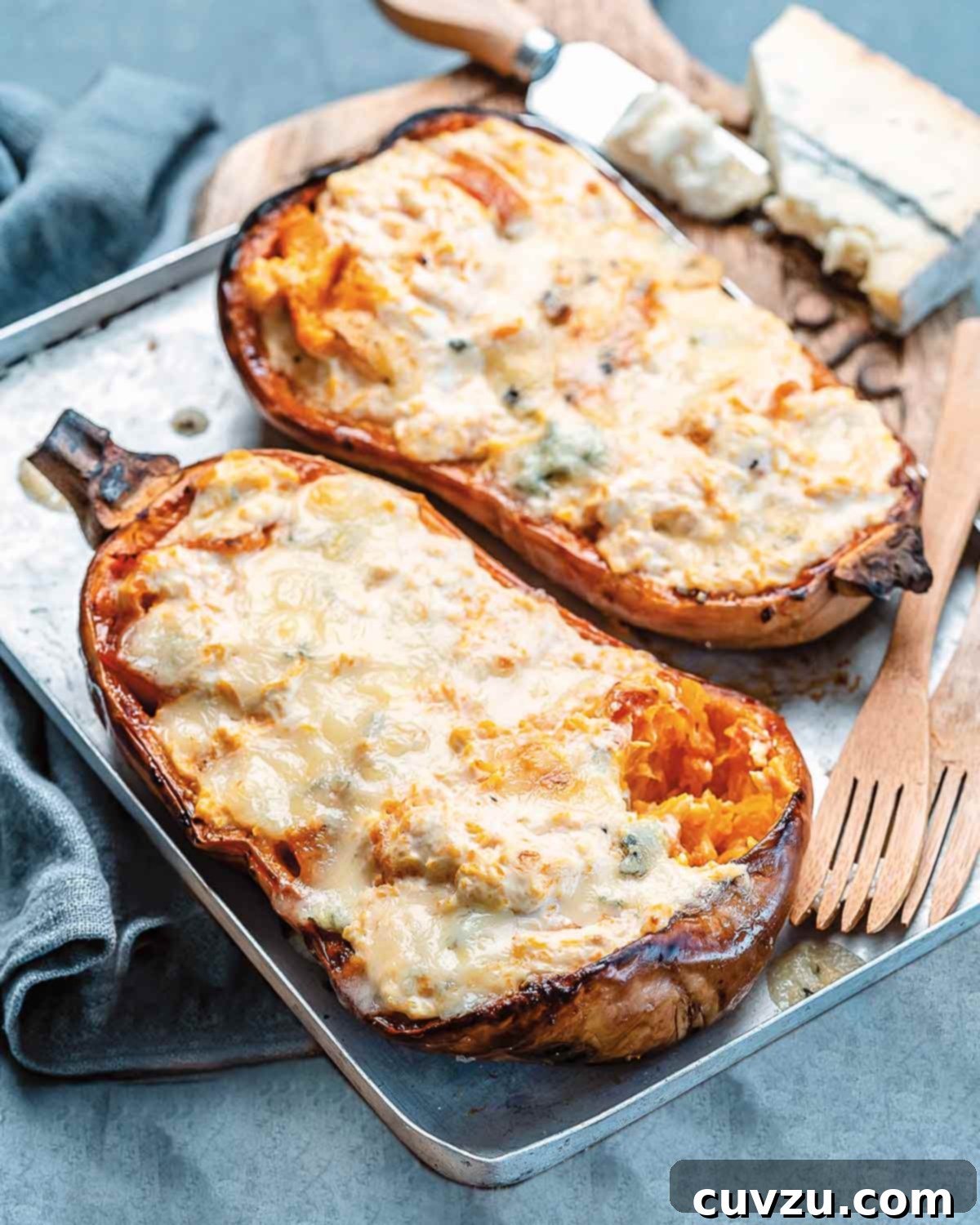
Welcome to a culinary delight that transforms humble winter squash into an extraordinary vegetarian masterpiece: our Roast Winter Squash with Blue Cheese. This recipe elegantly marries the sweet, earthy notes of perfectly caramelized roasted butternut squash with the distinctive, tangy creaminess of Gorgonzola cheese. It’s a dish that promises both comfort and sophistication, making it an ideal choice for a cozy weeknight dinner or a special holiday gathering.
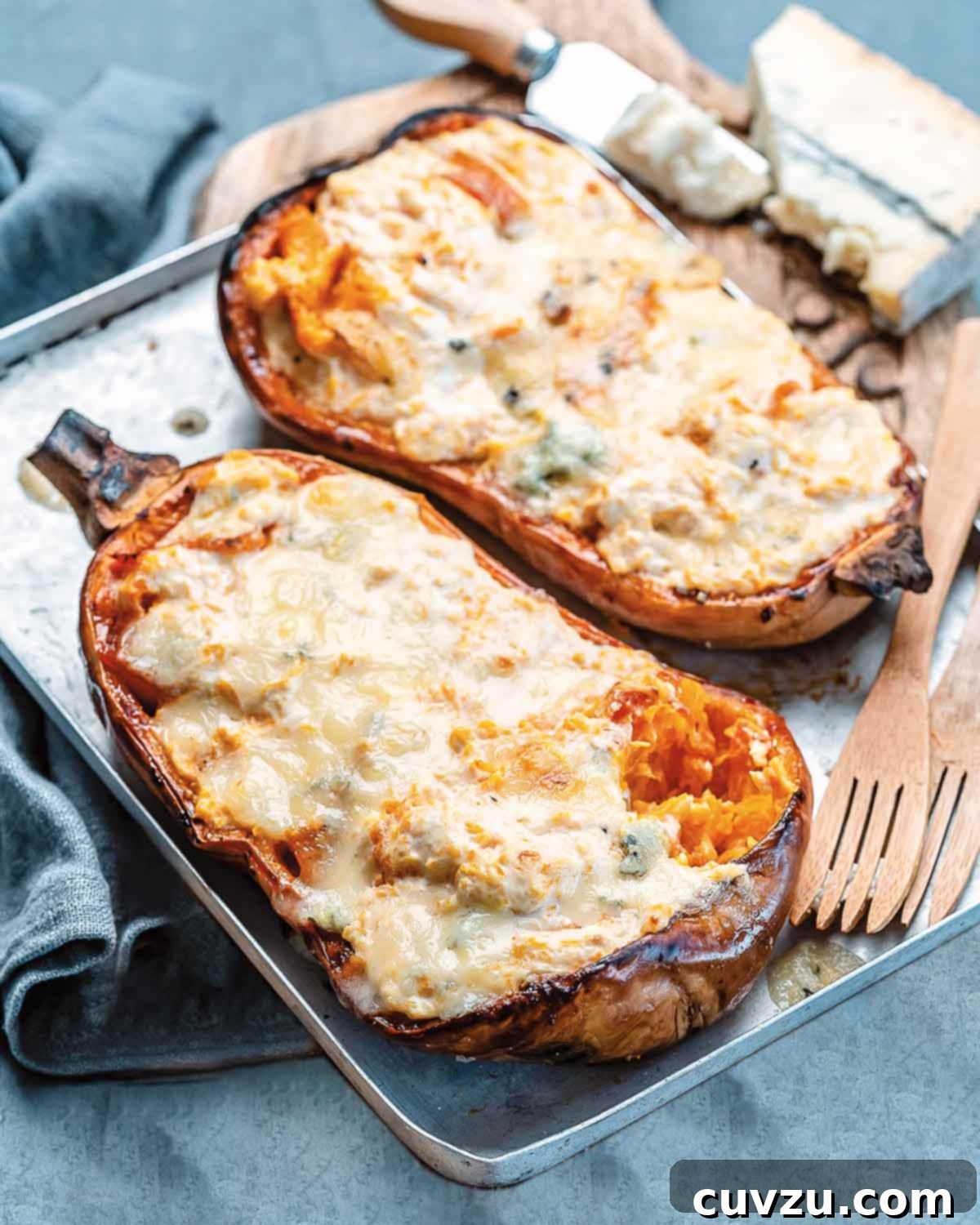
For enthusiasts of bold flavors, this dish is a true revelation. The tender, subtly sweet flesh of butternut squash becomes a perfect canvas for a rich, creamy filling loaded with savory Gorgonzola. The roasting process enhances the squash’s natural sugars, creating a beautiful caramelization that complements the cheese’s piquant character. With just five primary ingredients, this recipe proves that culinary excellence doesn’t have to be complicated or time-consuming. It elevates a simple fall vegetable into a main course or a luxurious side dish that will impress any palate.
Pair this exquisite roast winter squash with a mature dry white wine, such as a crisp Chenin Blanc, to highlight its subtle complexities, or a smooth red like Merlot for a more robust pairing. This dish isn’t just a recipe; it’s an experience, bringing together contrasting textures and flavors in harmonious balance. Mihaela Metaxa-Albu truly captures the essence of sophisticated simplicity in this creation.
Choosing Your Blue Cheese: Gorgonzola and Beyond
The choice of blue cheese can significantly impact the final flavor profile of this dish. Gorgonzola is often recommended for its delightful balance of saltiness and creaminess, making it an excellent “entry-level” blue cheese. There are two main types of Gorgonzola: Dolce and Piccante.
- Gorgonzola Dolce: This softer, milder variety is aged for a shorter period, resulting in a sweet, buttery, and less pungent flavor. It melts beautifully and blends seamlessly into the creamy filling, offering a gentle introduction to blue cheese for those who might find stronger varieties overpowering. Its smooth texture makes it ideal for creating a luxurious, uniform filling.
- Gorgonzola Piccante: Aged longer, this version is firmer, more crumbly, and boasts a sharper, more assertive flavor with a noticeable spicy kick. If you’re a true blue cheese aficionado seeking a bolder punch, Piccante can elevate the dish with its intense character. However, use it judiciously, as its strong flavor can dominate.
While Gorgonzola is the star, don’t hesitate to experiment with other blue cheeses if you have them on hand or prefer a different flavor profile. A good quality Danish blue cheese, Roquefort (for a sheep’s milk option with a salty, tangy profile), or even a Stilton can be excellent substitutes. Just be mindful of their intensity and adjust the quantity to your taste. For instance, a very strong blue cheese might require slightly less to prevent it from overwhelming the delicate sweetness of the squash. The goal is to create a delightful interplay of flavors, where the tang of the cheese complements the sweetness of the squash.
More Sensational Winter Squash Recipes
Brown Butter Winter Squash
40 mins
Stuffed Winter Squash
1 hr 30 mins
Mashed Kabocha Squash
1 hr 15 mins
Butternut Squash Gratin
50 mins
Write a Review
If you make this recipe, or any dish on LC, consider leaving a review, a star rating, and your best photo in the comments below. We love hearing from you! –David
Roast Winter Squash With Blue Cheese
David Leite
- PIN
Ingredients
US
Metric
Metric
Gathering fresh, high-quality ingredients is key to the success of this dish. Select firm butternut squash with smooth, unblemished skin. The choice of Greek yogurt and blue cheese will significantly influence the texture and flavor of your filling.
- 2 medium (approx. 5 lbs total) butternut squash, halved lengthwise and seeded
- Sea salt and freshly ground black pepper, to taste
- 1 tablespoon avocado or olive oil
- 1 1/3 cups (10 1/2 oz) plain Greek yogurt
- 8 ounces Gorgonzola, crumbled (or substitute other blue cheese)
Instructions
Follow these detailed steps to create a show-stopping dish that perfectly balances sweet and savory flavors. Precision in preparation ensures the best results for your roasted winter squash with blue cheese.
-
Step 1: Prepare for Roasting. Preheat your oven to a robust 400°F (200°C). This high temperature is crucial for achieving that delightful caramelization on the squash. Line a sturdy, rimmed baking sheet with aluminum foil. This step is a lifesaver for easy cleanup and preventing sticking.
☞ TESTER TIP: Always use aluminum foil, not parchment paper, for this recipe. Parchment can be dangerously close to the broiler’s flame in later steps, posing a fire hazard. Safety first!
-
Step 2: Season the Squash. Arrange the halved butternut squash, cut side up, on the prepared baking sheet. Season generously with sea salt and freshly ground black pepper to enhance its natural flavors. Drizzle the squash halves with avocado or olive oil, then use your fingers to evenly spread the oil over the cut surfaces. This helps in achieving beautiful browning and tender texture.
-
Step 3: First Roast. Place the baking sheet in the preheated oven and roast the squash until it is completely fork-tender. This usually takes between 50 to 60 minutes, depending on the size and density of your squash. You want the flesh to be soft and easily pierced, indicating it’s ready for scooping.
-
Step 4: Cool Slightly. Once roasted, carefully remove the squash from the oven. Allow it to cool slightly on the baking sheet for 10 to 15 minutes. It should still be warm, which helps with mixing and melting the cheese, but cool enough to handle comfortably without burning your hands.
-
Step 5: Create Squash Boats. In a large bowl, use a spoon or a melon baller to scoop out the tender flesh from each squash half, being careful to leave the skin intact. The goal is to create sturdy “boats” that will hold your delicious filling. Aim to leave at least a 1/4-inch (6-mm) border of flesh around the skin to ensure the squash retains its shape and structural integrity during the second bake.
☞ TESTER TIP: For a less formal presentation or if your squash boats don’t hold up well, you can transfer the entire filling mixture into a casserole dish and bake it that way. It will be just as delicious!
-
Step 6: Prepare the Creamy Filling. Add the scooped squash flesh to the large bowl. Introduce the plain Greek yogurt, a pinch more salt and pepper, and 6 ounces (170 g) of the crumbled Gorgonzola cheese. Mix all ingredients thoroughly until they are well combined and creamy. For optimal melting and blending, ensure the Gorgonzola is crumbled or cut into small pieces. Spoon this delectable mixture back into your prepared squash boats. Finish by sprinkling the remaining 2 ounces (57 g) of Gorgonzola over the top of each filled squash half.
☞ TESTER TIP: When adding the Greek yogurt, start with about 1 cup and mix. If you desire a creamier consistency, gradually add the remaining yogurt until it reaches your preferred texture. This allows for customization based on the squash’s moisture content.
-
Step 7: Second Bake and Broil. Return the filled squash boats to the oven. Roast for about 10 minutes, or until the cheese on top is beautifully melted and the filling is heated through. For that perfect golden-brown finish, switch your oven to broil. Broil for an additional 2 to 3 minutes, or until the tops are golden and slightly bubbly. Watch carefully during this stage, as broilers can vary in intensity and burn quickly.
-
Step 8: Serve Warm. Serve the roast winter squash with blue cheese immediately while it’s still warm, allowing the creamy, melted cheese and sweet squash flavors to shine. This dish is best enjoyed fresh from the oven.

Adapted From
I Heart Cheese
Buy On Amazon
Explore More with AI
Substitutions
Scale
Summarize
Nutrition
Calories: 441 kcal
Carbohydrates: 48 g
Protein: 23 g
Fat: 20 g
Saturated Fat: 11 g
Monounsaturated Fat: 7 g
Trans Fat: 0.01 g
Cholesterol: 46 mg
Sodium: 691 mg
Fiber: 8 g
Sugar: 11 g
Nutrition information is automatically calculated, so should only be used as an approximation.
Tried this recipe?Mention @leitesculinaria or tag #leitesculinaria!
Recipe Testers’ Reviews
Marcia L.
Marcia found this recipe sublimely delicious and highly recommends it for a Meatless Monday or a festive holiday option. She appreciated how little hands-on time it required and noted its potential for make-ahead preparation, adding to its convenience. The dish delivered complex flavors, a delightful interplay of sweetness from the squash and the sharp, creamy notes from the melted Gorgonzola. Marcia also confirmed that leftovers reheated beautifully in the microwave, making it a great option for meal prepping. She suggested preparing the dish up to the second baking/broiling stage, then finishing it off just before serving to maintain freshness and warmth.
Laura Hudeck
Laura’s first experience testing a recipe with this dish was a success, finding it both creamy and flavorful. She noted a slight color variation in her butternut squash, which affected the visual appeal when mixed with yogurt and cheese, but didn’t detract from the taste. Laura emphasized the importance of ensuring the squash is still warm when mixing the Gorgonzola, as the heat helps the cheese melt and blend easily. She suggested crumbling or finely dicing the Gorgonzola before incorporating it into the filling for better distribution and melting. Additionally, she found the recommended two ounces of cheese for topping insufficient to adequately cover all four portions, which could impact the final presentation. A crucial safety tip from Laura: double-check that you’re using foil, not parchment paper, for broiling to prevent potential fires. She wisely moved her pan to a lower rack to avoid this issue.
Deborah Wallace
Deborah initially considered this a side dish but was delighted to find it worked perfectly as a filling and delicious entrée, making her forget about needing a separate protein. She used a substantial 4-pound butternut squash, which yielded enough for multiple servings, even repeating the meal. Her choice of fat-free Chobani Greek Yogurt and Gorgonzola Dolce provided an ideal counterpoint to the squash’s sweetness. Deborah highlighted the benefit of mixing the cheese and yogurt directly into the squash flesh, ensuring a harmonious sweet-salty blend in every bite. She found the cooking times accurate, with an hour for roasting and about 7 minutes cooling time before scooping. While creating the ¼-inch border was slightly challenging, she managed it well. The final bake and broil resulted in a lovely golden-brown top. Deborah wisely suggested that while squash boats are visually appealing, baking the mixture in a casserole dish would be equally delicious and much easier, especially if you prioritize convenience or struggle with keeping the squash shells intact.
Irene Seales
Irene almost skipped this recipe due to lack of Gorgonzola but happily improvised with a Danish blue cheese, creating a fantastic meal for two with a halved recipe. She praised the minimal prep time, noting that slicing, seeding, seasoning, and oiling the squash can be done while the oven preheats. Irene reinforced the crucial advice to use foil for roasting, especially if broiling later, recounting a near-fire incident with parchment paper. She found a spoon and melon baller made scooping the squash easy and, impatient for the delicious aroma, used a gloved hand to handle the warm squash after just 5 minutes of cooling. Her broiler experience confirmed the need for vigilance; even a short time under the broiler can quickly scorch parchment. Irene also suggested that while individual squash halves are charming, smaller varieties like honey nut squash or serving the filling in ramekins could be more practical for formal settings, as large butternut halves can be cumbersome. She enthusiastically recommends this “ridiculously easy yet marvelously satisfying” dish, even if you substitute the blue cheese, and shared her appreciation for Nigella Lawson’s tip on not needing to peel butternut squash.
Insights from an Anonymous Tester
This tester lauded the recipe for its simplicity and delicious outcome, deeming it perfect for a midweek meal and easily scalable. The brilliant pairing of Gorgonzola with the sweetness of butternut squash was a highlight. They advised allocating half a butternut squash per person, as it appears large but is surprisingly light and satisfying. Using 0% fat thick Greek yogurt (like Fage) worked perfectly for them. For those who enjoy a stronger blue cheese flavor, they suggested either increasing the quantity or opting for a more potent variety, while still acknowledging its deliciousness for those less keen on strong blue cheese. Adding a touch of sage or serving with a crisp green salad and sharp vinaigrette were recommended enhancements. They stressed allowing a good 10 to 15 minutes for the squash to cool for easy handling and noted that the recipe could be prepped ahead to this point, then finished in the oven. For proper browning, they found the broiling time needed to be closer to 5 minutes, and raising the oven temperature to about 480°F was beneficial.
Jack V.
Jack expressed surprise at not having “twice-baked” winter squash before, finding the concept wonderful and delivering big, delicious flavor. He suggested using slightly less Greek yogurt than called for initially, adding only enough to achieve a smooth, creamy consistency, as too much can make the filling a bit soupy. Jack found the Gorgonzola present but mild, making this a potentially good “gateway” recipe for those who are typically blue cheese skeptics. He celebrated it as a refreshing alternative to the standard “cube-and-roast” squash routine. For serving, Jack provided valuable advice: due to the molten center, cutting a squash in half can lead to a messy “lava flow” of filling. While fine for family-style weeknight dinners, he recommended using smaller squash varieties like honey nut for individual portions, which also shortens roasting times. Alternatively, for more formal occasions, transferring the filling into individual ramekins or gratin dishes for baking and broiling would offer a neater, more self-contained presentation.
Elsa M. Jacobson
Elsa’s review radiated with her profound love for melty blue cheese, stating it had never been so fervent! She appreciated how the cheese perfectly balanced the sweetness of the squash and suggested that acorn squash could also work wonderfully, providing attractive individual servings. Alternatively, using smaller butternut squash could achieve the same individual portion effect. For those with a stronger preference for blue cheese, Elsa excitedly noted that a “stinkier, funkier, more potent” blue cheese would be a terrific substitution, especially if dining companions share the same adventurous palate. She even planned to replicate the recipe with a goat blue cheese purchased from her farmers market, aiming for a funkier style. As a bonus, she recommended another blue cheese delight, the Blue Cheese Tartine, which she has successfully adapted into vegetarian versions, much to her and others’ enjoyment. Elsa highlights the sheer joy of serving a bubbling, golden boat of cheese and squash, transforming even a routine meal into a special occasion.