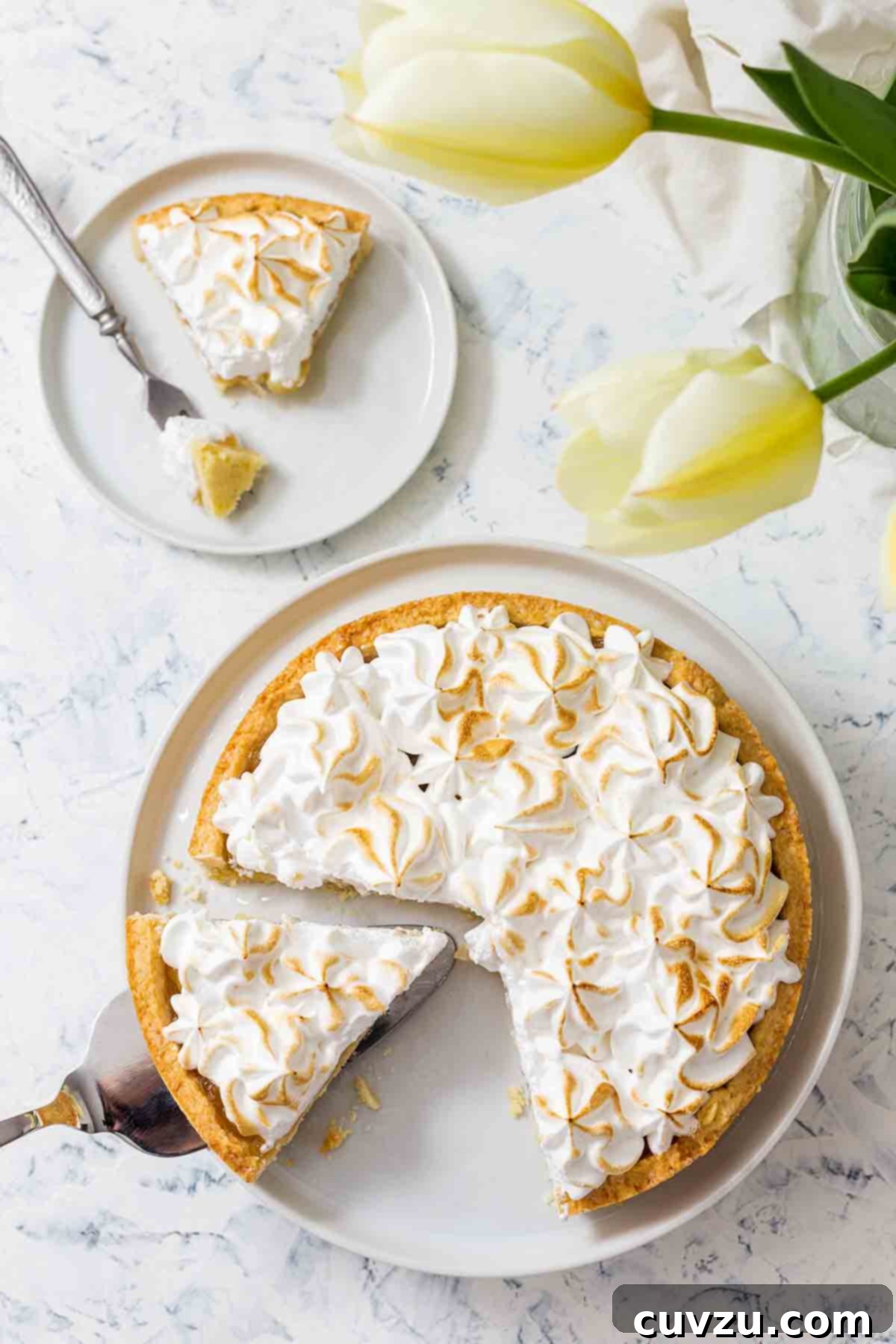
Experience a culinary masterpiece with this exquisite Lemon Meringue Tart, a stunning dessert featuring a perfectly crunchy almond tart shell, lusciously creamy lemon curd, and a crowning glory of ethereal, pillowy meringue. This isn’t just any lemon tart; it’s a symphony of textures and flavors designed to delight the senses and elevate any occasion.
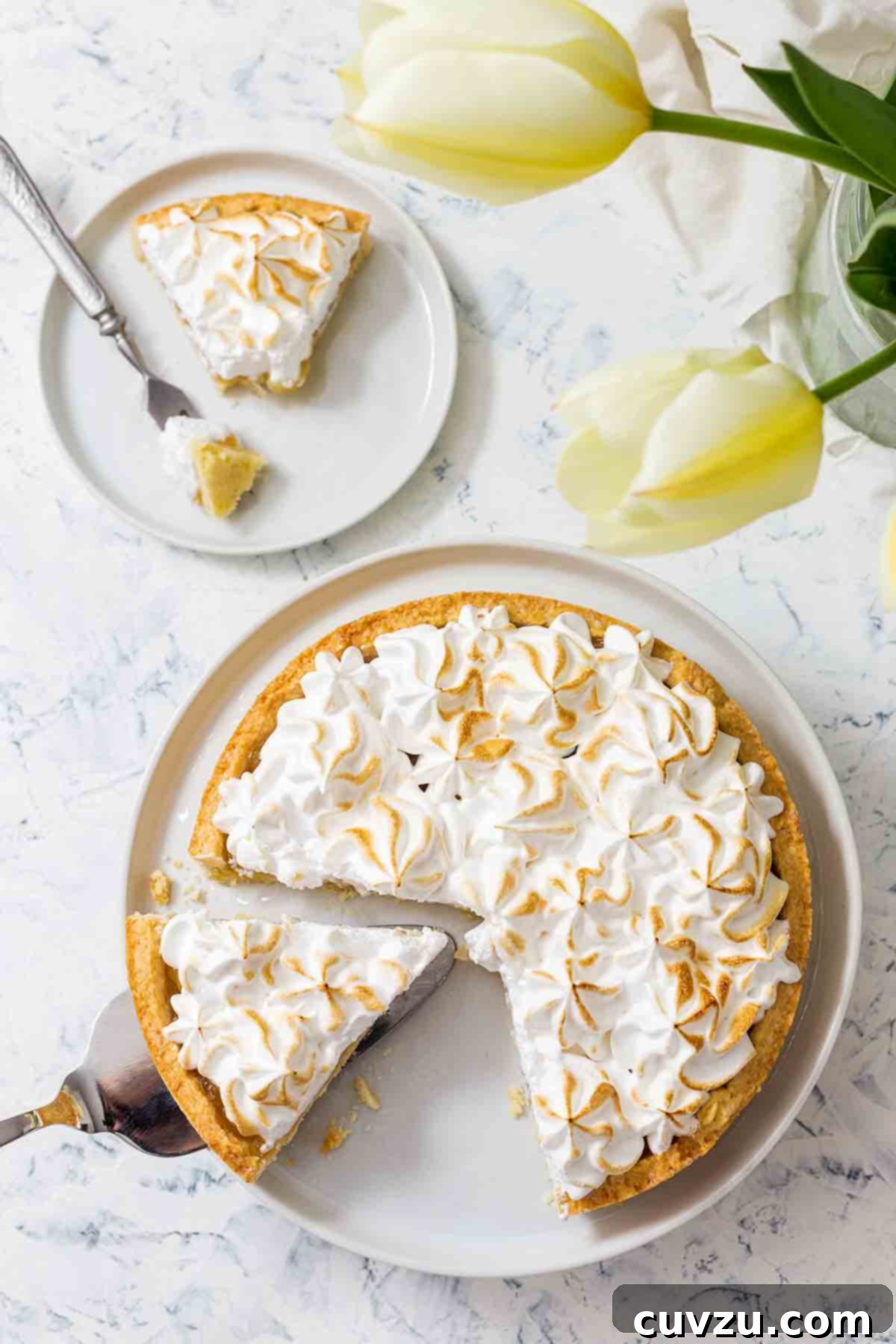
Inspired by the brilliant pastry chef Michel Richard, this recipe offers an unconventional yet utterly captivating take on the classic lemon meringue pie. While it diverges from tradition, the results are undeniably superior, offering a fresh perspective on a beloved dessert. Forget the pressure of perfectly piped meringue; Chef Richard himself encourages personalization. Whether you prefer a smooth, elegant finish or dramatic, dervish-like swoops and swirls, this recipe invites you to make it your own. The beauty of this tart lies in its adaptability and the sheer joy it brings to every bite.
The secret to this tart’s irresistible charm lies in the harmonious interplay of its three distinct layers. The almond tart shell provides a delicate crunch and a subtle nutty flavor that perfectly complements the vibrant acidity of the lemon curd. Nestled within this elegant base is a velvety, bright lemon curd – a smooth, tangy revelation that forms the heart of the dessert. Finally, a mountain of soft, cloud-like meringue adds a sweet, airy contrast, its peaks lightly toasted to a golden perfection. This stunning creation promises to be the highlight of any dessert table, leaving a lasting impression on your guests.
Lemon Meringue Tart: Frequently Asked Questions & Expert Tips
If you or your guests have a tree-nut allergen concern, we strongly recommend using an alternative crust altogether to ensure safety. Food allergies are serious, and it’s always best to err on the side of caution. In such cases, you can opt for a simple, classic pie crust or a delightful pâte sablée, and proceed with the remainder of the recipe as directed. If allergies are not an issue but you simply don’t prefer almonds, cashews or pecans can be used as alternatives. However, be mindful that substituting nuts will subtly alter the overall flavor profile of your finished tart, introducing new nuances. Rest assured, it will still be incredibly delicious!
While this tart is best enjoyed immediately after baking to appreciate the meringue at its peak, any leftovers can be loosely wrapped with foil or plastic wrap. It will keep well when refrigerated for two to three days. Note that the meringue may soften slightly over time, but the flavors will still be delightful.
Absolutely! This is a fantastic strategy to manage your time and ensure a stress-free baking experience. Both the lemon curd and the almond tart shell can be prepared a day or even two days ahead of time. The lemon curd requires at least 6 hours to chill properly, making it an ideal candidate for advance preparation. Once made, cover it with plastic wrap directly touching the surface to prevent a skin from forming, then refrigerate. The tart shell can also be baked and stored at room temperature for several hours or wrapped tightly and kept in the refrigerator for up to a day. Assembling the tart with pre-made components right before serving makes the final steps a breeze, allowing you to enjoy your guests and the fresh-baked aroma.
Achieving the perfect lemon curd consistency is key to this tart’s success. If your curd isn’t thickening, ensure your heatproof bowl is placed over, but not touching, the simmering water in your double boiler. Direct contact with boiling water can scramble the eggs. Consistent whisking is also crucial to prevent curdling and promote even thickening. Use a candy thermometer to accurately monitor the temperature; the curd should reach approximately 175°F (79°C) for optimal thickness. Patience is a virtue here, as it can take anywhere from 5 to 15 minutes, or sometimes even longer, depending on your stove and pan size. Don’t rush the process, and continue whisking until it coats the back of a spoon thickly.
Lemon Meringue Tart
David Leite
Dessert
French
8
servings
493
kcal
1 hour
30 minutes
1 hour
30 minutes
Equipment
-
9-inch (23-cm) tart pan with removable bottom
Ingredients
For the Lemon Curd
-
2/3 cup fresh lemon juice, strained (from 4 to 5 large lemons) -
8 large egg yolks, at room temperature (set aside 4 egg whites in a separate bowl for the meringue) -
1 cup granulated sugar -
5 tablespoons unsalted butter, cut into pieces, at room temperature
For the Almond Tart Shell
-
1/4 cup whole blanched almonds -
1/4 cup granulated sugar -
Pinch salt -
1 stick unsalted butter, cut into pieces, at room temperature, plus extra for greasing the pan -
1 large egg -
1 1/4 cups all-purpose flour
For the Meringue
-
4 large egg whites, at room temperature -
Pinch salt -
Pinch cream of tartar -
6 tablespoons granulated sugar
Instructions
Prepare the Lemon Curd
-
Fill a pot or the bottom of a double boiler with a few inches of water and bring it to a gentle simmer. In a medium heatproof bowl (or the top of a double boiler), vigorously whisk together the fresh lemon juice, egg yolks, and granulated sugar until well combined. Place this lemon mixture over the simmering water, ensuring the bottom of the bowl does not touch the water. Continue whisking constantly and patiently. The mixture will gradually thicken to the consistency of a luxurious, thick hollandaise sauce, coating the back of a spoon, and should register about 175°F (79°C) on a candy thermometer. This process typically takes 5 to 15 minutes, depending on the heat intensity and pan size.
Pro Tip: Once thickened, remove the bowl from the heat. Incorporate the unsalted butter, adding it a few pieces at a time, whisking continuously until the curd is perfectly smooth and glossy. Immediately press a piece of plastic wrap directly onto the surface of the lemon cream to prevent a skin from forming. Allow it to cool completely to room temperature, then refrigerate until thoroughly chilled, for at least 6 hours. This chilling step is essential for the curd to set properly and is ideal for preparing a day or two in advance.
Craft the Almond Tart Shell
-
In a food processor, combine the whole blanched almonds, granulated sugar, and a pinch of salt. Pulse until the almonds are finely chopped and the mixture resembles coarse meal. Add the room temperature butter pieces and process until the mixture becomes smooth and well-incorporated.
Dough Handling Tip: Next, add the large egg and process just until it’s fully incorporated into the mixture. Gradually add 1/3 cup of all-purpose flour and mix until barely combined. Then, add the remaining flour in two separate batches, processing only until the flour streaks disappear and the dough just comes together. Be careful not to overmix, as this can lead to a tough crust. The resulting dough will be quite soft. Scrape the dough onto a piece of plastic wrap, gently shape it into a flat disk, wrap it securely, and refrigerate for at least 1 hour. This chilling time helps the butter firm up, making the dough easier to handle. The dough can be refrigerated for up to 1 day.
-
Lightly butter a 9-inch (23-cm) tart pan, ideally one with a removable bottom for easier serving. If the dough has been chilled for more than an hour, let it rest at room temperature for a few minutes to soften slightly, making it more pliable. Roll the dough out evenly between two large sheets of plastic wrap to form a 10-inch circle.
Assembly Advice: Carefully remove the top sheet of plastic wrap and invert the dough into your prepared tart pan. Gently press the dough into the bottom and up the sides of the pan, ensuring an even thickness. Trim any excess dough from the edges. Cover the tart shell loosely with plastic wrap and refrigerate for at least 1 hour. This helps maintain its shape during baking.
-
Preheat your oven to 350°F (176°C).
-
Remove the tart pan from the refrigerator. Line the chilled tart shell with a large sheet of parchment paper or aluminum foil, then fill it with pie weights or dried beans. Bake for approximately 15 minutes, or until the tart shell feels firm and set.
Baking Insight: Carefully remove the pie weights and paper. Using the tines of a fork, prick the bottom of the tart shell all over. This crucial step prevents the crust from puffing up unevenly. Return the tart shell to the oven and continue baking for an additional 10 to 15 minutes, or until it achieves a beautiful golden-brown color. Allow the baked tart shell to cool completely in the pan on a wire rack. It can be kept at room temperature for several hours before filling, or prepared a day in advance.
Create the Meringue and Assemble the Tart
-
In a clean, dry bowl, beat the 4 large egg whites, a pinch of salt, and a pinch of cream of tartar with an electric mixer until soft peaks begin to form. Gradually add the granulated sugar, 1 tablespoon at a time, continuing to beat until the meringue is glossy, stiff, and holds its shape beautifully, but is not overly dry or crumbly.
-
Adjust your oven temperature to 400°F (204°C).
-
Fill the cooled tart shell evenly with the chilled lemon curd. Now it’s time for the meringue! If you’re using a piping bag, pipe elegant small flourishes, swirls, or stars to cover the entire surface of the lemon filling. If you’re not using a piping bag, simply spoon the meringue generously on top of the lemon curd. Use a spatula to gently spread and shape the meringue, creating attractive peaks and ensuring that the meringue completely covers the curd and extends to touch the edge of the tart shell. This seal helps prevent the meringue from shrinking during baking.
-
Bake the assembled tart in the preheated 400°F (204°C) oven for 8 to 10 minutes, or until the meringue’s peaks are beautifully golden brown. Keep a close eye on it to prevent scorching, as meringue can brown quickly. Immediately remove the sides of the tart pan. Carefully cut the tart into individual wedges and transfer them to your most elegant dessert plates. Serve this stunning creation immediately to best enjoy the fresh, warm meringue and chilled curd.
Serving & Storage Tip: For the ultimate experience, serve this Lemon Meringue Tart as soon as it comes out of the oven. While components can be made ahead, the final assembly and baking are best done shortly before serving. If you happen to have any leftovers, wrap them loosely and refrigerate, though the meringue’s texture will soften over time.
Nutrition Information
Calories: 493 kcal
Carbohydrates: 58 g
Protein: 9 g
Fat: 26 g
Saturated Fat: 14 g
Monounsaturated Fat: 8 g
Trans Fat: 1 g
Cholesterol: 257 mg
Sodium: 48 mg
Fiber: 1 g
Sugar: 41 g
Nutrition information is automatically calculated and should only be used as an approximation.
Tried this recipe?Mention @leitesculinaria or tag #leitesculinaria!
Insights from Our Recipe Testers
Our dedicated team of recipe testers rigorously evaluates each recipe, offering invaluable feedback to ensure your success in the kitchen. Here’s what they discovered about this delightful Lemon Meringue Tart:
Ralph Knauth’s Notes
Ralph was particularly impressed by the harmonious blend of flavors, especially the almond in the tart dough, which he found “wonderful.” He highly recommends preparing the tart shell and lemon curd a day in advance. This approach made the final assembly “pretty easy,” streamlining the overall process, which he notes is “a bit time-consuming and involves quite a few steps, but it’s not overly complicated and definitely worth the effort.” Ralph found the timing throughout the recipe to be quite accurate, leading to a straightforward process.
He observed a slight runniness in the lemon curd after the tart had sat for a few minutes, noting it “weeped out the tart a little.” For those without a specialized tart pan, Ralph successfully used a traditional pie plate, proving the recipe’s versatility. He also mused about the possibility of making “little personal tarts” for future occasions, a charming idea for individual servings.
Linda Pacchiano’s Insights
Linda lauded this as an “outstanding lemon tart,” appreciating the delicate and light dessert created by the combination of the almond crust, lemon curd, and meringue. She emphasized the “just right balance of sweet and tart” that makes it so appealing. Like Ralph, Linda affirmed that “it’s well worth all of the steps,” even with the necessary chilling and baking stages.
Her key recommendation for efficiency is to make the curd a day in advance, as it requires a minimum of 6 hours to chill. She also confirmed that the crust can be prepared and baked a day ahead, providing flexibility for busy schedules. Linda offered a crucial “tweak” regarding the curd’s preparation: “10 minutes of stirring is much more realistic than 5 minutes” for thickening the mixture. She also reiterated the importance of placing the bowl “over but not touching the water” to prevent scrambling the eggs.
Colleen Bloxham’s Practical Tips
Colleen, a self-proclaimed fan of lemon tarts, found this recipe to be “heavenly,” particularly praising the “lovely almond crust that brings a certain nuttiness to the dessert that’s delicious.” She reinforced the advice to be vigilant when preparing the lemon curd, ensuring the bowl is suspended above the bubbling hot water and watching for the correct thickness; she agreed that “5 minutes is about right” for the initial thickening stage.
A smart practical tip from Colleen for meringue preparation: “when separating the yolks from the whites for the curd, put 4 whites directly into a separate bowl, as it’s much easier than trying to divide them all afterward for the meringue.” This simple step saves time and reduces potential mess. She, too, made her curd and crust a day prior, assembling the tart “moments before my guests arrived.” Her only critique was the size: a 9-inch tart felt “quite small,” suggesting that “doubling this recipe for a 13-inch tart would be much better” to satisfy eager guests and perhaps even yield “leftovers for breakfast if you’re lucky.” She humorously noted, “who could resist taking another piece after the oohs and aahs when dessert hits the table?”