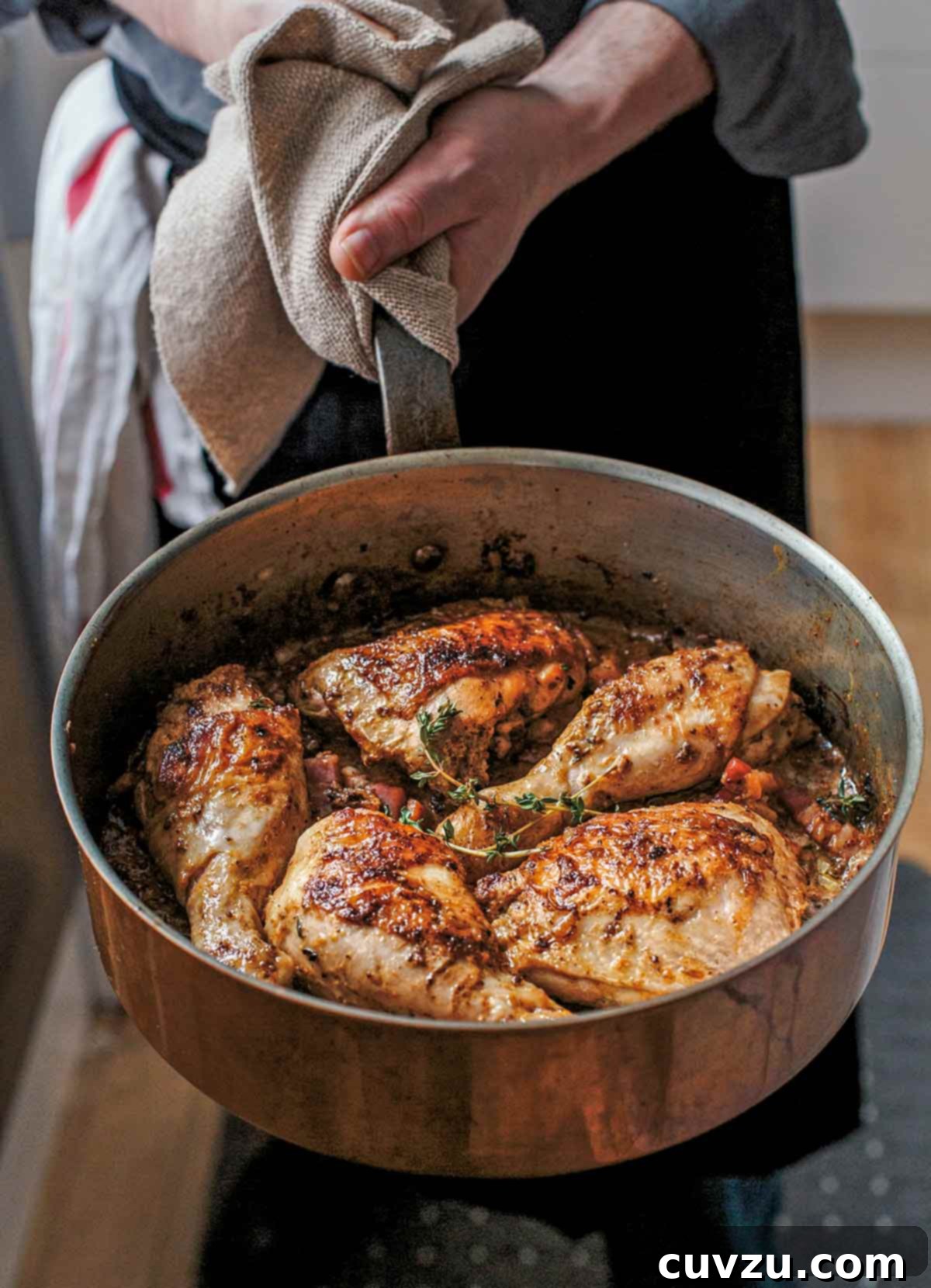
Discover the French Classic: Poulet à la Moutarde (Chicken with Mustard)
Embark on a culinary journey to France with this exquisite Chicken with Mustard recipe, lovingly shared by the renowned David Lebovitz. This classic French dish, marrying succulent chicken with the piquant depth of Dijon mustard, aromatic thyme, and rich stock, is a testament to the simple yet profound flavors of French cuisine. We adore French food, and this particular rendition epitomizes why—it’s comforting, elegant, and utterly delicious.
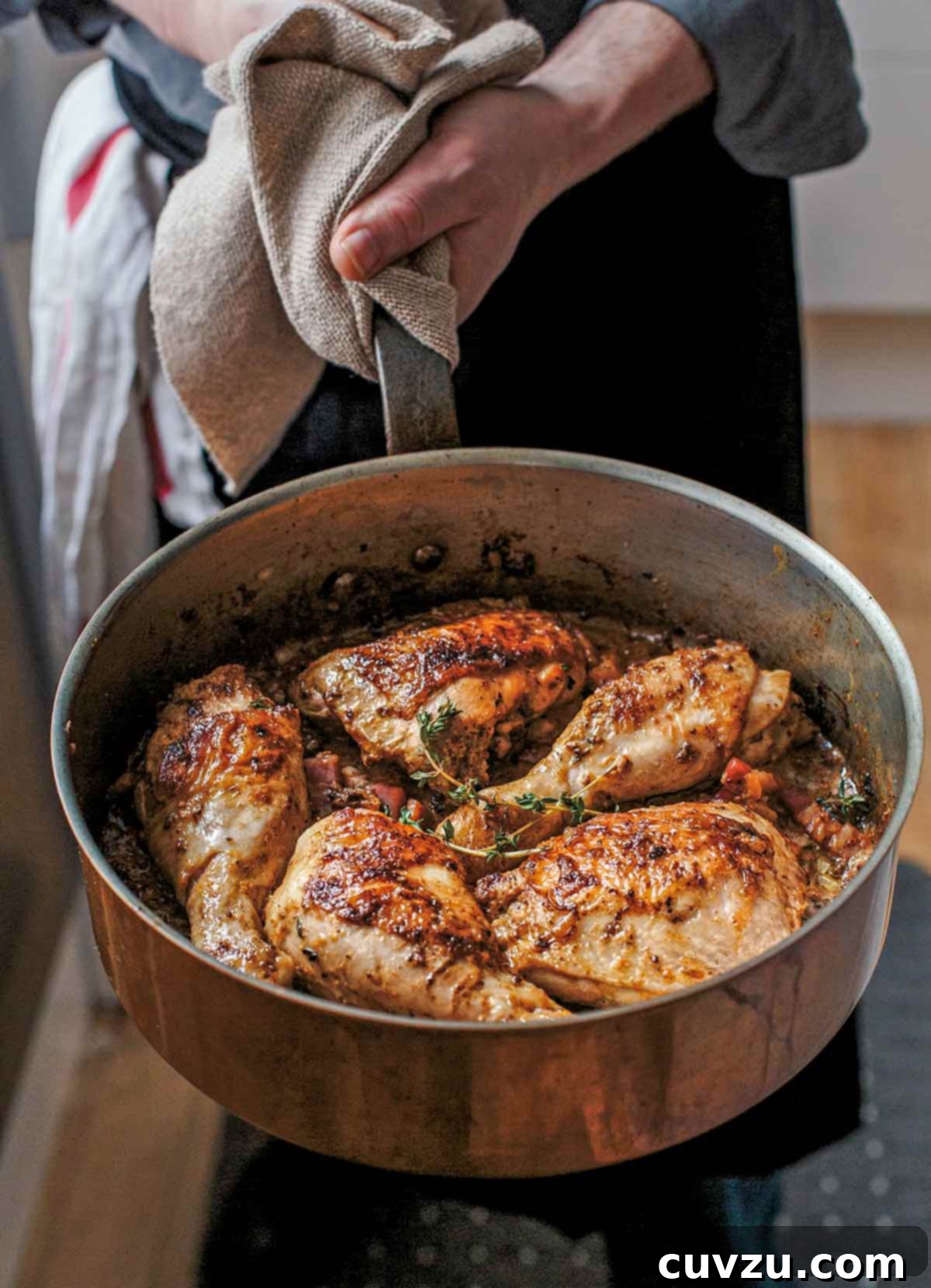
Years ago, amidst the charming chaos of E. Dehillerin, Paris’s famed cookware emporium in Les Halles, I acquired an impressive copper pan for an unbelievably low price. This one-pot chicken with mustard recipe is the perfect occasion to bring out your largest, most magnificent cookware, letting it shine as the centerpiece of your kitchen.
A crucial step in perfecting this dish involves properly browning the chicken thighs and legs. This isn’t just about color; it’s about developing a deep, caramelized “fond” on the bottom of your pan, which will infuse the sauce with layers of incredible flavor. To achieve this golden crust, it’s essential to avoid overcrowding the pan. If your skillet or Dutch oven isn’t large enough to accommodate all the chicken pieces in a single layer with ample space, be sure to brown them in batches. Overcrowding traps moisture, causing the chicken to steam rather than brown, a culinary misstep we aim to avoid. The rich, savory sauce created by this process begs for an equally delightful accompaniment, and a tangle of fresh, herbed pasta serves as the ideal vehicle for soaking up every last drop of that delectable elixir.
–David Lebovitz
The Art of Wine Pairing with Poulet à la Moutarde
The age-old culinary wisdom suggests, “If you wouldn’t drink it, don’t cook with it.” This adage holds particularly true for our Poulet à la Moutarde. Just as you wouldn’t use a mustard you dislike on a sandwich, only cook with a white wine you genuinely enjoy. The wine plays a pivotal role in deglazing the pan and contributing to the sauce’s overall character, so choosing wisely is key.
When selecting a white wine to complement this rich and tangy chicken dish, aim for something lighter, crisp, and with a delicate fruity overtone. Avoid anything overly sweet, such as some Gewürztraminers or Rieslings, as their sweetness can clash with the savory mustard. Instead, consider varietals known for their vibrant acidity and refreshing profiles. A classic Sauvignon Blanc is often an excellent choice, offering bright citrus notes and a herbaceous quality that beautifully cuts through the richness of the sauce. Albariño, with its aromatic complexity and saline minerality, also makes a superb pairing, as does a refined Pinot Blanc, which contributes subtle fruitiness without overwhelming the dish.
These wines not only enhance the cooking process but also make for delightful sips alongside your meal, creating a harmonious dining experience. Should you discover another white wine that perfectly complements this dish, we would be delighted to hear your recommendations in the comments below.
Classic Chicken with Mustard | Poulet à la Moutarde
This chicken with mustard recipe, crafted with tender chicken, bold Dijon mustard, aromatic thyme, and a flavorful stock, embodies the essence of a timeless French country dish. It’s a comforting yet elegant meal perfect for any occasion.
Recipe by David Leite
- Course
- Mains
- Cuisine
- French
- Servings
- 4 to 6 servings
- Calories
- 650 kcal
- Prep Time
- 30 minutes
- Cook Time
- 30 minutes
- Total Time
- 1 hour
Ingredients
- 1/2 cup plus 3 tablespoons Dijon mustard
- 1/4 teaspoon sweet or smoked paprika
- Freshly ground black pepper, to taste
- 3/4 teaspoon sea salt or kosher salt, (optional, adjust to taste given mustard’s saltiness)
- 4 bone-in, skin-on chicken thighs and 4 drumsticks (8 pieces total)
- 1 cup smoked thick-cut bacon, diced
- 1 small onion, finely diced
- 1 teaspoon fresh thyme leaves
- Olive oil, for the pan (as needed)
- 1 cup white wine (choose a dry, crisp variety you enjoy drinking)
- 1 tablespoon whole mustard seeds or grainy mustard
- 2 to 3 tablespoons crème fraîche or heavy cream
- Warm water, as needed (for thinning sauce)
- Chopped flat-leaf parsley or chives, for garnish
Instructions
- In a medium bowl, combine 1/2 cup of the Dijon mustard with the paprika, several generous grinds of fresh black pepper, and the salt (if using). Toss the chicken pieces thoroughly in this mustard mixture, ensuring each piece is well coated. For maximum flavor, gently lift the chicken skin and rub some of the mixture directly onto the meat beneath. Set the marinated chicken aside while you prepare the bacon and onion.
- Heat a wide skillet with a lid or a Dutch oven over medium-high heat. Add the diced bacon and cook, stirring frequently, just until it begins to brown and soften, approximately 4 minutes. This step is about gently cooking the bacon and rendering some fat, not crisping it completely.
- Carefully remove the cooked bacon from the skillet and transfer it to a plate lined with paper towels to drain. Leave approximately 1 tablespoon of bacon fat in the skillet, reserving any excess bacon fat for other culinary uses rather than discarding it. Bacon fat is a flavor enhancer for sautéing potatoes, frying eggs, or even gilding popcorn!
- Add the finely diced onion to the reserved bacon drippings in the skillet. Cook for about 5 minutes over medium heat, stirring occasionally, until the onion becomes soft and translucent. Stir in the fresh thyme leaves and cook for another few minutes until fragrant. Scrape the cooked onion and thyme mixture onto the plate with the bacon.
- If necessary, add a small amount of olive oil to the skillet to ensure sufficient fat for browning. Place the marinated chicken pieces into the skillet in a single layer, ensuring they are not overcrowded. If all pieces don’t fit comfortably, brown them in two batches. Brown the chicken well on one side until a deep golden crust forms, then flip and brown the other side. This browning is critical as it creates the flavorful “fond” that will enrich your sauce.
- Once browned, return all chicken pieces to the skillet, arranging them over the bacon and onions (if they were cooked in batches). Pour the white wine into the hot skillet, using a sturdy flat utensil to scrape up all the delicious browned bits (“fond”) from the bottom of the pan. Cover the skillet and reduce the heat to low to medium. Cook the chicken, turning the pieces occasionally in the burgeoning sauce, until it is cooked through. This will take approximately 15 to 25 minutes. To check for doneness, insert a knife near the thigh bone; if the meat is no longer pink, it’s ready.
- Remove the skillet from the heat. Carefully transfer the cooked chicken pieces to a serving platter. Stir the remaining 3 tablespoons of Dijon mustard, the whole mustard seeds (or grainy mustard), and the crème fraîche or heavy cream into the pan drippings. If the sauce has reduced and become too thick, thin it with warm water, adding a teaspoon at a time until the desired consistency is achieved. Pour the luxurious sauce generously over the chicken, sprinkle with chopped parsley or chives for a fresh garnish, and serve immediately.
Adapted From
My Paris Kitchen
Buy On Amazon
Nutrition
- Serving: 1 portion
- Calories: 650 kcal
- Carbohydrates: 7 g
- Protein: 38 g
- Fat: 47 g
- Saturated Fat: 14 g
- Monounsaturated Fat: 20 g
- Trans Fat: 1 g
- Cholesterol: 209 mg
- Sodium: 1268 mg
- Fiber: 2 g
- Sugar: 2 g
Nutrition information is automatically calculated, so should only be used as an approximation.
Tried this recipe?
Mention @leitesculinaria or tag #leitesculinaria!
Recipe Testers’ Reviews: Real-World Insights for Your Kitchen
Our dedicated team of recipe testers put this Poulet à la Moutarde recipe through its paces, offering invaluable feedback and practical tips. Their diverse experiences highlight the dish’s versatility and provide real-world insights to help you achieve perfect results every time.
Eydie Desser
Eydie Desser, whose husband is a great admirer of mustard chicken, found this recipe to be a true winner. She noted that throughout the cooking process, one might wonder if the effort is truly worth it, but the end result unequivocally proves that it is. The dish is complex, involving numerous steps, which led Eydie to emphasize the importance of “mise en place.” Pre-prepping all ingredients—measuring, chopping, and lining them up—simplifies the cooking flow, preventing any last-minute scrambling.
Eydie adapted the recipe for her husband’s preference for white meat, successfully using a whole chicken cut into breasts, legs, and thighs. Her practical tips include ensuring the pan is exceptionally hot before adding bacon, which prevents sticking and aids in sautéing. She clarified that the bacon should be lightly browned, not fully crisped, as it continues to cook during braising. Proper heat management is also vital for the onions, cooking them until translucent without burning to avoid a bitter sauce. For browning the chicken, Eydie advised adding extra olive oil if the pan seems dry after removing the onions and, crucially, browning the chicken in batches to prevent steaming.
She observed that the first batch of chicken browns in about 6 minutes per side, while subsequent batches cook faster due to the developing fond. Eydie highlighted the transformative moment when wine is added, deglazing the pan and bringing a beautiful, caramelized exterior to the chicken. While the recipe suggests 15 minutes for this stage, she found her chicken was cooked through in just 6 to 7 minutes. Her final advice for plating included carefully spooning sauce over chicken and wiping the plate edges for an elegant presentation, making it a memorable romantic meal.
Pat Francis
Pat Francis, having prepared this chicken with mustard recipe twice, enthusiastically declared it a “winning dish.” She praised the chicken for its exceptional moistness and the sauce for its “exquisite” layers of flavor, deriving richness from mustard, bacon, onion, and crème fraîche. Pat noted that even with slightly larger chicken pieces, she successfully fit them all into a very large skillet without any overcrowding, emphasizing the importance of choosing appropriate cookware.
Her only minor critique concerned the repetitive need to transfer ingredients in and out of the skillet, acknowledging that a “lazier approach” would inevitably yield an inferior result. This highlights that while the process might involve a few movements, each step contributes significantly to the final depth of flavor. Regarding serving size, Pat felt the recipe comfortably serves 4 people, suggesting it might stretch to 6 in a more traditional French setting, depending on chicken piece size and accompanying dishes. She personally served her Poulet à la Moutarde with a refreshing baby spinach and arugula salad, alongside buttered boiled new potatoes with dill, a perfect choice for soaking up the flavorful sauce.
Elie Nassar
Elie Nassar commenced his review with a fascinating observation on basic culinary science, specifically regarding Dijon mustard’s heat dissipation upon cooking. He noted that despite marinating the chicken in a substantial amount of spicy mustard, the final dish had lost its harshness, becoming mellow and perfectly balanced—a pleasant surprise for his family. He particularly appreciated the instruction to add a few tablespoons of fresh mustard at the end, off the heat, as this reintroduced a subtle, tamed sharpness, creating a perfect flavor equilibrium.
Elie was also intrigued by how the chicken managed to brown so effectively despite being “wet” from the mustard marinade. He described the result as a “lovely” fricassée that Julia Child would undoubtedly approve of. For the wine, he opted for a Sauvignon Blanc, valuing its good acidity. A practical tip from Elie was the need for additional olive oil for browning the chicken, as most of the bacon fat was absorbed by the onions. He found it necessary to brown his 8 chicken thigh pieces in three batches in his oval Le Creuset Dutch oven, underscoring the importance of not overcrowding the pan.
Finally, Elie gave a “BIG thumbs up” for the use of weight measurements (in grams) in the recipe, finding it much more convenient and accurate for ingredients like mustard and bacon, and far easier to clean up afterward. He concluded by adding the cookbook to his collection, affirming the dish’s delicious, rich, and robust flavors, its simplicity, and its potential to become a fall favorite.
Erin W.
Erin W. was thoroughly impressed by this chicken with mustard recipe, finding it “so good it’s almost hard to believe!” She successfully prepared it as a weeknight supper, transforming her home into what felt like a French bistro. The chicken was wonderfully moist, and the sauce proved to be rich and bursting with flavor. A true measure of success for Erin was that her kids genuinely enjoyed it, and her husband extracted a promise for a repeat performance.
One notable modification Erin made and highly recommends is serving the dish with rice instead of the suggested pasta. She argued that the sauce is so exceptional, one will undoubtedly seek another medium to savor it, even after the chicken is gone. From a practical standpoint, Erin appreciated the minimal chopping and lack of marinating time, making it an ideal candidate for a weeknight meal. Her hands-on time was roughly 25 minutes, with a total start-to-table time of 45 minutes, confirming its weeknight viability. She also liked that the chicken finished cooking in the sauce during the final 15 minutes, allowing her to focus on preparing side dishes and beginning cleanup.
Erin used fairly lean bacon and opted not to pour off any of the bacon fat, supplementing it with a tablespoon of olive oil to ensure adequate fat for browning the chicken. She exercised caution with salt, finding the mustard provided sufficient “zip.” Her white wine choice was Chardonnay, and she advised against cooking it for too long before adding the chicken, to preserve enough liquid for simmering. The chicken was perfectly done in 15 minutes, but she recommended careful monitoring to prevent drying out. While she needed a touch of warm water to thin the sauce, she noted that the sauce “virtually made itself,” underscoring the recipe’s inherent ease and delicious outcome.
Larry Noak
Larry Noak, despite his proficiency in the kitchen, including baking and even curing meats, confessed to a long-standing intimidation by French cuisine. This chicken with mustard recipe, however, proved to be a “huge barrier remover” for him, prompting him to make it twice in a single week due to its exceptional quality. His initial attempt using a Le Creuset Dutch oven yielded divine flavor but less-than-ideal browning. For his second attempt, he switched to a large cast-iron skillet, declaring it the “only way” he would prepare this dish moving forward, underscoring the importance of the right cookware for optimal browning.
Larry’s detailed tips included cooking the diced bacon for 5 to 8 minutes, acknowledging that smaller pieces cook quickly. The onion and thyme also required just a few minutes. He suggested against draining the bacon fat entirely, noting there isn’t much of it, and even recommended adding extra oil to ensure sufficient fat for browning the chicken. A key insight for him was to avoid sticking chicken skin: ensure the oil is hot enough to sizzle before placing the thighs bone-side down for about 5 minutes. Then, flip them to brown the meaty side, which can take 15 to 20 minutes depending on the batch size.
He used a Sauvignon Blanc, adhering to the principle of cooking with wine you’d drink. Instead of a knife, Larry preferred a meat thermometer to confirm the chicken reached 165ºF, which took about 20 minutes. He concluded by adding mustard seeds and 3 tablespoons of heavy cream. Larry’s experience illustrates how this Poulet à la Moutarde can serve as perfect “medicine” for those daunted by French cooking, confidently stating, “Please let Julia know I’m leaving the sidelines!”
M.K. Morgan
M.K. Morgan found this chicken with mustard recipe to be a bit time-consuming but ultimately “worth it,” highlighting the rewarding outcome of the effort. She customized her ingredients, opting for smoked paprika, 8 chicken thighs, and Millbrook Tocai Friulano for her white wine choice. She also used approximately 1 cup of onion, whole mustard seeds, and crème fraîche, demonstrating the recipe’s adaptability to personal preferences and available ingredients. The final cooking phase involved about 20 minutes on low heat, covered.
The dish was a resounding success both on the night it was prepared and as leftovers. M.K. Morgan enjoyed it with pasta initially, and then reheated it the following day, serving it alongside mashed potatoes. This adaptability as a leftover meal, particularly with different starchy sides, further solidifies its appeal as a versatile and delicious recipe that can be enjoyed in various contexts.
Dawn English
Dawn English was captivated by the recipe title, “Poulet à la Moutarde,” and the promise of browned chicken with Dijon mustard and white wine immediately drew her in. She described it as the “perfect comforting home-style French dish,” and it lived up to her expectations. Dawn found the recipe straightforward and easy to assemble, noting that its structure allows for staggered ingredient preparation. For instance, she diced the onion while the bacon was browning and tossed the chicken with mustard while the onions cooked, making the entire process efficient.
Her total preparation time from start to finish was about an hour, making it a feasible option for many home cooks. Dawn emphasized the utility of a large and deep Dutch oven or skillet with a lid. Using her classic round 6-quart Dutch oven, she intelligently browned the chicken in two stages to prevent overcrowding and ensure proper browning, a technique echoed by other testers for achieving optimal results. Her family thoroughly enjoyed the flavors, ensuring this recipe will be a repeat in her kitchen. She served the chicken with roasted potatoes, which perfectly absorbed the “lovely sauce.”
Dawn suggested a serving size closer to 4 people, indicating its richness and deliciousness might encourage larger portions. She also wisely omitted salt, trusting the Dijon mustard’s inherent saltiness. For her wine choice, Dawn opted for a Gruner Veltliner from Hungary, further demonstrating the flexibility of wine pairings as long as the wine’s profile complements the dish.
Sandy Hill
Sandy Hill described the chicken with mustard recipe as a “comforting and aromatic dish for 4 people.” She used smoked paprika, which she noted beautifully amplified the bacon’s smokiness within the dish, adding another layer of flavor complexity. For her white wine, Sandy chose a Chardonnay, a popular and accessible option. She strongly advocated for retaining the bacon drippings, putting them to excellent use by seasoning fresh green beans, showcasing a resourceful approach to flavor maximization.
In the final step, Sandy added 2 tablespoons of warm water to loosen the sauce, achieving her preferred consistency. Her group particularly enjoyed the “spicy kick” imparted by the whole mustard seeds, which added textural interest and a burst of flavor. Sandy found the dish “perfect for company,” as it allowed for relaxed enjoyment while the pasta cooked. She concluded by praising its fragrant and mustardy characteristics, deeming it a “delicious dish” overall.
Ayanna Fews
Ayanna Fews enthusiastically recommended making this chicken with mustard recipe “ASAP” if one has the ingredients on hand, promising zero disappointment. As a self-professed fan of both bacon and Dijon mustard, she had high expectations, which the dish exceeded. Ayanna found the preparation “pretty straightforward.” She specifically chose smoked paprika for its flavor profile, having recently acquired a quality tin.
Adhering to the advice to avoid waste, Ayanna utilized the bacon fat to cook the onions and thyme, and instead of discarding excess drippings, she reserved them. In fact, she even added more bacon fat, rather than olive oil, before browning the chicken, prioritizing the rich flavor it imparts. She noted that browning all the chicken took her about 10 to 15 minutes, attributing the speed to her pan’s generous surface area, suggesting it might take longer in smaller cookware.
Ayanna highlighted an interesting aspect of the deglazing process: the mustard tends to stick and caramelize to the pan, creating “a lot of bits to be scraped up” once the wine is added. This “fond” is precisely what contributes incredible depth to the sauce. She used a Pinot Grigio to deglaze, and found the recipe’s timing for cooking the chicken accurate. Concluding her review, Ayanna declared the recipe “so good…definitely a keeper!”
Ralph Knauth
Ralph Knauth found this chicken with mustard recipe to be a “quick, fun dish to make” that garnered universal approval. He generally found the recipe straightforward and accurate. His main challenge was achieving proper browning of the chicken, as the mustard-coated skin remained quite wet. Despite this, enough “bits and pieces” adhered to the pan and browned well, contributing to the overall flavor. Ralph used a cast-iron skillet and fried the chicken in two batches, a common and recommended technique to prevent overcrowding.
He noted that the initial frying of bacon, onions, and chicken took him approximately 30 minutes, a phase that “could easily be done in advance,” offering flexibility for busy schedules. Once these foundational steps were complete, the dish quickly came together. Ralph used an open bottle of “cheap rosé” for the wine, demonstrating that a sophisticated wine isn’t always necessary for a delicious outcome, as long as it’s something you’d drink. After cooking the chicken through, he simply added some cream and mustard, adjusted seasonings, and the dish was done. Ralph enthusiastically declared this recipe “a keeper” and confirmed it would be made again.
Suzanne Fortier
Suzanne Fortier aptly summarized the chicken with mustard recipe as “so much greater than the sum of its parts!” She drew a parallel to chicken cacciatore in its simplicity, finding this “simple, homey dish” elegant enough for guests, yet quick enough to prepare in about an hour, utilizing only one pan. Suzanne detailed her process of browning three strips of diced thick-cut bacon. She ingeniously used the pot lid to hold the browned bacon bits, then the onions and thyme that were sautéed in the rendered bacon drippings. Her use of about five sprigs of fresh thyme created an intoxicating aroma.
She firmly believed that dried thyme would not yield the same excellent results. Suzanne found she didn’t need any additional oil to brown the chicken, as the thighs provided ample fat. Browning the chicken pieces in batches took her about 20 minutes, with the browned pieces also being transferred to the pot lid with the bacon and onions. She deglazed the pan with a Portuguese Vinho Verde, then returned all ingredients to simmer together. The bone-in thigh meat required 20 to 25 minutes to cook through. After removing the chicken, she stirred mustard, mustard seeds, and strained goat milk yogurt into the pan juices, serving the chicken in the thick sauce over pasta. Her verdict: “lick-the-plate delicious.”
Kristel Poole
Kristel Poole’s love affair with Dijon mustard began a decade ago in France, culminating in an obsession with quality condiments. She firmly believes that the quality of your finished chicken dish hinges significantly on using great mustard, affirming that while it will be good with any, it will be “great with great mustard.” Living in a two-person household, Kristel halved the recipe, completing the entire process in about an hour, even while simultaneously preparing several other dishes.
She started by generously tossing the chicken in the mustard mixture, ensuring as much as possible was worked under the skin. Her bacon was cooked in a Dutch oven for about 5 minutes until browned, then set aside, with the drippings diligently saved in her “bacon fat jar” – a true Southern tradition. Onions and fresh thyme followed, then joined the bacon in a bowl. A little oil was needed before browning the chicken pieces, which she placed skin-side down to maximize crispiness. Once browned, they too joined the bacon and onions.
A dry Pinot Grigio was her choice for deglazing, providing excellent flavor to the finished dish. Everything cooked together until the chicken was done, at which point she stirred in the final Dijon mixture and a couple of tablespoons of water before serving. Kristel and her companion adored the chicken, enthusiastically dunking their sides into the abundant extra sauce. This recipe, she declared, “will definitely be in the rotation from now on.”
Jackie Gorman
Jackie Gorman’s review began with a resounding “Wow! These flavors are fantastic.” She found that prepping all ingredients ahead of time was incredibly helpful, ensuring everything was at hand when needed. Like several other testers, she poured off excess bacon fat into a dedicated jar for future use. Jackie customized the chicken, opting for 8 thighs instead of a mix of legs and thighs, catering to a family preference.
Her choice of white wine was a Sauvignon Blanc, and she utilized a very nice mustard from one of her favorite wineries, emphasizing the impact of quality ingredients. Jackie added all 3 tablespoons of homemade crème fraîche to the sauce, contributing to its rich texture and flavor. The dish was “fabulous” when served alongside—and drizzled over—buttermilk Yukon Gold mashed potatoes, creating a deeply satisfying meal. Her anticipation for leftovers further cemented the recipe’s success.
Melissa Maedgen
Melissa Maedgen praised this chicken with mustard sauce for truly delivering a “robust, mustard flavor.” She highlighted the harmonious combination of the bacon’s smokiness, the wine’s tang, and the smooth richness of the crème fraîche, culminating in a dish that is “absolutely delicious while being easy enough for a weeknight.” Melissa affirmed that the recipe works beautifully as written, declaring, “There’s nothing not to love about this one!”
She found the cooking time for the chicken in the wine to be accurate. Melissa did note the need to add a small amount of oil to the pan after sautéing the onions, and a small amount of water to the sauce during the final steps to prevent it from over-thickening, which are common adjustments in cooking. Her wine choice was a dry Riesling, showcasing another excellent pairing option that complements the dish’s flavor profile. Her concise and positive feedback reinforces the recipe’s status as a reliable and delectable French classic.